Freedom251 › AI Video Lip Sync Tools
Diff2Lip
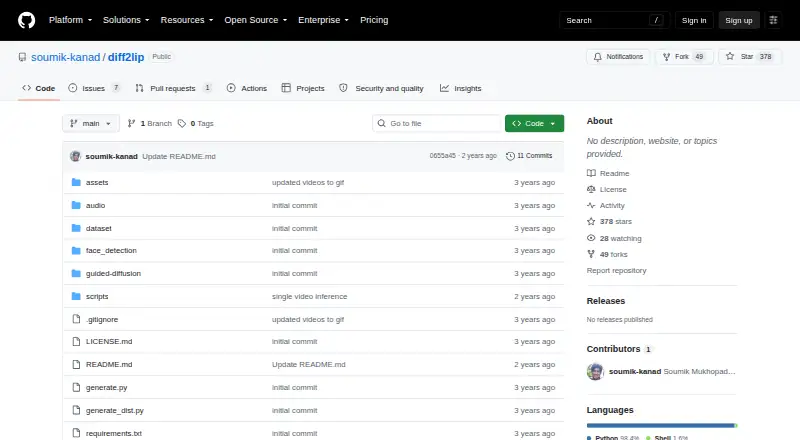
What Diff2Lip is
Diff2Lip is a project for synchronizing speech with face videos using an audio-conditioned diffusion model. It takes arbitrary speech and face videos as inputs and aims to generate high-quality lip-synced video while preserving the identity in the source frames. The repository includes inference scripts for audio-video pairs and for running a single video with specified video, audio, and output paths. Its documented cross mode uses an audio source to drive a video; reconstruction mode uses audio to drive the video's first frame. The project describes preserving identity, pose, emotions, and image quality while generating lip movements. It lists movies, education, and virtual avatars as applications, with video conferencing as a possible future application. Diff2Lip is not real time yet. The project identifies the work as a WACV 2024 paper and reports evaluation results on VoxCeleb2 and LRW. Its repository links a Google Colab notebook for trying the project. The setup instructions use Python 3.9, FFmpeg 5.0.1, and the repository requirements file; inference configuration includes a NUM_GPUS setting, with values above one running distributed generation. The code and text use a CC BY-NC 4.0 license: sharing and adaptation require attribution and are limited to noncommercial use.
Who it suits
Diff2Lip suits researchers and developers working on lip-synced video who can use a Linux, self-hosted project and its documented setup. Its listed applications include movies, education, and virtual avatars; the project also describes video conferencing as a possible future use.
What it does well
- Inference scripts support audio-video pairs and single videos.
- Cross and reconstruction inference modes are documented.
- A Google Colab notebook is linked for trying the project.
- Inference can run distributed generation with more than one GPU.
- The license permits sharing and adaptation with attribution for noncommercial purposes.
What to know first
- The project is not real time yet.
- Commercial use is barred by its CC BY-NC 4.0 license.
- Setup instructions require Python 3.9 and FFmpeg 5.0.1.
Limits
The project is not real time yet. Its CC BY-NC 4.0 license limits use to noncommercial purposes and requires attribution for sharing or adaptation.
Getting started
- Open the project repository at https://github.com/soumik-kanad/diff2lip.
- Use the linked Google Colab notebook to try the project, or follow the repository setup instructions.
- Set up Python 3.9, FFmpeg 5.0.1, and the repository requirements file.
- Choose an inference script and mode for an audio-video pair or a single video.
- Configure NUM_GPUS; values above one run distributed generation.
Verdict
Choose Diff2Lip if you need a self-hosted research project for generating lip-synced video and can work within its setup and license terms. Look elsewhere if you need real-time processing or commercial use.
Questions
What does Diff2Lip do?
It uses an audio-conditioned diffusion model to synchronize speech with face videos and generate lip-synced video.
Is Diff2Lip free and open source?
It is listed as free and open source. The repository says its code and text are licensed under CC BY-NC 4.0.
Can it be used commercially?
No. The repository's license description says the work may not be used for commercial purposes.
Which platforms does it support?
The listed platforms are Linux, self-hosted, and web. The repository also links a Google Colab notebook to try Diff2Lip.
What setup does inference use?
The setup instructions use Python 3.9, FFmpeg 5.0.1, and the repository's requirements file. Inference supports one or more GPUs.
Is Diff2Lip real time?
No. The project states that it is not real time yet.
Facts from Diff2Lip's own pages
- Access
- The repository links a Google Colab notebook to try Diff2Lip. · github.com, 10 Oct 2026
- Applications
- The project lists movies, education, and virtual avatars as applications, and video conferencing as a possible future application. · soumik-kanad.github.io, 4 Oct 2026
- Commercial use
- The repository's license description says the work may not be used for commercial purposes. · github.com, 4 Oct 2026
- Datasets
- The paper says the model was trained on VoxCeleb2 and reports results on VoxCeleb2 and LRW. · arxiv.org, 10 Oct 2026
- GPU requirement
- The inference instructions include a NUM_GPUS setting and say values greater than one run distributed generation. · github.com, 4 Oct 2026
- Identity preservation
- The project says its generated video frames preserve identity without identity loss. · soumik-kanad.github.io, 4 Oct 2026
- Inference
- The repository includes scripts for lip-sync inference on audio-video pairs and on a single video. · github.com, 4 Oct 2026
- Inference inputs
- The repository includes inference scripts for audio-video pairs and supports running on a single video with specified video, audio, and output paths. · github.com, 10 Oct 2026
- Inference modes
- The repository documents cross mode to drive a video with an audio source and reconstruction mode to drive the video's first frame with an audio source. · github.com, 4 Oct 2026
- Input and output
- The project describes its task as turning arbitrary speech and face videos into high-quality lip-synced video. · github.com, 4 Oct 2026
- Integrations
- The repository links Google Colab for trying the project; it does not list other product integrations. · github.com, 10 Oct 2026
- License
- The repository states that its text and code are under CC BY-NC 4.0, with attribution required and commercial use prohibited. · github.com, 10 Oct 2026
- Method
- It uses an audio-conditioned diffusion model for lip synchronization in the wild. · soumik-kanad.github.io, 10 Oct 2026
- Not real time
- The project states that Diff2Lip is not real time yet. · soumik-kanad.github.io, 4 Oct 2026
- Purpose
- Diff2Lip generates lip-synchronized videos from speech audio and face videos. · github.com, 10 Oct 2026
- Quality goals
- The project describes its approach as preserving identity, pose, emotions, and image quality while generating lip movements. · arxiv.org, 10 Oct 2026
- Requirements
- The setup instructions use Python 3.9 and FFmpeg 5.0.1, and inference can use one or more GPUs. · github.com, 10 Oct 2026
- Research publication
- The repository identifies Diff2Lip as a WACV 2024 paper. · github.com, 4 Oct 2026
- Research result
- The paper reports better FID and user Mean Opinion Scores than Wav2Lip and PC-AVS in its evaluations. · arxiv.org, 10 Oct 2026
- Research results
- The project reports reconstruction and cross-audio-video results on VoxCeleb2 and LRW datasets. · soumik-kanad.github.io, 4 Oct 2026
- Setup
- The README setup instructions use Python 3.9, FFmpeg 5.0.1, and the repository's requirements file. · github.com, 4 Oct 2026
- Speed limit
- The project website says Diff2Lip is not real time yet. · soumik-kanad.github.io, 10 Oct 2026
- Try it
- The project links to a Google Colab notebook for trying Diff2Lip. · github.com, 4 Oct 2026
- Use cases
- The project lists movies, education, virtual avatars, and eventually video conferencing as applications. · soumik-kanad.github.io, 10 Oct 2026
Where Diff2Lip stands on Freedom251
- AI Video Lip Sync Tools#5 of 28