Freedom251 › Reverse Proxy Software

Apache Traffic Server
What Apache Traffic Server is
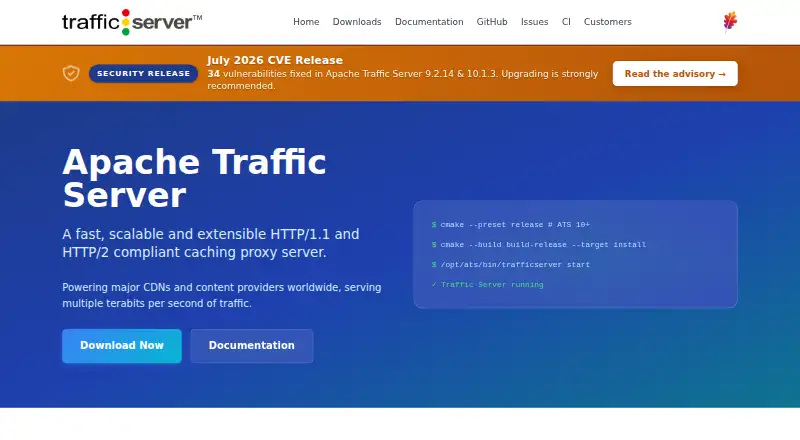
Apache Traffic Server is a free, open-source HTTP caching proxy server for HTTP/1.1 and HTTP/2. It reuses frequently requested pages, images, and web service calls, helping improve response time while reducing server load and bandwidth needs. It can add keep-alive behavior, filter or anonymize requests, and provide load balancing through a proxy layer. Documented deployment patterns include web proxy cache, reverse proxy, and cache hierarchy. As a layer 7 HTTP load balancer, it can select next-hop servers using request attributes, weighted round robin, or URL consistent hashing. Plug-in APIs allow custom behavior, including changing HTTP headers, handling ESI requests, and implementing cache algorithms. Security options include client access controls and authentication, SSL termination, and SSL-based access control. The project lists Linux, macOS, and self-hosted use. The latest stable release listed is 10.2.0; 9.2.15 is the long-term support release with security fixes and critical updates.
Who it suits
It is designed for enterprises, internet service providers, backbone providers, and large intranets. It suits teams that need a self-hosted proxy with caching, load balancing, or extensible behavior.
What it does well
- Free and open source under Apache License 2.0.
- Supports HTTP/1.1 and HTTP/2.
- Offers proxy, reverse proxy, and cache hierarchy deployments.
- Plug-in APIs support custom behavior.
- Includes SSL termination and client access controls.
What to know first
- Self-hosted deployment requires managing the installation.
- The listed stable release is 10.2.0; 9.2.15 is the LTS release.
Plans
| Plan | Billed and limits | Price |
|---|---|---|
| Apache Traffic Server | No price or usage limits stated on the opened pages | Free |
As trafficserver.apache.org lists them, read 9 Oct 2026. The maker's own page has the final word.
Getting started
- Visit https://trafficserver.apache.org/ for the project and documentation.
- Choose a deployment pattern: web proxy cache, reverse proxy, or cache hierarchy.
- Use the documentation to configure the proxy; configuration can be done through both available methods.
- Download a release for a self-hosted Linux or macOS deployment.
- Verify the downloaded mirror files using the hash and OpenPGP-compatible signature.
- Seek help through the Users Mailing List or ASF Slack; code questions can go to the developers discussion list.
Apache Traffic Server is HTTP proxy software for teams running large-scale infrastructure, with caching, request routing, and plug-in customization in one self-hosted service. Its strongest case is combining those roles under operator control; teams seeking a managed proxy should look elsewhere.
Overview
Traffic Server supports HTTP/1.1 and HTTP/2, and can be deployed as a web proxy cache, reverse proxy, or part of a cache hierarchy. That range suits infrastructure operators who want to choose where the proxy sits and how it handles requests. The trade-off is ownership: this is self-hosted software, so deployment and configuration remain with the organization running it.
The project identifies enterprises, internet service providers, backbone providers, and large intranets as its intended audience. Its Apache License 2.0 and free, open-source model avoid a software purchase price, while the breadth of its roles is most useful to teams with substantial proxy or caching needs.
Key features
Caching lets Traffic Server reuse frequently requested pages, images, and web service calls. For workloads with recurring requests, that can improve response times while reducing origin-server load and bandwidth use. The benefit depends on having traffic that can usefully be served from cache; caching alone is not a reason to adopt a proxy of this scope.
As a proxy, it can add keep-alive, filter or anonymize content requests, and provide load balancing. Its layer 7 HTTP balancer selects next-hop servers using request attributes, weighted round robin, or URL consistent hashing. Those choices give operators several ways to direct traffic, but also make it a better fit for teams that want to manage routing behavior themselves.
Plug-in APIs can modify HTTP headers, handle ESI requests, or implement a cache algorithm. That extensibility matters when built-in proxy or cache behavior needs to be adapted; teams with straightforward requirements may not benefit enough to justify choosing a customizable self-hosted component.
Security options include client access controls, client authentication, SSL termination, and access control via SSL. Traffic Server also supports WebSockets and rate limiting. The project states full HTTP/1.1 and HTTP/2 support, with work continuing on emerging web standards and protocols.
Pricing
Apache Traffic Server is free and open source under the Apache License 2.0. The Apache Traffic Server plan costs nothing. It is self-hosted, and no usage limits are stated for the plan. This makes it a no-license-cost option for operators prepared to run the software themselves, rather than a managed service with a paid convenience tier.
The project lists 10.2.0 as its latest stable release and 9.2.15 as its long-term support release, which receives security fixes and critical updates. Users can seek help through the Users Mailing List or ASF Slack; code questions go to the developers discussion list. The downloads page advises verifying mirror downloads with the supplied hash and an OpenPGP-compatible signature.
Platforms
Traffic Server is available for Linux and macOS, as well as through an API, and is designed for self-hosted deployment. That setup gives infrastructure teams control over where it runs, but does not offer a hosted deployment option.
Who it's for
Traffic Server is a strong fit for enterprises, internet service providers, backbone providers, and large intranets that need caching alongside proxying or layer 7 HTTP load balancing. It is especially relevant when request routing or cache behavior needs customization through plug-ins. It is less suitable for individuals or teams looking for a turnkey hosted proxy, or for organizations that do not want to operate and configure self-hosted infrastructure.
Pros and cons
- Multiple infrastructure roles: caching, proxying, reverse-proxy deployment, and layer 7 load balancing can be handled in one self-hosted service.
- Custom behavior: plug-in APIs support changes to headers, ESI handling, and cache algorithms.
- No software price: the open-source plan is free, with no usage limits stated.
- Operational ownership: self-hosting puts deployment and configuration on the operator, so it is not a fit for teams seeking a managed proxy.
- Release verification required: the project advises checking downloaded mirrors with a hash and OpenPGP-compatible signature.
Alternatives
For a freemium option spanning web and desktop platforms as well as mobile, Cloudflare Gateway has a free plan for 50 users with up to 24 hours of standard log retention; its listed pay-as-you-go plan is $7 a month, billed monthly. Choose it when that stated user cap and retention window suit your needs rather than a self-hosted proxy.
mitmproxy is a free, open-source interactive HTTPS proxy, so it is an alternative when interactive HTTPS proxying is the priority. 3proxy is freeware and open source for Linux, macOS, Windows, and self-hosted use; consider it when that platform coverage is the relevant distinction. Privoxy is free to use, copy, modify, or distribute, with no registration; its stated terms make it an option for readers who value those permissions.
Squid is free to download, use, and modify as self-hosted proxy software, with third-party commercial support potentially available. LatentSync is a free open-source release with inference code and checkpoints, a data-processing pipeline, and training code; it is not presented as a proxy alternative. Tinyproxy is Linux, macOS, and self-hosted software distributed under GNU GPL version 2 or above. Skyhigh Private Access is a paid option for web, desktop, and mobile platforms, with custom pricing.
Compare other options in Forward Proxy Software, Caching Software, Proxy Software, and Reverse Proxy Software.
Verdict
Choose Apache Traffic Server if your organization needs a free, self-hosted HTTP proxy that can combine caching, load balancing, and custom behavior through plug-ins. Its breadth and routing options are the main reasons to choose it; the need to operate the service yourself is the clearest reason to look elsewhere.
Verdict
Apache Traffic Server combines caching, proxying, and layer 7 load balancing in a self-hosted server. Its deployment options and plug-in APIs suit organizations that need to tailor proxy behavior.
Questions
Is Apache Traffic Server free?
It is listed as free, with no price or usage limits stated.
Which platforms does it support?
The listed platforms are Linux, macOS, API, and self-hosted deployment.
Which HTTP versions does it support?
The project states full support for HTTP/1.1 and HTTP/2.
Can it be used as a load balancer?
Yes. It can act as a layer 7 HTTP load balancer and select next-hop servers using request attributes, weighted round robin, or URL consistent hashing.
Is Apache Traffic Server open source, and what license does it use?
Yes. It is open source under Apache License 2.0.
Where can users get support?
Users can seek help through the Users Mailing List or ASF Slack. Code questions can go to the developers discussion list.
Facts from Apache Traffic Server's own pages
- Audience
- The documentation says Traffic Server is designed for enterprises, internet service providers, backbone providers, and large intranets. · docs.trafficserver.apache.org, 9 Oct 2026
- Cache architecture
- The cache indexes objects by URL and headers, supports alternate cached versions, RAM caching and partitioned storage, and can continue as a proxy when cache disks fail. · docs.trafficserver.apache.org, 21 Oct 2026
- Caching
- It caches and reuses frequently requested pages, images and web-service calls to reduce response time, origin load and bandwidth. · trafficserver.apache.org, 21 Oct 2026
- Cloud integrations
- The origin-authentication plugin supports Amazon S3 and Google Cloud authentication. · docs.trafficserver.apache.org, 21 Oct 2026
- Current releases
- The page lists 10.2.0 as the latest stable release and 9.2.15 as the long-term support release with security fixes and critical updates. · trafficserver.apache.org, 9 Oct 2026
- Deployment
- The documentation lists web proxy cache, reverse proxy, and cache hierarchy deployments. · docs.trafficserver.apache.org, 9 Oct 2026
- Deployment modes
- Documentation covers explicit and transparent forward proxying, reverse proxying, parent-child cache hierarchies and layer-7 HTTP load balancing. · docs.trafficserver.apache.org, 21 Oct 2026
- DNS
- ATS includes an asynchronous DNS resolver and a host database tracking DNS, HTTP version and origin reliability. · docs.trafficserver.apache.org, 21 Oct 2026
- Documentation
- The manual includes getting-started material, administrator and developer guides, API reference, configuration, monitoring, troubleshooting, FAQ and command-line appendices. · docs.trafficserver.apache.org, 21 Oct 2026
- Documentation limitation
- The developer guide is described as a work in progress and contains sections referring to removed functionality from an older commercial version. · docs.trafficserver.apache.org, 21 Oct 2026
- Extensibility
- Its plug-in APIs allow custom behavior such as modifying HTTP headers, handling ESI requests, or implementing a cache algorithm. · trafficserver.apache.org, 9 Oct 2026
- Funding model
- The foundation is funded by individual donations and corporate sponsors. · crunchbase.com, 21 Oct 2026
- Installation
- The project distributes source tarballs and repository code rather than project-provided binary downloads; installation uses CMake. · docs.trafficserver.apache.org, 21 Oct 2026
- Latest release news
- The home page lists security releases v10.2.1, v10.1.5 and v9.2.16 dated October 20, 2026. · trafficserver.apache.org, 21 Oct 2026
- License
- ATS is distributed under the OSI-approved Apache License 2.0. · apache.org, 21 Oct 2026
- Limit: documentation and monitoring
- Reviewers say documentation can be hard to understand and request better Grafana/Prometheus monitoring visibility. · g2.com, 21 Oct 2026
- Limit: learning curve
- Reviewers report complicated configuration, a steep learning curve and difficulty managing the system after initial setup. · g2.com, 21 Oct 2026
- Limit: startup and cache behavior
- One reviewer reports caching lags and extra startup time for newcomers, with solutions sometimes taking considerable time to find. · g2.com, 21 Oct 2026
- Limit: support responsiveness
- Several reviewers report that support responses to problems or reports can take a long time. · g2.com, 21 Oct 2026
- Load balancing
- Layer-7 balancing supports weighted round robin and URL-consistent hashing. · docs.trafficserver.apache.org, 21 Oct 2026
- Maker founded
- The Apache Software Foundation was established in 1999. · linkedin.com, 21 Oct 2026
- Maker headquarters
- LinkedIn lists the foundation headquarters as Wilmington, Delaware. · linkedin.com, 21 Oct 2026
- Maker legal name
- The Apache Software Foundation is listed as the legal nonprofit organization behind Apache projects. · crunchbase.com, 21 Oct 2026
- Maker size
- LinkedIn lists the foundation in the 5,001–10,000 employee range. · linkedin.com, 21 Oct 2026
Where Apache Traffic Server stands on Freedom251
- Reverse Proxy Software#1 of 33
- Caching Software#1 of 27
- Proxy Software#2 of 35
- Web Accelerator Software#1 of 14
- Forward Proxy Software#2 of 25