Freedom251 › Text-to-Speech Software
KittenTTS
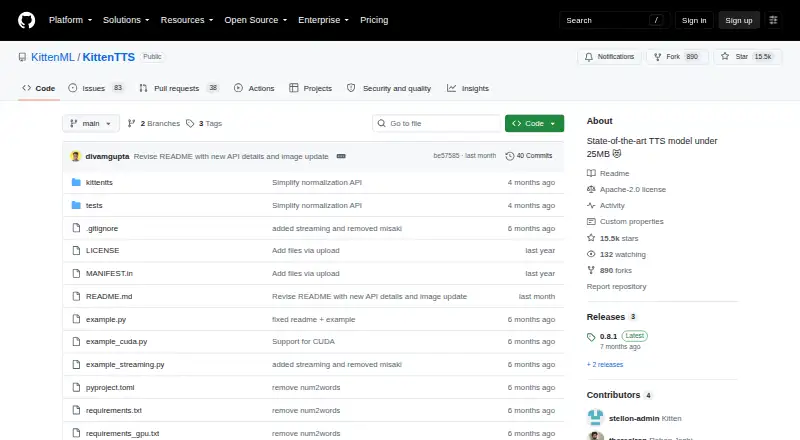
What KittenTTS is
KittenTTS is an open-source text-to-speech library with a CPU-capable 1.7B-parameter KittenTTS 2 model and lightweight legacy models. KittenTTS 2 can clone a voice from a short audio sample without fine-tuning; the README lists 47 built-in voices and 20 languages. Its expression controls include emotion tags, vocal-event tags, and emphasis spans, though emotion control is beta and can vary by voice and sentence. The hosted API provides speech generation, voice cloning, and transcription through OpenAI-compatible HTTP requests, with streaming options. WAV is the listed export format. Users can download weights and self-host, including on-premises, in a VPC, or on-device. The maker also lists on-device SDKs for Python, Swift, React Native, Flutter, and Web, with Kitten-TTS 2 SDKs described as coming soon. The code is Apache 2.0, but model weights have separate terms; KittenTTS 2 uses the Stellon Labs Community License. Long scripts may truncate or repeat in one pass, so sentence-aware chunks are recommended.
Who it suits
KittenTTS suits developers building speech features, voice agents, or content workflows who want a library, hosted API, or self-hosted deployment. Its stated use cases include customer-support call automation and dedicated endpoints.
What it does well
- KittenTTS 2 supports voice cloning from short audio samples.
- README lists 47 voices and 20 languages.
- Hosted API includes speech, cloning, and transcription endpoints.
- Self-hosting is available, including on-premises and on-device.
- Free plan includes 30 free minutes of speech and transcription.
What to know first
- Long scripts can truncate or repeat when processed in one pass.
- Emotion control is beta and varies by voice and sentence.
- Model weights use separate licensing terms from the code.
- Free plan has usage rates after 30 free minutes.
Limits
The Free plan includes 30 free minutes of speech and transcription, then charges $15 per 1M TTS characters and $1 per ASR audio hour. It includes 36 voices, 10 languages, five ASR sessions, and two concurrent TTS streams. Pro costs $14.99 a month, billed $179.88 annually, includes $24.99 of monthly usage, and lists rates of $0.65 per 1M TTS characters and $0.10 per ASR audio hour.
Plans
| Plan | Billed and limits | Price |
|---|---|---|
| Free | 30 free minutes of speech and transcription · Then $15 per 1M TTS characters and $1 per ASR audio hour · 36 voices · 10 languages · 5 ASR sessions and 2 TTS streams at once | Free |
| Pro | $179.88 billed annually · $24.99 of usage included monthly · TTS: $0.65 per 1M characters · ASR: $0.10 per audio hour · Cancel anytime | $14.99 a month |
| Enterprise | Custom usage and rates · Custom API capacity · Private deployment · Invoicing · Dedicated support and onboarding | On request |
As github.com lists them, read 12 Oct 2026. The maker's own page has the final word.
Getting started
- Visit the KittenTTS GitHub website.
- Choose the hosted API or download weights to self-host.
- For KittenTTS 2 locally, use Linux, Windows, or Mac with Python 3.9 or later.
- Use an on-device SDK for Python, Swift, React Native, Flutter, or Web.
- Choose the Free plan or Pro plan for hosted usage.
KittenTTS is an open-source text-to-speech library with local models and a hosted API for speech generation, voice cloning and transcription. It suits developers and teams who want to build speech into apps or run models on their own infrastructure. Its broad voice and language support is appealing, but check the model-weight terms and usage costs before choosing it for production.
Overview
The project pairs a CPU-capable 1.7B-parameter KittenTTS 2 model with lighter legacy models. That gives developers a local option as well as a hosted API, but the system requirements for KittenTTS 2—Linux, Windows or Mac and Python 3.9 or later—make it a developer-oriented choice rather than a turnkey consumer reader.
KittenTTS 2 can clone a voice from a short audio sample without fine-tuning. The README describes 47 built-in voices and 20 languages, while the Free hosted plan provides 36 voices and 10 languages. Expression controls cover emotion, vocal events and emphasis; emotion control is beta, and its effect varies by voice and sentence.
Key features
The hosted API offers speech generation, voice cloning and transcription through OpenAI-compatible HTTP requests, with streaming options. On-device SDKs are available for Python, Swift, React Native, Flutter and Web; Kitten-TTS 2 SDKs are coming soon. This mix is useful for developers choosing between hosted inference and local integration, though the project’s long-script limitation calls for care: a single pass may truncate or repeat, so long input should be split into sentence-aware chunks.
Generated audio exports as WAV. The maker also supports self-hosting, including in a VPC, on-premises or on-device for enterprise deployments. The repository code is Apache 2.0, but model weights have separate terms: KittenTTS 2 uses the Stellon Labs Community License. Review those terms before building a commercial workflow around the weights; commercial use is supported, but the code license alone does not settle model licensing.
The privacy policy says service inputs, including audio or voice recordings, and outputs are collected. It also describes safeguards for personal data and notes that data may be transferred to jurisdictions with different protection levels, subject to due diligence and appropriate measures. Teams handling sensitive voice data should weigh that policy against their deployment needs; self-hosting may be a better fit where infrastructure control is a priority.
Pricing
The code is open source and free, but hosted usage has its own plans and rates. The Free plan costs nothing and includes 30 free minutes of speech and transcription, then charges $15 per 1M TTS characters and $1 per ASR audio hour. It includes 36 voices and 10 languages, with five ASR sessions and two TTS streams at once. This is a practical way to try the hosted service, but the included minutes and concurrency may constrain sustained or parallel workloads.
Pro costs $14.99 a month, billed $179.88 billed annually, and includes $24.99 of usage monthly. TTS costs $0.65 per 1M characters and ASR $0.10 per audio hour; cancellation is available anytime. The lower listed usage rates and monthly allowance suit recurring workloads, though the annual billing is a meaningful commitment despite the cancellation term.
Enterprise has custom pricing, usage and rates, custom API capacity, private deployment, invoicing, dedicated support and onboarding. It is the option for teams needing deployment control or tailored capacity, rather than a published self-serve rate. There is no free trial.
Platforms
KittenTTS supports Android, iOS, Linux, macOS, Windows, web, API and self-hosted use. The breadth helps teams target varied environments, but actual integration depends on the SDK and model version: the maker says Kitten-TTS 2 SDKs are coming soon.
Who it's for
KittenTTS is best suited to developers building voice agents, customer-support call automation, content creation workflows or dedicated speech endpoints. Its cloning, streaming API and self-hosting options serve teams that need to shape their own integration. It is less suitable for readers seeking a simple finished app, or for teams unwilling to check model-weight licensing and manage sentence-aware chunking for long scripts.
Pros and cons
- Pro: Local models, hosted API and self-hosting give developers several deployment choices, including private infrastructure.
- Pro: Zero-shot voice cloning, 47 built-in voices and 20 languages offer a broad creative and localization toolkit.
- Pro: Hosted speech and transcription are available through OpenAI-compatible requests, with streaming options.
- Con: KittenTTS 2 model weights have separate Community License terms, so Apache 2.0 code does not by itself cover the model.
- Con: Long scripts can truncate or repeat in a single pass and need sentence-aware chunking.
- Con: Emotion control is beta and varies with the voice and sentence, so results may not be consistent.
- Con: Hosted Free usage is capped at 30 minutes before metered charges, with limits on voices, languages and concurrent sessions.
Alternatives
For a wider comparison, browse Text-to-Speech Software. Choose iSpeech instead if you want a freemium option with a free trial and a free personal-use plan; its Plus plan is $2.95 a month for 30-minute recordings. Vocalware may suit buyers who prefer published monthly stream tiers, starting at $99.50 a month for 40,000 streams.
Voice RSS is worth considering for a freemium API with a free tier of 350 daily requests and a 100KB per-request cap. Resemble AI is another paid, API-capable option with a free trial and a Flex plan offering one team seat and pay-as-you-go credits that never expire. TTSReader is a freemium alternative with a free plan and free trial.
Voice.ai offers a free monthly plan with 5k credits, online voice changing, text to speech and audio tools. Yappy is a free alternative with no free trial. Adobe Firefly is a freemium option with limited daily generations on its free plan.
Verdict
Choose KittenTTS if you are a developer who wants speech generation and voice cloning with a choice of local, hosted or self-hosted deployment. Its API, voice range and deployment flexibility are strong reasons to consider it, while sentence-aware chunking and separate model-weight licensing deserve attention before adoption. Look elsewhere if you need a finished consumer app or predictable long-script output without extra handling.
Verdict
KittenTTS combines local and hosted speech options with voice cloning and a broad listed voice and language set. Check the model-weight terms and plan usage limits, and split long scripts into sentence-aware chunks.
Questions
Is KittenTTS free?
Yes. The Free plan costs nothing and includes 30 free minutes of speech and transcription; usage charges apply after that.
What does Pro cost?
Pro is $14.99 a month, billed $179.88 annually. It includes $24.99 of usage each month.
Can KittenTTS be self-hosted?
Yes. Users can download weights and self-host, including in a VPC, on-premises, or on-device.
Which platforms and SDKs are listed?
Platforms include Android, API, iOS, Linux, macOS, self-hosted, Web, and Windows. On-device SDKs are listed for Python, Swift, React Native, Flutter, and Web.
What are the licensing terms?
The repository code is Apache 2.0. Model weights have separate terms, and KittenTTS 2 is listed under the Stellon Labs Community License.
What output format is listed?
WAV is the listed export format.
Facts from KittenTTS's own pages
- API access
- Yes · github.com, 20 Sept 2026
- Commercial use
- Yes · github.com, 20 Sept 2026
- Export formats
- WAV · github.com, 20 Sept 2026
- Expression controls
- Expression controls include emotion tags, inline vocal-event tags, and emphasis spans; the README labels emotion control beta and says its effect varies by voice and sentence. · github.com, 12 Oct 2026
- Hosted API
- The hosted API provides speech generation, voice cloning, and transcription endpoints, with OpenAI-compatible HTTP requests and streaming options. · kittenml.com, 12 Oct 2026
- Integrations
- The maker lists on-device SDKs for Python, Swift, React Native, Flutter, and Web, and says Kitten-TTS 2 SDKs are coming soon. · kittenml.com, 12 Oct 2026
- Intended users
- The maker describes use cases including voice agents, customer-support call automation, content creation, and dedicated endpoints. · kittenml.com, 12 Oct 2026
- Local requirements
- The README lists Linux, Windows, or Mac and Python 3.9 or later as system requirements for KittenTTS 2. · github.com, 12 Oct 2026
- Model licensing
- The repository code is Apache 2.0, while model weights have separate terms; KittenTTS 2 is listed under the Stellon Labs Community License. · github.com, 12 Oct 2026
- Notable model limitation
- The README says a single-pass whole script can truncate or drift into repetition, so long input is split into sentence-aware chunks. · github.com, 12 Oct 2026
- Platforms
- windows,macos,linux,api · github.com, 20 Sept 2026
- Privacy and security
- The privacy policy says the company collects service inputs including audio or voice recordings and outputs, and uses technical, physical, and organizational safeguards for personal data. · kittenml.com, 12 Oct 2026
- Privacy limitation
- The privacy policy says personal data may be transferred to jurisdictions with different protection levels, subject to due diligence and appropriate technical and organizational measures. · kittenml.com, 12 Oct 2026
- Self-hosting
- The maker says users can download the weights and self-host, including in a VPC, on-premises, or on-device for enterprise deployments. · kittenml.com, 12 Oct 2026
- Support
- The maker offers commercial integration assistance, custom voice development, enterprise licensing, email support, GitHub Issues, and a Discord community. · github.com, 12 Oct 2026
- Voice cloning
- KittenTTS 2 supports zero-shot voice cloning from a short audio sample without fine-tuning. · github.com, 12 Oct 2026
- Voices and languages
- The README lists 47 built-in voices and support for 20 languages. · github.com, 12 Oct 2026
- What it does
- KittenTTS is an open-source text-to-speech library with a CPU-capable 1.7B-parameter KittenTTS 2 model and lightweight legacy models. · github.com, 12 Oct 2026
Where KittenTTS stands on Freedom251
- Text-to-Speech Software#31 of 223
- Text-to-speech tools#97 of 232