Freedom251 › Text-to-speech tools
Voice RSS
What Voice RSS is
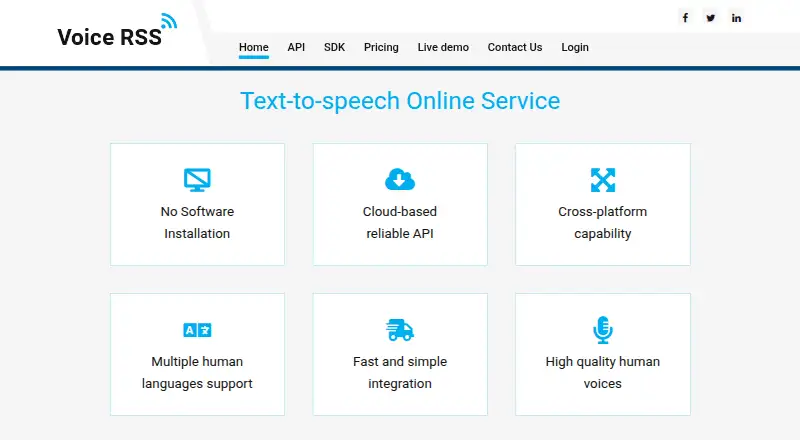
Voice RSS is a cloud text-to-speech API that converts text into audio without requiring software installation. It lists 49 languages and 100 voices, with output in MP3, WAV, AAC, OGG and CAF. API settings include voice choice, speech rate from -10 to 10, output format and optional SSML. Each request returns audio or an error in the same response; callbacks are not supported, and text is limited to 100KB per request. The free plan allows 350 daily requests. Advanced costs $5 a month and allows 1,000 daily requests, with plain text only and no SSML. Higher listed plans include Premium at $15 a month, Premium Plus at $40 a month, Business at $120 a month and Enterprise at $300 a month. The maker also offers SDKs for some programming languages and platforms, and describes uses such as converting documents, web content and RSS feeds into speech.
Who it suits
Voice RSS suits developers adding speech output to applications or converting documents, web content and RSS feeds. Its API and SDKs provide options for integrating text-to-speech into software.
What it does well
- Supports 49 languages and 100 voices
- Five audio output formats
- Free plan allows 350 daily requests
- SDKs are offered for some languages and platforms
What to know first
- Requests are limited to 100KB of text
- Callbacks are not supported
- Advanced plan does not include SSML
- Service does not warrant uninterrupted availability
Limits
The Free plan allows 350 daily requests, with a 100KB text limit per request. Advanced, Premium, and Premium Plus list plain text only and no SSML; Business and Enterprise include SSML, and every listed tier retains the 100KB per-request limit.
Plans
| Plan | Billed and limits | Price |
|---|---|---|
| Advanced | Monthly Subscription · 1,000 daily requests · 100KB per request · plain text · no SSML · basic dashboard · no premium dashboard · no 0.5 sec SLA | $5 a month |
| Premium | Monthly Subscription · 5,500 daily requests · 100KB per request · plain text · no SSML · basic dashboard · no premium dashboard · 0.5 sec SLA | $15 a month |
| Premium Plus | Monthly Subscription · 20,000 daily requests · 100KB per request · plain text · no SSML · basic and premium dashboards · 0.5 sec SLA | $40 a month |
| Business | Monthly Subscription · 100,000 daily requests · 100KB per request · plain text and SSML · basic and premium dashboards · 0.5 sec SLA | $120 a month |
| Enterprise | Monthly Subscription · Unlimited daily requests · 100KB per request · plain text and SSML · basic and premium dashboards · 0.5 sec SLA | $300 a month |
| FREE | Monthly Subscription · 350 daily requests · 100KB per request · plain text · no SSML · no dashboard · no 0.5 sec SLA | Free |
| Custom | Contact Us · Daily requests and pricing by contact · plain text and SSML · basic and premium dashboards · 0.5 sec SLA | On request |
As voicerss.org lists them, read 12 Oct 2026. The maker's own page has the final word.
Getting started
- Open the Voice RSS website and try the online live demo.
- Choose the Free plan or a paid monthly plan based on the listed request quota and features.
- Use the API to submit text and select a voice, speech rate, and audio format.
- Use an available SDK for a supported programming language or platform if it fits your integration.
Voice RSS is a cloud text-to-speech API for developers who want to add generated speech to applications, documents or feeds. Its broad language and format support is useful, but the fixed request cap and plan-dependent SSML access narrow its fit.
Overview
Voice RSS converts text to audio through an API, without requiring software installation. It supports 49 languages and 100 voices, with controls for voice selection and speech rate from -10 to 10. Output can be MP3, WAV, AAC, OGG or CAF, giving developers flexibility to fit different playback needs.
Each request returns audio or an error synchronously; callbacks are not supported. That is a straightforward model for integrations able to wait for each response, but a limitation for workflows that need asynchronous processing. The 100KB text limit applies to every request, so longer material must be split. SDKs for some popular languages and platforms can speed integration.
Potential uses include turning documents, web content and RSS feeds into audio, or adding auditory information when users' eyes are occupied. The terms say authorized employees access customer personal information on a need-to-know basis and that it is not sold, shared or rented to third parties. They also do not warrant uninterrupted, timely or error-free service. The maker offers a live demo and email contact for questions.
Key features
- Voice and rate controls: Select among 100 voices and adjust speech rate from -10 to 10, useful when an application needs more than a single default voice.
- Five audio formats: MP3, WAV, AAC, OGG and CAF support different output requirements without limiting developers to one codec.
- SSML input: SSML is available on the free plan and on Business and Enterprise, but not on Advanced, Premium or Premium Plus. That makes plan choice important for users who need structured speech input.
- Request-size ceiling: The 100KB limit on each request puts a practical boundary on long-form conversion, regardless of plan.
- Synchronous API: Audio or an error comes back in the same request, with no callback support; this suits request-response integrations better than queued jobs.
Pricing
Voice RSS uses a freemium model. Paid plans are monthly subscriptions, with daily allowances and dashboard access scaling by tier; every plan retains the 100KB-per-request limit.
| Plan | Price | What it includes |
|---|---|---|
| Free | free | 350 daily requests; 100KB per request. |
| Advanced | $5 a month | 1,000 daily requests, plain text, basic dashboard; no SSML, premium dashboard or 0.5 sec SLA. |
| Premium | $15 a month | 5,500 daily requests, plain text, basic dashboard and 0.5 sec SLA; no SSML or premium dashboard. |
| Premium Plus | $40 a month | 20,000 daily requests, plain text, basic and premium dashboards, and 0.5 sec SLA; no SSML. |
| Business | $120 a month | 100,000 daily requests, plain text and SSML, both dashboards, and 0.5 sec SLA. |
| Enterprise | $300 a month | Unlimited daily requests, plain text and SSML, both dashboards, and 0.5 sec SLA. |
| Custom | custom pricing | 100KB per request. |
The free tier is a useful way to try a low-volume integration, but 350 requests per day can constrain a production service. Advanced is the lowest-cost paid option for a larger daily allowance, though it still excludes SSML and the SLA. Premium adds a 0.5 sec SLA and more requests, while Premium Plus adds the premium dashboard. Business is the first paid tier with SSML; Enterprise is the choice for unlimited daily requests. All paid plans are monthly subscriptions, and none raises the per-request text cap.
Platforms
Voice RSS lists Android, iOS, Linux, macOS, web and Windows, alongside API access. Its central offering is the cloud API, making those platform listings most relevant to developers integrating speech into software rather than people seeking a standalone desktop authoring tool.
Who it's for
Voice RSS is a good fit for developers adding speech to apps, feeds or document workflows who can work within synchronous requests and split text at the 100KB boundary. The free plan suits modest volumes; higher-volume services can choose a paid daily allowance, and teams needing SSML must move to Business or Enterprise. It is less suitable for long single-request content or systems that depend on callbacks.
Pros and cons
Pros
- 49 languages and 100 voices give applications substantial voice choice.
- Five audio formats and a configurable speech rate help accommodate varied playback requirements.
- Daily request allowances scale from a free tier to unlimited requests on Enterprise.
- SDKs for some popular languages and platforms can reduce integration work.
Cons
- The 100KB request ceiling requires long content to be divided, even on Enterprise.
- No callbacks means integrations must handle each request-response cycle synchronously.
- SSML is absent from four paid tiers, including Advanced, Premium and Premium Plus.
- The free tier's 350 daily requests may be too restrictive for services with regular user traffic.
Alternatives
For another freemium text-to-speech option with broad platform coverage and a free personal-use plan, consider iSpeech; its Plus plan is $2.95 a month for 30-minute recordings.
TTSReader is another freemium alternative with a free plan and support across Android, API, extensions, iOS, macOS, web and Windows.
Voice.ai may suit readers looking for a tool that combines text to speech with online voice changing and audio tools; its free plan includes 5k credits per month and a five-minute conversion limit.
Choose Adobe Firefly instead if you want a broader creative-generation tool: its free plan offers limited daily generations, and its platform coverage includes Android, API, iOS and web.
AnySpeak.ai is worth considering when local processing matters: its Local plan is free, has no character limit and runs on your computer, while its server-hosted Demo has a 50-character limit.
Calik AI offers a broader AI toolkit, with its free plan covering 10 of 43 AI Center modules and five Agent Office agents.
Fish Audio may fit readers who want a free tier with monthly credits; it includes 8,000 credits, up to seven minutes of generation and up to 500 characters per generation.
Kokoro TTS is a free alternative built around an 82-million-parameter open-weight model with Apache-licensed weights.
Browse more options in Text-to-Speech Software.
Verdict
Choose Voice RSS if you need a developer-facing speech API with many language and voice options, multiple output formats and daily request tiers that can scale. Its strongest case is configurable, cloud-based generation without installation. Look elsewhere if your workflow needs asynchronous callbacks, long text in a single request or SSML on a lower paid tier.
Verdict
Voice RSS provides API-based speech generation with multiple voices, languages and audio formats. Check the daily request allowance and SSML availability for the plan you choose; Advanced costs $5 a month.
Questions
Is Voice RSS free?
Yes. The Free plan is listed as free and allows 350 daily requests, with a 100KB limit per request.
How much do paid plans cost?
Advanced costs $5 a month, Premium $15 a month, Premium Plus $40 a month, Business $120 a month, and Enterprise $300 a month. A Custom plan is listed without a price.
Which platforms does Voice RSS list?
It lists Android, API, iOS, Linux, macOS, web, and Windows.
Which audio formats does it support?
The API supports MP3, WAV, AAC, OGG, and CAF audio codecs.
Does the API accept SSML?
The Free, Advanced, Premium, and Premium Plus plans do not list SSML access. Business and Enterprise list plain text and SSML.
Does Voice RSS support callbacks?
No. Each request returns audio data or an error message synchronously in that same request.
Facts from Voice RSS's own pages
- API access
- The API accepts HTTP GET and HTTP POST requests over HTTP or HTTPS. · voicerss.org, 12 Oct 2026
- Audio output
- The API supports MP3, WAV, AAC, OGG, and CAF audio codecs. · voicerss.org, 12 Oct 2026
- Availability
- The terms say services are available worldwide unless otherwise stated and do not warrant uninterrupted, timely, or error-free service. · voicerss.org, 12 Oct 2026
- Export formats
- MP3,WAV,AAC,OGG,CAF · voicerss.org, 20 Sept 2026
- Free plan
- Yes · voicerss.org, 20 Sept 2026
- Integrations
- The maker offers SDKs for some popular programming languages and platforms to wrap the Text-to-Speech API and speed integration. · voicerss.org, 12 Oct 2026
- Languages and voices
- The service states it supports 49 languages and 100 voices. · voicerss.org, 12 Oct 2026
- Platforms
- web,api · voicerss.org, 20 Sept 2026
- Privacy
- The terms state that customer personal information is accessed by authorized employees on a need-to-know basis and is not sold, shared, or rented to third parties. · voicerss.org, 12 Oct 2026
- Purpose
- Voice RSS provides a cloud text-to-speech API that converts textual content into audio without software installation. · voicerss.org, 12 Oct 2026
- Request limit
- The API text parameter is limited to 100KB per request. · voicerss.org, 12 Oct 2026
- Security disclosure
- The opened maker pages provide privacy and server-log statements but do not state a security certification or compliance standard. · voicerss.org, 12 Oct 2026
- Speech controls
- API parameters include voice selection, speech rate from -10 to 10, audio format, and optional SSML input. · voicerss.org, 12 Oct 2026
- Paid from
- 5 · voicerss.org, 20 Sept 2026
- Support
- The maker directs questions and suggestions to email contact and provides an online live demo. · voicerss.org, 12 Oct 2026
- Synchronous response
- The API does not support callbacks and synchronously returns audio data or an error message in the same request. · voicerss.org, 12 Oct 2026
- Use cases
- The maker describes use with documents, web content, RSS feeds, and applications that provide auditory information while users' eyes are occupied. · voicerss.org, 12 Oct 2026
Where Voice RSS stands on Freedom251
- Text-to-speech tools#62 of 232
- Text-to-Speech Software#112 of 223