Freedom251 › AI Voice Conversion Software
Amphion
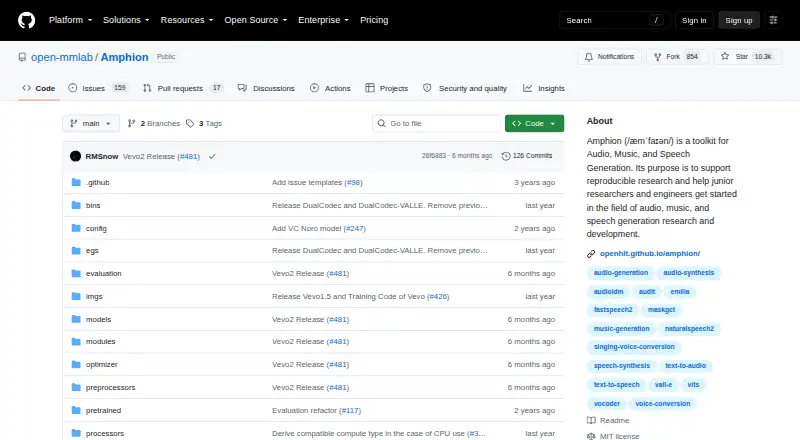
What Amphion is
Amphion is an open-source toolkit for generating audio, music, and speech, intended to support reproducible research and help researchers and engineers get started. It supports text-to-speech, singing voice synthesis, voice conversion, accent conversion, singing voice conversion, and text-to-audio; text-to-music is still in development. Its model implementations span diffusion, transformer, VAE, and flow-based architectures. Named speech models include FastSpeech2, VITS, VALL-E, NaturalSpeech2, MaskGCT, and Vevo-TTS, while Vevo, FACodec, and Noro are used for voice conversion. Vevo2 adds controllable speech and singing functions such as melody control and singing voice editing. For text-to-audio, Amphion uses a latent diffusion model. It also provides objective audio evaluation metrics, interactive visualizations, and shared preprocessing for open-source datasets including Emilia and Emilia-Pipe. The toolkit is free under the MIT License for research and commercial use. It runs on Linux or as a self-hosted setup; documented installation options use Conda with Python 3.9.15 or Docker. Docker setup requires NVIDIA components and a mounted dataset.
Who it suits
Amphion suits researchers and engineers working on speech, singing, voice conversion, or text-to-audio generation. It is also relevant to teams that want shared dataset preprocessing and objective audio evaluation tools.
What it does well
- Supports several speech and singing generation tasks.
- Includes named models for speech and voice conversion.
- Provides objective audio evaluation metrics.
- Unifies preprocessing for multiple open-source datasets.
- MIT-licensed and free for commercial use.
What to know first
- Text-to-music is still in development.
- Docker setup requires NVIDIA drivers, toolkit, and CUDA.
- Docker use requires mounting the dataset.
Limits
Text-to-music is in development rather than supported. The project is free under the listed MIT-licensed plan, with no free-plan quota stated.
Plans
| Plan | Billed and limits | Price |
|---|---|---|
| Amphion | MIT-licensed · free for research and commercial use | Free |
As github.com lists them, read 5 Oct 2026. The maker's own page has the final word.
Getting started
- Open the Amphion project website on GitHub.
- Choose a Linux, self-hosted setup.
- Follow the documented setup with Python 3.9.15 and Conda, or use the Docker image.
- For Docker, install Docker, NVIDIA drivers, NVIDIA Container Toolkit, and CUDA.
- Mount the dataset into the Docker container.
Amphion is a free, open-source toolkit for generating and evaluating speech, singing, and audio. It suits researchers and engineers who want to build or study audio systems in a Linux or self-hosted environment.
Its breadth and MIT license make it a flexible research foundation; text-to-music remains in development, and setup calls for technical expertise and NVIDIA-compatible infrastructure.
Overview
Amphion brings generation models, evaluation metrics, visualizations, and dataset preprocessing together for reproducible research. Supported tasks include text-to-speech, voice and accent conversion, singing voice synthesis, and text-to-audio. That range is valuable for teams exploring several audio-generation problems in one toolkit, but it is not a ready-made hosted voice service.
Installation is documented through Conda with Python 3.9.15 or Docker. The Docker path requires NVIDIA drivers, NVIDIA Container Toolkit, and CUDA, and the dataset must be mounted into the container. These demands are manageable for equipped research teams, but less suitable for people seeking a quick, hardware-agnostic workflow.
Key features
Speech and voice models
For text-to-speech, Amphion includes FastSpeech2, VITS, VALL-E, NaturalSpeech2, MaskGCT, and Vevo-TTS. Voice conversion models include Vevo, FACodec, and Noro; accent conversion is also supported. The variety gives developers multiple architectures to work with rather than locking them into one approach, though it also places Amphion firmly in the toolkit category.
Controllable singing and text-to-audio
Vevo2 supports controllable speech and singing generation, including voice conversion, singing voice conversion, singing voice editing, singing style conversion, and melody control. The controls make it relevant to work spanning speech and singing, not only standard voice conversion. Text-to-audio uses a latent diffusion model and implements the text-to-audio component of Amphion's NeurIPS 2023 paper.
Text-to-music is still in development. Readers whose main requirement is generating music directly from prompts should choose a tool with that task supported rather than plan around Amphion.
Evaluation and datasets
Amphion supplies objective metrics for F0 and energy modeling, intelligibility, spectrogram distortion, and speaker similarity. Its interactive visualizations cover classic model processing, including SingVisio for the diffusion model used in singing voice conversion. Together, these tools support examining and comparing model behavior, not just generating outputs.
Preprocessing is unified across multiple open-source audio datasets, with support for the Emilia dataset and Emilia-Pipe pipeline for in-the-wild speech. Content-based features can draw on pretrained WeNet, Whisper, and ContentVec models.
Pricing
Amphion costs nothing. The MIT-licensed toolkit is free for research and commercial use, so teams can explore or use it commercially without a paid tier or per-seat plan. Its cost advantage does not remove the practical price of providing compatible hardware and managing setup.
Platforms
Amphion is available for Linux and self-hosted use. Audio uploads support WAV, MP3, and FLAC, and exports are in WAV. The project documents Conda and Docker setup; Docker requires NVIDIA drivers, NVIDIA Container Toolkit, CUDA, and a mounted dataset. That makes it a fit for Linux-based development environments, not a turnkey cross-platform desktop or web app.
Who it's for
Amphion is aimed at researchers and engineers developing audio, music, and speech-generation systems, including junior practitioners entering the field. It is especially useful for teams that need model implementations, evaluation, visualizations, and dataset preparation in one open-source project. People who want a simple voice-conversion app, or need text-to-music today, should look elsewhere.
Pros and cons
- Pros: Broad support for speech, voice conversion, singing, and text-to-audio gives research teams one toolkit for several generation tasks.
- Pros: Evaluation metrics, visualizations, and dataset preprocessing complement generation models for reproducible research workflows.
- Pros: MIT licensing and free research and commercial use make it accessible for commercial as well as academic projects.
- Cons: Text-to-music is in development, so it does not meet that need as a supported capability.
- Cons: The documented Docker path requires NVIDIA software and dataset mounting, creating a substantial setup hurdle for casual users.
- Cons: Linux and self-hosted availability favors technical teams over users seeking a hosted, cross-platform voice app.
Alternatives
LALAL.AI is worth considering for a freemium option spanning web, desktop, mobile, and Linux; its free Starter plan limits uploads to 200 MB per file and the Relaxed Queue to 10 minutes, with previews but no full downloads.
Resemble AI is a broader platform alternative across web, desktop, mobile, API, and self-hosted environments. Its Flex plan starts free with one team seat and pay-as-you-go credits that never expire.
Altered Studio may suit users seeking a desktop or web voice tool: its free plan includes three minutes per month of Voice Morphing, 10,000 AI Tokens, and local voice cloning, with attribution and noncommercial restrictions.
Applio is another free, MIT-licensed open-source option for voice conversion, with Linux, macOS, Windows, web, and self-hosted availability.
IK Multimedia ReSing fits users who prefer a macOS or Windows application; its free plan includes two voices, two instruments, and one RVC import, but no model generation.
Audimee is a web-based alternative with a free plan that allows 15 minutes of conversions and 11 royalty-free voices, but no custom voice model slots and MP3 downloads only.
AudioPod AI is an API, iOS, and web option whose free Basic plan includes 1,000 credits per month, approximately three minutes of text-to-speech and one minute of music generation.
Kits AI is an alternative for users seeking a web, Windows, or API workflow; its free plan includes 15 conversion minutes, voice designer/blender, and generative vocals, but no voice slots or download minutes.
The AI Voice Conversion Software list and Text-to-Speech Software list can help compare other tools in those categories.
Verdict
Choose Amphion if you are a researcher or engineer who wants a free, MIT-licensed foundation for studying or developing multiple speech, singing, and audio-generation tasks, with evaluation and dataset tools alongside models. Its strongest reason to choose it is that research breadth; its clearest reason to look elsewhere is the technical setup, compounded by text-to-music not yet being supported.
Verdict
Amphion brings a broad set of audio-generation tasks, models, evaluation metrics, and dataset tools into one open-source toolkit. Text-to-music is not yet supported, and its Docker setup has specific NVIDIA and dataset requirements.
Questions
How much does Amphion cost?
The listed plan is free. It is MIT-licensed and stated to be free for research and commercial use.
Which platforms does Amphion support?
Linux and self-hosted use are listed.
What can Amphion generate?
Supported tasks include text-to-speech, singing voice synthesis, voice conversion, accent conversion, singing voice conversion, and text-to-audio. Text-to-music is in development.
Is Amphion open source?
Yes. Amphion is released under the MIT License.
What setup options are documented?
The project documents Python 3.9.15 with Conda or a Docker image. Docker setup requires NVIDIA drivers, NVIDIA Container Toolkit, CUDA, and a mounted dataset.
What audio formats are listed?
WAV is listed as an export format. WAV, MP3, and FLAC are listed as audio upload formats.
Facts from Amphion's own pages
- Audio evaluation
- Its evaluation metrics cover F0 and energy modeling, intelligibility, spectrogram distortion, and speaker similarity. · github.com, 5 Oct 2026
- Dataset preprocessing
- It unifies preprocessing for multiple open-source audio datasets and supports the Emilia dataset and Emilia-Pipe pipeline for in-the-wild speech data. · github.com, 4 Oct 2026
- Datasets
- Amphion unifies preprocessing for several open-source datasets and supports the Emilia dataset and Emilia-Pipe for in-the-wild speech data. · github.com, 5 Oct 2026
- Docker requirement
- The Docker instructions call for Docker, an NVIDIA Driver, NVIDIA Container Toolkit, and CUDA, and state that mounting the dataset with -v is necessary. · github.com, 5 Oct 2026
- Export formats
- WAV · github.com, 20 Sept 2026
- External model tools
- For content-based features, the README lists pretrained models including WeNet, Whisper, and ContentVec. · github.com, 5 Oct 2026
- Free plan
- Yes · github.com, 20 Sept 2026
- Generation tasks
- Supported tasks include text-to-speech, singing voice synthesis, voice conversion, accent conversion, singing voice conversion, and text-to-audio; text-to-music is listed as in development. · github.com, 4 Oct 2026
- Installation
- The README documents installation with a setup installer using Python 3.9.15 and with a Docker image. · github.com, 5 Oct 2026
- Integrations and dependencies
- The project lists WeNet, Whisper, and ContentVec among pretrained models used for content-based features, and its Docker instructions require NVIDIA drivers, NVIDIA Container Toolkit, and CUDA. · github.com, 4 Oct 2026
- Intended users
- The project describes itself as supporting reproducible research and helping junior researchers and engineers enter audio, music, and speech generation research and development. · github.com, 5 Oct 2026
- License
- Amphion is released under the MIT License and is stated to be free for research and commercial use. · github.com, 5 Oct 2026
- License and cost
- Amphion is licensed under MIT and the README says it is free for research and commercial use. · github.com, 4 Oct 2026
- Models
- The toolkit implements diffusion, transformer, VAE, and flow-based model architectures. · github.com, 5 Oct 2026
- Purpose
- Amphion is an open-source toolkit for audio, music, and speech generation intended to support reproducible research and help junior researchers and engineers get started. · github.com, 5 Oct 2026
- Singing generation
- Vevo2 supports controllable speech and singing generation, including voice conversion, singing voice conversion, singing voice editing, singing style conversion, and melody control. · github.com, 4 Oct 2026
- Support and community
- The project invites contributions and links to a Discord channel for community engagement. · github.com, 4 Oct 2026
- Supported tasks
- The README marks text-to-speech, singing voice synthesis, voice conversion, accent conversion, singing voice conversion, and text-to-audio as supported, while text-to-music is in development. · github.com, 5 Oct 2026
- Technical limit
- Text-to-music is listed as in development rather than supported. · github.com, 5 Oct 2026
- Text to audio
- Amphion supports text-to-audio generation using a latent diffusion model and describes it as the official implementation of the text-to-audio generation part of its NeurIPS 2023 paper. · github.com, 4 Oct 2026
- Visualization
- Amphion provides interactive visualizations of classic models and currently supports SingVisio for visualizing the diffusion model for singing voice conversion. · github.com, 5 Oct 2026
- Voice and speech models
- The toolkit includes architectures such as FastSpeech2, VITS, VALL-E, NaturalSpeech2, MaskGCT, and Vevo-TTS for text-to-speech, plus Vevo, FACodec, and Noro for voice conversion. · github.com, 4 Oct 2026
- Voice cloning
- Yes · github.com, 20 Sept 2026
Where Amphion stands on Freedom251
- AI Voice Conversion Software#3 of 29
- Text-to-Speech Software#28 of 223
- Text-to-speech tools#92 of 232