Freedom251 › AI Software Testing Tools

Keploy
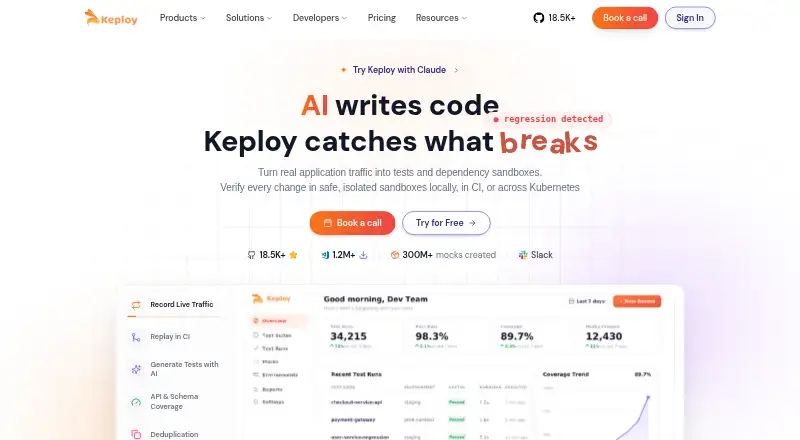
What Keploy is
Keploy captures application traffic and turns it into API tests and dependency sandboxes for local development, CI, and Kubernetes verification. It records incoming requests and outgoing calls to dependencies through eBPF and network interception, without requiring changes to application code. Recorded traffic can be replayed as regression tests in CI with mocks and isolation. The free Playground plan can generate API test suites from OpenAPI or Postman inputs, and AI can add edge cases.
The listed protocols and databases include HTTP(S), HTTP/2, gRPC, Protobuf, GraphQL, Kafka, MySQL, MongoDB, Redis, DynamoDB, Postgres, and RDS. CI/CD integrations include GitHub, GitLab, Jenkins, and Argo. A Chrome extension captures XHR and fetch traffic with headers, cookies, and authentication context, then exports calls as cURL, JSON, or Keploy YAML. Keploy's core local record-and-replay platform is open source under Apache 2.0. Plans include a free self-hosted option, a free Playground plan, Pro at $19/user/mo plus additional usage, and Enterprise with pricing available through discussion. Supported platforms include API, extension, Linux, macOS, self-hosted, web, and Windows.
Who it suits
Keploy suits developers who want to derive regression tests and dependency sandboxes from application traffic for local work or CI. Teams using its listed protocols, databases, and CI/CD integrations can use it to replay captured behavior, while the Chrome extension supports capturing browser requests.
What it does well
- Captures traffic without requiring application code changes.
- Replays recorded traffic as CI regression tests with mocks and isolation.
- Generates API tests from OpenAPI or Postman inputs.
- Supports GraphQL and a broad list of protocols and databases.
- Core local record-and-replay platform is open source under Apache 2.0.
- Chrome extension exports captured calls as cURL, JSON, or Keploy YAML.
What to know first
- Pro costs $19/user/mo plus additional usage.
- Playground limits monthly test generations, test runs, sandbox runs, and AI credits.
- Enterprise pricing is available through discussion.
Limits
The free Playground plan allows 30 test suite generations, 100 test runs, 5,000 integration and sandbox runs, and 5 AI credits per month. The free Open Source plan is self-hosted and provides local recording and CI replay. Pro provides 100 test suite generations, 400 test runs, 20,000 integration and sandbox runs, and 20 AI credits; it costs $19/user/mo plus additional usage.
Plans
| Plan | Billed and limits | Price |
|---|---|---|
| Open Source | Free · Self-hosted · Local recording on macOS, Windows, Linux, and Docker · CI replay | Free |
| Playground | Free forever · 30 test suite generations/mo · 100 test runs/mo · 5,000 integration and sandbox runs/mo · 5 AI credits/mo | Free |
| Pro | $19/user/mo + additional usage · 100 test suite generations/mo · 400 test runs/mo · 20,000 integration and sandbox runs/mo · 20 AI credits · Email and chat support | $19 a month |
| Enterprise | Let's talk · Production traffic capture · Kubernetes recording · SSO and RBAC · Private or air-gapped deployments · Dedicated support engineer | On request |
As keploy.io lists them, read 7 Oct 2026. The maker's own page has the final word.
Getting started
- Visit https://keploy.io/.
- Choose the free self-hosted Open Source plan or the free Playground plan.
- For local recording, use macOS, Windows, Linux, or Docker.
- Use the Chrome extension to capture XHR and fetch traffic, or provide OpenAPI or Postman inputs for test generation.
- For paid usage, choose Pro at $19/user/mo plus additional usage, or contact Keploy about Enterprise.
Keploy is a traffic-driven testing platform for teams that want regression tests and dependency sandboxes based on real application requests. Its strongest fit is API and service teams working across local development, CI, and Kubernetes. The open-source local recorder and a usable free Playground make it approachable; Pro raises the quotas, while Kubernetes recording and production capture require custom-priced Enterprise.
Overview
Keploy captures incoming requests and outgoing dependency calls through eBPF and network-level interception, without changes to application code. It replays that traffic as regression tests in CI, using mocks and isolation. This approach is useful when teams want to preserve real request and dependency behavior in a test suite, rather than construct every case manually. SOAP is unsupported, so it is a poor fit for teams whose API coverage depends on that protocol.
Key features
Capture, generate, replay
Recorded traffic can be reused to catch regressions, while the Playground plan can generate API tests from OpenAPI or Postman inputs and use AI to expand edge cases. That gives teams a way to build an initial suite from existing API definitions, but the free plan's five AI credits per month and 30 suite generations limit repeated use. Pro raises those caps to 20 credits and 100 generations monthly.
Protocols and integrations
Keploy supports HTTP(S), HTTP/2, gRPC, Protobuf, GraphQL, and Kafka, plus databases including MySQL, MongoDB, Redis, DynamoDB, Postgres, and RDS. GitHub, GitLab, Jenkins, and Argo integrations connect it to common CI/CD workflows; AWS Marketplace is also available. The breadth makes it relevant to teams testing services with varied dependencies, though the published protocol coverage does not include SOAP.
Browser capture and security
The Chrome extension captures XHR and fetch traffic with headers, cookies, and authentication context, then exports calls as cURL, JSON, or Keploy YAML. That can help turn browser-driven API activity into reusable cases. Keploy describes access controls, encryption at rest and in transit, regular audits, and anonymization where possible for AI processing. Enterprise adds SOC 2, GDPR, and HIPAA compliance features, plus cloud, self-hosted, and air-gapped deployment options.
Pricing
The Open Source plan is free and self-hosted, with local recording on macOS, Windows, Linux, and Docker, plus CI replay. It suits developers who can run the tooling themselves and need the core record-and-replay workflow. The core platform is open source under Apache 2.0.
Playground is free forever and includes 30 test suite generations, 100 test runs, 5,000 integration and sandbox runs, and five AI credits per month. It is a solid starting point for individual evaluation or modest usage, but its quotas may constrain teams running larger suites or generating tests regularly.
Pro costs $19/user/mo plus additional usage. It includes 100 suite generations, 400 test runs, 20,000 integration and sandbox runs, 20 AI credits, and email and chat support. It suits teams that have outgrown Playground's caps and want direct support; usage beyond the included quotas adds cost.
Enterprise has custom pricing and includes production traffic capture, Kubernetes recording, SSO and RBAC, private or air-gapped deployments, a dedicated support engineer, and onboarding. Pro CI replay uses a Keploy API key; Enterprise can replay in a Kubernetes cluster or in CI using a Keploy API key. Enterprise is the relevant tier for organizations that need its deployment, access-control, or production capture options.
Platforms
Keploy lists API, browser extension, Linux, macOS, Windows, web, and self-hosted availability. The Open Source plan specifically supports local recording on macOS, Windows, Linux, and Docker.
Who it's for
Keploy fits developers and service teams that want to turn existing traffic into repeatable regression tests, mock dependencies, or generate API suites from OpenAPI and Postman definitions. Its free local option works for self-hosting developers, while Playground and Pro suit teams whose run volume fits their quotas. Teams that need SOAP coverage or production-focused capabilities without moving to custom-priced Enterprise should consider another tool.
Pros and cons
- Pros: Captures requests and dependency calls without application code changes, making existing traffic useful as test input.
- Pros: Free local record-and-replay and a free Playground provide two ways to start, including API test generation from OpenAPI or Postman.
- Pros: Broad listed protocol and database support, plus GitHub, GitLab, Jenkins, and Argo integrations, suits varied service stacks.
- Cons: SOAP is not supported, ruling it out for teams that need SOAP testing.
- Cons: Playground and Pro enforce monthly generation, run, sandbox, and AI-credit quotas; additional Pro usage costs extra.
- Cons: Production capture, Kubernetes recording, and private or air-gapped deployment are Enterprise features with custom pricing.
Alternatives
For a fully open-source, community-driven option, consider Microcks. If you need endpoint mock rules and CRUD objects, Beeceptor offers an Individual plan at $10 a month with 15,000 requests per month per endpoint and up to 50 mock rules. Teams focused on emulating AWS services can choose LocalStack, whose free Hobby plan includes 30+ emulated services and one personal sandbox for non-commercial use.
MockServer is a free, self-hosted option with no SaaS account requirement. For open-source contract testing, consider Pact. Specmatic is worth considering if you need WSDL and SOAP alongside OpenAPI, contract testing, or service virtualization. Testcontainers Desktop offers individual developers 300 minutes of cloud runtime per month on its free plan. Karate covers REST, GraphQL, and SOAP API testing, as well as browser and desktop UI automation and Gatling performance testing.
Browse more Integration Testing Tools, AI Software Testing Tools, and API Testing Tools.
Verdict
Choose Keploy if your team wants to turn captured application and dependency traffic into regression tests, with local open-source tooling and free hosted quotas to get started. Its protocol range and traffic-based workflow are compelling for API and service testing. Look elsewhere if SOAP is essential, or if you need production capture and Kubernetes recording but cannot justify Enterprise custom pricing.
Verdict
Choose Keploy if you want to turn captured application traffic into regression tests and dependency sandboxes, with free local and Playground options. Pro adds higher usage quotas and email and chat support at $19/user/mo plus additional usage; look elsewhere if your needs include SOAP, which is not supported.
Questions
Is Keploy free?
Yes. The Open Source plan is free and self-hosted, and Playground is free forever with monthly usage quotas.
How much does Keploy Pro cost?
Pro costs $19/user/mo plus additional usage.
Which platforms does Keploy support?
Listed platforms are API, extension, Linux, macOS, self-hosted, web, and Windows.
Is Keploy open source?
Its core local record-and-replay platform is open source under the Apache 2.0 license.
Which CI/CD integrations are listed?
GitHub, GitLab, Jenkins, and Argo are listed. The pricing page also says AWS Marketplace is available.
Does Keploy support SOAP?
No. GraphQL support is listed, while SOAP support is listed as unavailable.
Facts from Keploy's own pages
- Browser extension
- The Chrome extension captures XHR and fetch traffic, including headers, cookies, and authentication context, and can export captured calls as cURL, JSON, or Keploy YAML. · keploy.io, 7 Oct 2026
- Capture
- Keploy captures incoming requests and outgoing dependency calls using eBPF and network-level interception without requiring application code changes. · keploy.io, 7 Oct 2026
- Compliance
- The pricing page lists SOC 2, GDPR, and HIPAA compliance among Enterprise features. · keploy.io, 7 Oct 2026
- Deployment
- The page lists Cloud, Self-Hosted, and air-gapped deployment options for Enterprise. · keploy.io, 7 Oct 2026
- Integrations
- Listed CI/CD integrations include GitHub, GitLab, Jenkins, and Argo, and the pricing page also says AWS Marketplace is available. · keploy.io, 7 Oct 2026
- Open source
- Keploy says its core local record-and-replay platform is open source under the Apache 2.0 license. · keploy.io, 7 Oct 2026
- Plan limit
- The pricing comparison says CI replay for Pro uses a Keploy API key, while Enterprise can replay in a Kubernetes cluster or CI using a Keploy API key. · keploy.io, 7 Oct 2026
- Product
- Keploy turns real application traffic into tests and dependency sandboxes for local, CI, and Kubernetes verification. · keploy.io, 7 Oct 2026
- Protocols and dependencies
- The pricing page lists HTTP(S), HTTP/2, gRPC, Protobuf, GraphQL, Kafka, MySQL, MongoDB, Redis, DynamoDB, Postgres, and RDS among supported protocols and databases. · keploy.io, 7 Oct 2026
- Replay
- Keploy replays recorded traffic as regression tests in CI with mocks and isolation. · keploy.io, 7 Oct 2026
- Security
- Keploy's security policy describes strict access controls, encryption at rest and in transit, regular security audits, and data anonymization where possible for AI processing. · keploy.io, 7 Oct 2026
- Support
- Pro includes email and chat support, while Enterprise includes a dedicated support engineer and onboarding. · keploy.io, 7 Oct 2026
- Test generation
- The Playground plan generates API tests from OpenAPI or Postman inputs, and AI can automatically expand edge cases. · keploy.io, 7 Oct 2026
Where Keploy stands on Freedom251
- AI Software Testing Tools#7 of 34
- Integration Testing Tools#6 of 26
- Ai Code Testing#6 of 25
- AI software testing tools#9 of 34
- API Testing Tools#13 of 34