Freedom251 › API Mocking Tools

Beeceptor
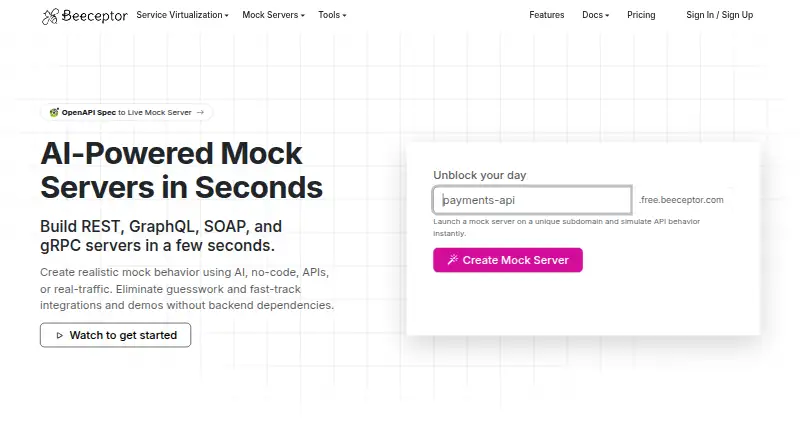
What Beeceptor is
Beeceptor is a developer-focused API simulation platform for creating mocks, virtualizing services, testing contracts, and simulating failures. It supports HTTP, HTTPS, HTTP/2, mTLS, REST/OpenAPI, SOAP, GraphQL, and gRPC. Users can build no-code mocks with request-matching rules and customize response status codes, headers, and bodies. An uploaded OpenAPI specification can generate a populated mock server with AI-generated data. Beeceptor can also proxy requests to live backends, record traffic, and switch to mocks if a backend is unavailable. Latency, timeouts, and errors can be simulated to check client resilience. Its CLI exposes a localhost service through a public HTTPS URL on Windows, macOS, and Linux. Management APIs support programmatic setup, and MCP connectivity supports AI agents including Claude and Cursor. Beeceptor offers a free plan with 50 requests per day per endpoint and three mock rules; paid plans start at $10 a month. Free endpoints are public by default, and unclaimed endpoints are removed after 30 days. The company says it is SOC 2 Type II audited, adheres to ISO 27001, and complies with GDPR.
Who it suits
Beeceptor is suited to developers, testers, and QA professionals building or testing API integrations, CI pipelines, and demos. It may fit teams that need mocks, service virtualization, contract testing, or controlled failure simulation.
What it does well
- Supports HTTP, REST/OpenAPI, GraphQL, and gRPC
- Can generate mocks from OpenAPI specifications
- Can proxy and record live backend traffic
- Paid plans include chat and email support
What to know first
- Free endpoints are public by default
- Free plan allows 50 requests per day per endpoint
- Unclaimed endpoints are removed after 30 days
- Free request payloads are limited to 1 MB
Limits
The free plan allows 50 requests per day per endpoint, three mock rules, public endpoints, and 10 small CRUD objects. It has a 1 MB maximum request payload; unclaimed endpoints are cleaned up after 30 days, while claimed endpoints are retained for 90 days.
Plans
| Plan | Billed and limits | Price |
|---|---|---|
| Free | monthly · 50 requests/day per endpoint · 3 mock rules · public endpoint · 10 CRUD objects · ephemeral local tunnel | Free |
| Individual | monthly · 15,000 requests/month per endpoint · up to 50 mock rules · private endpoint · 100 CRUD objects · persistent local tunnel | $10 a month |
| Team | monthly · 100,000 requests/month per endpoint · up to 250 mock rules · private endpoint · 500 CRUD objects · historical traffic inspection · persistent local tunnel | $25 a month |
| Scale | monthly · 1M+ requests/month per endpoint · up to 500 mock rules · private endpoint · 5,000 CRUD objects · historical traffic inspection · persistent local tunnel | $99 a month |
| Enterprise | contact vendor · private-cloud or VPC deployment · unlimited usage · unlimited team access · SAML SSO · observability and logging · IP whitelisting · dedicated support | On request |
As beeceptor.com lists them, read 14 Oct 2026. The maker's own page has the final word.
Getting started
- Open the Beeceptor website and choose the free plan or a paid plan.
- Use the 10-day trial if you want a time-limited start.
- Create a mock with request matching rules and configure its response, or upload an OpenAPI specification to populate a mock server.
- For a local service, use the CLI to expose it through a public HTTPS URL; the CLI is available for Windows, macOS, and Linux.
- Configure mock servers programmatically with the management APIs, or connect an AI agent through MCP.
Overview
Beeceptor is an API simulation platform for building mocks, virtualizing services, and testing failure behavior. It is best suited to developers, testers, and QA teams who need controlled endpoints for development, integrations, CI pipelines, or customer demos. Its mix of mock rules, proxying, and traffic recording covers more than static fixtures, but public-by-default free endpoints make that tier unsuitable for sensitive traffic.
Key features
No-code request matching lets users define response status codes, headers, and bodies. That is a practical way to shape test responses without building a separate mock service; the Free plan’s three-rule limit, however, is likely to constrain anything beyond a small set of cases. OpenAPI uploads can generate a populated mock server with AI-generated data, reducing the setup needed to create a usable starting point from a specification.
Protocol coverage includes HTTP, HTTPS, HTTP/2, mTLS, REST/OpenAPI, SOAP, GraphQL, and gRPC. This makes Beeceptor a credible fit for teams testing across different API styles, rather than only REST endpoints. Proxying to live backends, recording traffic, and switching to mock behavior when a backend is unavailable help bridge integration work and deterministic testing. Latency, timeouts, and errors can also be simulated, which is useful when the important question is how a client behaves under failure rather than whether a successful response works.
The CLI exposes a localhost service through a public HTTPS URL and runs on Windows, macOS, and Linux. Management APIs allow mock servers to be configured and operated programmatically, while MCP connectivity supports AI agents including Claude and Cursor. API Connections store OAuth credentials and generate tokens for outbound requests through callout or proxy rules, a useful option when mocks need to interact with authenticated external APIs.
Beeceptor states that it is SOC 2 Type II audited, adheres to ISO 27001, and is GDPR compliant, with data encrypted in transit and at rest. Request payloads are retained for 15 days before permanent purging; metadata-only application logs remain for 90 days. Those retention periods matter when teams need to inspect past requests or manage test data.
Pricing
The Free plan has 50 requests per day per endpoint, three mock rules, public endpoints, 10 small CRUD objects, and an ephemeral local tunnel. Unclaimed endpoints are cleaned up after 30 days, while claimed endpoints are retained for 90 days. These caps make Free most appropriate for trying the workflow or maintaining a small public demo, not for private use or sustained traffic.
Individual costs $10 a month and includes 15,000 requests per month per endpoint, up to 50 mock rules, private endpoints, 100 CRUD objects, a persistent local tunnel, and chat and email support. It is the natural step up for an individual or small project that needs privacy and regular use. Team costs $25 a month, raising the allowance to 100,000 requests per month per endpoint and 250 rules, with live and historical traffic inspection, 500 CRUD objects, a persistent tunnel, and chat and email support. That added inspection and capacity better suits collaborative integration work. Scale costs $99 a month and includes 1M+ requests per month per endpoint, up to 500 rules, private endpoints, live and historical traffic inspection, 5,000 CRUD objects, a persistent tunnel, and chat and priority email support. It is the tier for heavier endpoint traffic and larger mock libraries; teams that do not need its substantially higher limits may be better served by Team. Paid Individual and Team plans include chat and email support, while Scale upgrades email to priority.
Beeceptor offers a 10-day trial. The pricing model is freemium, with paid plans starting at $10 a month.
Platforms
Beeceptor supports API, web, Windows, macOS, Linux, and self-hosted environments. The local tunnel CLI is available for Windows, macOS, and Linux, giving developers a way to expose a local service through HTTPS during development or demos.
Who it's for
Beeceptor is a strong fit for developers and QA professionals who need configurable API responses, contract testing, service virtualization, or controlled failure scenarios across multiple protocols. Teams that benefit from recorded live traffic and mock fallback can use it for integration work as well as client resilience testing. It is less suitable for anyone who requires private endpoints without a paid plan, or whose use exceeds the Free plan’s daily request and rule ceilings.
Pros and cons
- Broad API coverage: support for REST/OpenAPI, SOAP, GraphQL, gRPC, and multiple HTTP variants serves teams with mixed interfaces.
- Useful beyond basic mocks: proxying, traffic recording, fallback behavior, and failure simulation support integration and resilience testing.
- Free tier has meaningful restrictions: endpoints are public by default, with only 50 requests per day per endpoint and three rules.
- Retention is bounded: payloads are purged after 15 days, so teams needing longer access to request bodies must account for that lifecycle.
Alternatives
For a broader service-virtualization category, compare Service Virtualization Software; for integration-focused testing, see Integration Testing Tools. The API Mocking Tools list is a useful comparison point for teams focused primarily on mocks.
Choose Microcks if a free, 100% open-source, community-driven CNCF Incubating project is the priority. LocalStack is the better fit when AWS service emulation is the goal: its Hobby plan includes 30+ emulated services and one personal sandbox, with non-commercial use. MockServer is a free, open-source option for self-hosted use without a SaaS account. For local Azure Storage emulation, choose Azurite; for local DynamoDB development and testing, choose DynamoDB Local, which is not intended for production. Tricentis Testim suits teams looking for mobile and web testing, with a free tier of up to 1,000 runs per month and customized paid plans. Amazon RDS is a database service rather than an API mock platform. mountebank is another free, open-source service-virtualization option.
Verdict
Choose Beeceptor if your team needs configurable mocks plus proxying, traffic capture, and failure simulation across several API protocols. Its central advantage is covering both ordinary mock responses and less predictable integration conditions in one platform. Look elsewhere if private endpoints are essential at no cost, if you need longer request-payload retention, or if your use case is a narrower local emulator such as Azure Storage or DynamoDB.
Verdict
Beeceptor combines configurable mocks with proxying, traffic recording, and failure simulation across a wide range of API protocols. The free plan has public endpoints and usage limits; paid plans start at $10 a month.
Questions
How much does Beeceptor cost?
Beeceptor has a free plan, paid plans starting at $10/mo, and a 10-day trial. The Individual plan is $10.00 per month, Team is $25.00 per month, and Scale is $99.00 per month.
What does the free plan include?
It includes 50 requests per day per endpoint, three mock rules, public endpoints, 10 small CRUD objects, and an ephemeral local tunnel. Unclaimed endpoints are cleaned up after 30 days; claimed endpoints are retained for 90 days.
Which protocols does Beeceptor support?
It supports HTTP, HTTPS, HTTP/2, mTLS, REST/OpenAPI, SOAP, GraphQL, and gRPC.
Can Beeceptor run locally?
The listed deployment model includes both options, and the platform lists self-hosted use. Its CLI can expose a localhost service through a public HTTPS URL and is available for Windows, macOS, and Linux.
Does Beeceptor integrate with AI agents?
Yes. Beeceptor provides MCP connectivity for AI agents including Claude and Cursor.
What security and compliance does Beeceptor state?
Beeceptor says it is SOC 2 Type II audited, adheres to ISO 27001, and is GDPR compliant. It says data is encrypted in transit and at rest.
Facts from Beeceptor's own pages
- API and AI integrations
- Beeceptor provides management APIs for programmatically configuring and operating mock servers, and MCP connectivity for AI agents including Claude and Cursor. · beeceptor.com, 7 Oct 2026
- CLI platforms
- The local-tunnel CLI documentation lists Windows, macOS and Linux support, with macOS ARM64 and x64 binaries. · beeceptor.com, 14 Oct 2026
- Company facts
- Crunchbase lists Beeceptor as a private, for-profit software company in Hyderabad, India, with founders Ankit Jain and Arti Bandi and 1–10 employees. · crunchbase.com, 14 Oct 2026
- CRUD APIs
- CRUD routes automatically expose create, read, update and delete REST operations over endpoint-scoped JSON data. · beeceptor.com, 14 Oct 2026
- Documentation depth
- The documentation site includes quickstarts, protocol guides, API reference, CI/CD guidance, security, governance and troubleshooting material. · beeceptor.com, 14 Oct 2026
- Dynamic responses
- Mock rules can generate predefined or dynamically templated responses and apply latency, failure and chaos behavior. · beeceptor.com, 14 Oct 2026
- External API authentication
- API Connections store OAuth credentials and automatically generate tokens for outbound requests through callout or proxy rules. · beeceptor.com, 7 Oct 2026
- Founded
- G2’s company profile states that Beeceptor was founded in 2017 and is headquartered in Hyderabad, Telangana. · g2.com, 14 Oct 2026
- Free endpoint exposure
- Free endpoints are public by default, and anyone with the dashboard URL can view and inspect their traffic. · beeceptor.com, 14 Oct 2026
- Free plan limits
- Free endpoints are public by default, have a maximum request payload size of 1 MB, and unclaimed endpoints are removed after 30 days. · beeceptor.com, 7 Oct 2026
- Headquarters
- Hyderabad, India · beeceptor.com, 23 Sept 2026
- Intended users
- Beeceptor describes its audience as developers, testers, and QA professionals using API mocks for development, testing, integrations, CI pipelines, and customer demos. · beeceptor.com, 7 Oct 2026
- Limit: complexity and retention
- G2 reviewers mention complex manual rule setup, short retention periods, limited advanced simulation controls and a basic management-API documentation experience. · g2.com, 14 Oct 2026
- Limit: CRUD behavior
- Beeceptor warns that CRUD routes provide storage without business logic and can automatically purge the oldest records after plan limits are exceeded. · beeceptor.com, 14 Oct 2026
- Limit: free tier
- A Gartner review headline describes the free tier as limiting, while another criticizes prominent banners that make configuration harder to find. · gartner.com, 14 Oct 2026
- Limit: free usage
- The free tier is capped at 50 requests per day per endpoint and unclaimed endpoints are automatically removed after the stated retention period. · app.beeceptor.com, 14 Oct 2026
- Limit: missing features
- G2’s pros-and-cons summary reports missing query-string handling, limited Faker options and absent file-upload support in some scenarios. · g2.com, 14 Oct 2026
- Local tunnel
- Its CLI exposes a localhost service through a public HTTPS URL and is available for Windows, macOS, and Linux. · beeceptor.com, 7 Oct 2026
- Local tunneling
- Its CLI publishes localhost services through a Beeceptor endpoint and is distributed through npm or standalone binaries. · beeceptor.com, 14 Oct 2026
- Management API
- Beeceptor documents a version 2.0.0 management API with an OpenAPI specification, API-key authentication and endpoints for configuring and inspecting mock servers. · beeceptor.com, 14 Oct 2026
- MCP extensibility
- The documentation provides an MCP endpoint for connecting coding agents such as Codex or Claude to create and manage virtual APIs. · beeceptor.com, 14 Oct 2026
- Mocking
- Users can create no-code mocks with request matching rules and customize response status codes, headers, and bodies. · beeceptor.com, 7 Oct 2026
- Mocking protocols
- The management API documentation lists HTTP/REST, SOAP, gRPC and GraphQL mocking support. · beeceptor.com, 14 Oct 2026
- Notable news: snapshots
- On August 7, 2026 Beeceptor announced configuration snapshots for restoring and switching mock-server setups. · beeceptor.com, 14 Oct 2026
Where Beeceptor stands on Freedom251
- API Mocking Tools#2 of 26
- Service Virtualization Software#3 of 21
- Integration Testing Tools#4 of 26
- API Development Tools#6 of 32