Freedom251 › Service Virtualization Software
mountebank
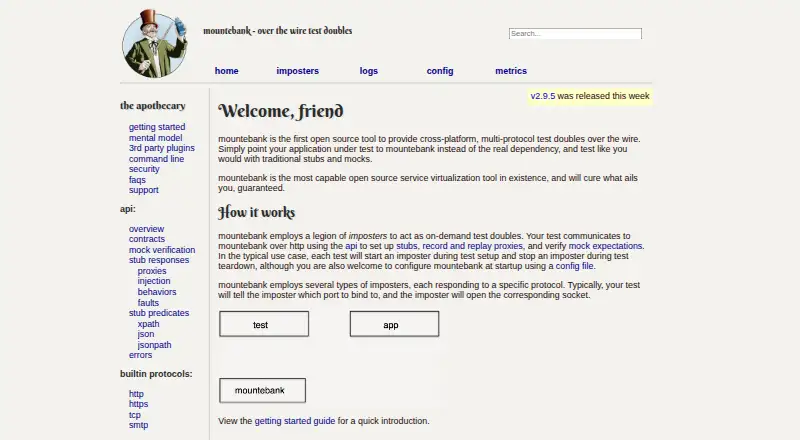
What mountebank is
mountebank is a free, self-hosted tool for developers who need test doubles in place of real application dependencies. It provides cross-platform, multi-protocol doubles over the wire. Tests use its HTTP API to set up stubs, record and replay proxies, and check mock expectations. HTTP, HTTPS, TCP and SMTP are built in. Community plugins add LDAP, WebSockets, GraphQL, SNMP, Telnet, SSH and NETCONF. Installation options documented by the project include npm and a Docker image. Community extensions include client libraries for C#, Clojure, Go, Java, JavaScript, Python, Ruby, TypeScript and Swift, as well as build tool plugins for Grunt, Gradle and Maven. By default, mountebank stores everything in memory, which the site says can become a performance bottleneck at scale. Its security guidance warns that enabling JavaScript injection can allow attackers to run code on the machine, and recommends protections such as localhost-only access or an IP whitelist. CORS is disabled by default, with safe origins available through a command-line flag. Help is directed to a Google group.
Who it suits
mountebank suits developers who want to test applications against on-demand doubles rather than real dependencies. Its API, protocol support and client libraries can fit different development languages and build tools.
What it does well
- Free, open-source service virtualization
- Built-in HTTP, HTTPS, TCP and SMTP protocols
- Supports proxy recording and replay
- Client libraries span multiple programming languages
- Includes Grunt, Gradle and Maven plugins
What to know first
- Stores everything in memory by default
- Memory use can bottleneck at scale
- JavaScript injection can enable code execution
- CORS is disabled by default
Limits
The Free plan costs nothing and is described as open source service virtualization. By default, data is stored in memory, which can become a performance bottleneck at scale.
Plans
| Plan | Billed and limits | Price |
|---|---|---|
| Free | Open source service virtualization · No platform constraints stated | Free |
As mbtest.dev lists them, read 4 Oct 2026. The maker's own page has the final word.
Getting started
- Install mountebank through npm or run its Docker image.
- Use the HTTP API to set up stubs, record and replay proxies, and verify mock expectations.
- Use a client library or build tool plugin if one fits your language or build setup.
- Restrict access with localhost-only access or an IP whitelist if enabling JavaScript injection.
- Optionally configure an API key and send a matching x-api-key header with API requests.
Verdict
mountebank offers protocol-based test doubles with a broad set of community extensions. Review the memory and injection warnings when planning deployment and configuration.
Questions
How much does mountebank cost?
The Free plan costs nothing. The pricing model is free.
Is there a free trial?
No. The listed free trial is no, and a Free plan is available.
Where does mountebank run?
Its listed platforms are API, Linux, and self-hosted. Installation options include npm and a Docker image.
Which protocols does it support?
Built-in protocols are HTTP, HTTPS, TCP, and SMTP. Community plugins include LDAP, WebSockets, GraphQL, SNMP, Telnet, SSH, and NETCONF.
Is mountebank open source?
The Free plan is described as open source service virtualization.
How can users get help?
The support page directs users to a Google group.
Facts from mountebank's own pages
- API key option
- The command-line documentation describes an optional API key that requires a matching x-api-key header for API requests. · mbtest.dev, 4 Oct 2026
- Audience
- The site describes mountebank as a platform for developers to test applications against on-demand test doubles instead of real dependencies. · mbtest.dev, 4 Oct 2026
- Build integrations
- Listed build tool plugins include Grunt, Gradle, and Maven. · mbtest.dev, 4 Oct 2026
- Built-in protocols
- The site lists HTTP, HTTPS, TCP, and SMTP as built-in protocols. · mbtest.dev, 4 Oct 2026
- Client libraries
- The community extensions page lists client libraries for languages including C#, Clojure, Go, Java, JavaScript, Python, Ruby, TypeScript, and Swift. · mbtest.dev, 4 Oct 2026
- Community protocols
- The site lists LDAP, WebSockets, GraphQL, SNMP, Telnet, SSH, and NETCONF as community plugins. · mbtest.dev, 4 Oct 2026
- CORS
- CORS is disabled by default to prevent CSRF attacks, and safe origins can be explicitly enabled with a command-line flag. · mbtest.dev, 4 Oct 2026
- Installation
- The getting started guide documents installation through npm or running a Docker image. · mbtest.dev, 4 Oct 2026
- Persistence limit
- By default, mountebank stores everything in memory; the page says this can become a performance bottleneck at scale. · mbtest.dev, 4 Oct 2026
- Purpose
- mountebank provides cross-platform, multi-protocol test doubles over the wire for testing applications in place of real dependencies. · mbtest.dev, 4 Oct 2026
- Security
- The security page warns that enabling JavaScript injection can allow attackers to run code on the machine and recommends protections such as localhost-only access or an IP whitelist. · mbtest.dev, 4 Oct 2026
- Support
- The support page directs users to a Google group for help. · mbtest.dev, 4 Oct 2026
- Testing workflow
- Tests use its HTTP API to set up stubs, record and replay proxies, and verify mock expectations. · mbtest.dev, 4 Oct 2026
Where mountebank stands on Freedom251
- Service Virtualization Software#9 of 21