Freedom251 › API Mocking Tools
Mockfly
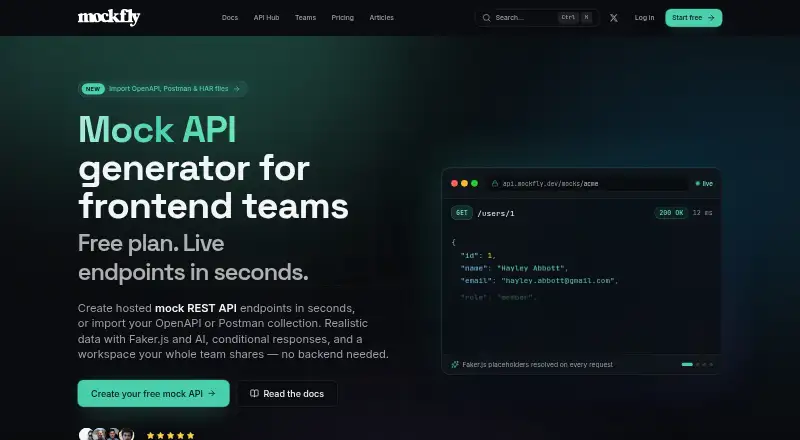
What Mockfly is
Mockfly creates hosted mock REST API endpoints for teams building and testing before a backend is ready. Endpoints can return JSON, XML, or files such as PDFs and CSVs, with multiple responses selected by rules applied to incoming requests. Mock data can use Faker.js templates or AI-generated JSON. Projects can start from OpenAPI, Swagger, Postman collection, or HAR imports, and the Chrome extension can capture browser requests and add selected endpoints. Teams can share and edit mocks, inspect request logs, and review response-body history. For offline work, the mockfly-cli npm package can pull projects and serve them locally without an internet connection. A public REST API and MCP server support programmatic mock creation and editing. Mockfly is available through web, API, Linux, an extension, and self-hosting, and supports REST and WebSocket. The free Starter plan allows 500 requests per day, one project, four endpoints, and two responses per endpoint; paid plans start at €15/mo.
Who it suits
Mockfly suits frontend, backend, mobile, QA, and testing engineers who need shared mock APIs. Its local serving and programmatic tools may also suit teams working offline or automating mock setup.
What it does well
- Supports conditional responses for each endpoint.
- Returns JSON, XML, PDF, and CSV files.
- Imports OpenAPI, Swagger, Postman, and HAR.
- Projects can be served locally offline.
- Teams can inspect request logs and response history.
What to know first
- Starter is limited to 500 requests per day.
- Starter includes one project and four endpoints.
- Starter allows two responses per endpoint.
Limits
Starter costs nothing and allows 500 requests per day, one project, four endpoints, and two responses per endpoint. Pro costs €15 a month and includes unlimited requests, projects, endpoints, and responses per endpoint.
Plans
| Plan | Billed and limits | Price |
|---|---|---|
| Starter | 0€ per month · 500 requests/day · 1 project · 4 endpoints · 2 responses per endpoint | Free |
| Pro | 15€ per month · Unlimited requests · projects · endpoints · responses · AI JSON generation · AI endpoint descriptions · custom domain · callbacks | €15 a month |
| Pro annual | 150€ per year · Same Pro features and limits | €150 a year |
| Company | From 199€ per month · Everything in Team · OpenAPI/Postman setup · centralized billing · custom seats/integrations/SLA · direct builder contact | €199 |
| Team | 49€ per month for 5 seats · Everything in Pro · 5 seats · 9€ per extra seat · free-account collaborators · one invoice · priority support | €49 a month |
As mockfly.dev lists them, read 15 Oct 2026. The maker's own page has the final word.
Getting started
- Visit https://mockfly.dev/.
- Choose the Starter plan or a paid plan.
- Create a project and import an OpenAPI, Swagger, Postman, or HAR file if useful.
- Add endpoints and configure their responses and conditional rules.
- Use the Chrome extension to capture browser requests, or use mockfly-cli to serve a project locally.
Mockfly is a hosted mock-API workspace for engineers who need shared endpoints before production services exist. It fits teams that want imports, conditional behavior, automation and local offline serving in one workflow. The main trade-off is capacity: the free tier is suitable for a small proof of concept, while sustained team use requires a paid plan.
Overview
Mockfly creates mock REST endpoints with several possible responses. Conditional rules select a response from the incoming request, allowing one endpoint to represent success, error and state-specific paths instead of returning a single fixture. Responses can be JSON, XML, or files such as PDF and CSV, so it can model clients that consume more than JSON.
Faker.js templates and AI-generated JSON produce sample payloads without hand-authoring every value. OpenAPI, Swagger, Postman collections and HAR captures can be imported, reducing setup when an interface already exists. The Chrome extension captures browser requests and adds chosen endpoints to a project, useful when a real user flow is the starting point.
Key features
Teams can share and edit mocks, inspect request logs and review response-body history. That makes the service a shared testing asset rather than a disposable local stub. A public REST API and MCP server let automation create and modify mocks programmatically, which suits CI or internal tooling workflows.
The mockfly-cli npm package pulls projects and serves them locally without an internet connection. This provides an offline path for development and testing, while the hosted service remains the collaboration hub. Mockfly supports REST and WebSocket protocols. Its stated data practice is to store mock definitions and project request logs to operate the service, not sell that data, and it says it does not set tracking cookies. Direct support is offered by email in English or Spanish.
Pricing
Starter — free (billed 0€ per month) is a constrained evaluation tier: 500 requests per day, one project, four endpoints and two responses per endpoint. Those ceilings can work for a demo or a single small feature, but they leave little room for several concurrent client flows.
Pro — €15 a month (billed 15€ per month) removes request, project, endpoint and per-endpoint response limits. It adds a custom domain, AI generation and support, making it the practical baseline for an individual or small project that has outgrown Starter.
Team — €49 a month (billed 49€ per month) includes everything in Pro, five seats and priority support. Extra seats cost 9€ a month each. This is the clearest fit for a small group that needs shared editing and defined user access.
Company — from €199 a month (billed From 199€ per month) includes Team features plus setup assistance and custom seats, integrations and SLA. It is aimed at organizations needing a tailored commercial arrangement rather than a fixed self-serve package.
Platforms
Mockfly is offered through web, API and extension interfaces, with Linux and self-hosted options. The CLI enables local serving without an internet connection, while hosted projects support browser-based collaboration.
Who it's for
Frontend, backend, mobile, QA and testing engineers can use Mockfly to unblock client work before a backend is ready. It is especially appropriate for teams importing existing API descriptions, modeling request-dependent behavior, or keeping mocks synchronized through scripts and MCP tooling. A solo developer with only a few endpoints may find Starter adequate; larger shared projects will quickly need Pro or Team. If your priority is a permanently local, open-source mock server with no hosted workspace, Mockfly is less aligned with that requirement.
Pros and cons
Pros
- Conditional multi-response endpoints model varied request states and error paths.
- OpenAPI, Swagger, Postman and HAR imports shorten migration from existing definitions.
- JSON, XML, PDF and CSV responses cover more client scenarios than JSON-only fixtures.
- CLI-based offline serving, REST API and MCP support both local work and automation.
- Shared editing, logs and response history support team review.
Cons
- Starter is limited to 500 requests per day, one project, four endpoints and two responses per endpoint.
- Team collaboration costs €49 per month for five seats before extra-seat charges.
- Hosted operation requires storing mock definitions and request logs with the service.
Alternatives
Browse the broader API Mocking Tools list when you want to compare the category. Choose Microcks instead if a 100% open-source, community-driven CNCF Incubating project and broad self-hosted platform coverage matter most.
Mockzilla is a better fit when a low-cost plan with 1,000 requests per month, 5 requests per second and one simulation matches your workload. Beeceptor suits users seeking a $10-per-month Individual plan with 15,000 requests per month per endpoint, private endpoints and persistent CRUD objects.
Pick MockServer for a free, self-hosted open-source server with no SaaS account. Mockttp is aimed at traffic viewing, rewriting, manual breakpoints and a built-in HTTP client. WireMock offers a free tier with 1,000 calls per month, three mock APIs and 10 requests per second.
Knockout API is an option for image-oriented usage with a free 30-images-per-month plan. MockAPI costs $5 per month for 20 projects and 50 resources, making it preferable when simple project/resource quotas are the deciding factor.
Verdict
Choose Mockfly if you need shared, importable mocks with conditional responses, automation hooks and an offline local fallback. Its strongest advantage is the breadth of one workflow, from browser capture and API imports to team history and scripted editing. Look elsewhere if you require an entirely open-source self-hosted product or if the Starter limits cannot accommodate your request volume and endpoint count.
Verdict
Mockfly combines hosted and local mock API workflows with imports, conditional responses, and team tools. The free Starter plan has defined request and project limits, while paid plans start at €15/mo.
Questions
Is Mockfly free?
Yes. Starter costs nothing, with 500 requests per day, one project, four endpoints, and two responses per endpoint.
What do the paid plans cost?
Pro is €15 a month. Team is €49 a month with five seats included, and Company starts at €199 a month.
Which response formats does Mockfly support?
Endpoints can return JSON, XML, or files such as PDF and CSV.
Can it import API definitions or captures?
Yes. Mockfly can import OpenAPI, Swagger, Postman collections, and HAR captures.
Can I use Mockfly offline?
Yes. The mockfly-cli npm package can pull projects and serve them locally without an internet connection.
Which platforms does Mockfly support?
It supports API, extension, Linux, self-hosting, and web.
Facts from Mockfly's own pages
- AI generation
- Natural-language descriptions can generate JSON response structures and endpoint descriptions. · mockfly.dev, 15 Oct 2026
- API specification
- The public API has a machine-readable OpenAPI 3.1 specification and a Postman collection. · mockfly.dev, 15 Oct 2026
- Automatic documentation
- Mockfly generates documentation from defined endpoints and keeps it available for sharing. · mockfly.dev, 15 Oct 2026
- Automation
- A public REST API and an MCP server can be used to create and edit mocks programmatically. · mockfly.dev, 29 Sept 2026
- Callbacks
- Paid plans can send delayed outgoing webhooks with retries, headers, bodies and optional HMAC-SHA256 signatures. · mockfly.dev, 15 Oct 2026
- Chrome extension
- The extension captures browser requests and lets users add selected requests to a Mockfly project. · chromewebstore.google.com, 15 Oct 2026
- Company location
- The site footer identifies Madrid as Mockfly's location. · mockfly.dev, 15 Oct 2026
- Company origin
- Mockfly says it was started in 2023 by Sergio Zamarro and is self-funded by a small independent developer team. · mockfly.dev, 15 Oct 2026
- Conditional responses
- Rules select responses using request parameters, headers or body content. · mockfly.dev, 15 Oct 2026
- Custom domains
- Paid plans can serve mocks on a customer hostname with Mockfly-managed TLS certificates. · mockfly.dev, 15 Oct 2026
- Data formats
- Endpoints can return JSON, XML, or files such as PDF and CSV. · mockfly.dev, 29 Sept 2026
- Data generation
- Mockfly supports Faker.js templates and AI-generated JSON payloads. · mockfly.dev, 29 Sept 2026
- Data handling
- The company says it stores mock definitions and project request logs only to run the service, does not sell them and does not set tracking cookies. · mockfly.dev, 15 Oct 2026
- Dynamic routes
- Path parameters such as /users/:id are supported. · mockfly.dev, 15 Oct 2026
- Endpoint creation
- Users define paths, HTTP methods, status codes, headers and response bodies in a browser without installing software. · mockfly.dev, 15 Oct 2026
- Extension privacy
- The Chrome listing says the developer does not collect or use user data and does not sell it. · chromewebstore.google.com, 15 Oct 2026
- Faker.js integration
- Faker.js placeholders generate changing realistic names, emails, addresses and other data on requests. · mockfly.dev, 15 Oct 2026
- Founded
- 2023 · mockfly.dev, 28 Sept 2026
- Imports
- OpenAPI, Swagger, Postman and HAR captures can be imported into editable projects. · mockfly.dev, 15 Oct 2026
- Integrations
- The Chrome extension captures browser requests and adds selected endpoints to a Mockfly project. · mockfly.dev, 29 Sept 2026
- Intended users
- Mockfly describes its users as frontend, backend, mobile, QA, and testing engineers who need shared mock APIs. · mockfly.dev, 29 Sept 2026
- Limit: AI accuracy
- A G2 reviewer says AI responses are not always fully accurate and need adjustment. · g2.com, 15 Oct 2026
- Limit: desktop app
- A G2 reviewer notes that Mockfly has no desktop version. · g2.com, 15 Oct 2026
- Limit: manual synchronization
- G2 reviewers say changes in the real API must be copied into Mockfly manually. · g2.com, 15 Oct 2026
Where Mockfly stands on Freedom251
- API Mocking Tools#4 of 26