Freedom251 › Business Process Management Software

jBPM
What jBPM is
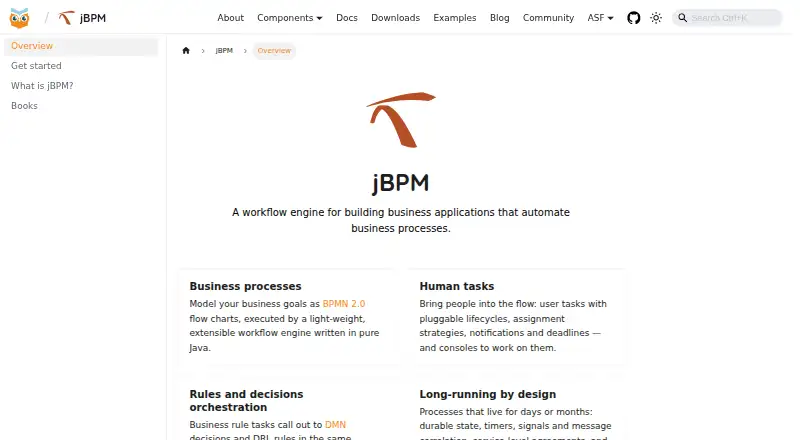
jBPM is an open-source Java toolkit for automating business processes, tasks, decisions, and rules. It runs as Java libraries embedded in a service rather than as a standalone server, and executes processes modeled with BPMN 2.0. Human tasks support configurable lifecycles, assignment strategies, and deadlines; process rule tasks can invoke DRL rules or DMN decisions evaluated by Drools in the same service. For long-running work, jBPM supports durable process state, timers, signals, message correlation, service-level agreement tracking, and migration of running instances to a newer process version. Persistence options include PostgreSQL and other JDBC databases, MongoDB, Infinispan, RocksDB, and the filesystem. Web and IDE modelers provide graphical drag-and-drop process creation. For Apache KIE 10, the documented approach is to build a service with Kogito on Quarkus or Spring Boot; BPMN models are compiled at build time, with no runtime deployment step or process repository to manage. The project is licensed under Apache License 2.0 and runs on any JVM.
Who it suits
jBPM suits Java developers building business automation into a service, especially when processes include human tasks, decisions, or long-running state. It may also suit teams seeking an open-source, self-hosted workflow engine.
What it does well
- Executes BPMN 2.0 business processes.
- Supports human tasks, decisions, and business rules.
- Provides durable state, timers, signals, and process migration.
- Offers several persistence options.
- Released under Apache License 2.0.
What to know first
- It is a set of embedded Java libraries, not a standalone server.
- Getting started lists an IDE, JDK 21 preferred or JDK 17, and Maven 3.9 or later.
- Apache KIE is in incubation and has not been fully endorsed by the ASF.
Plans
| Plan | Billed and limits | Price |
|---|---|---|
| Apache KIE (jBPM) | Open-source Java workflow engine; Apache License 2.0 | Free |
As kie.apache.org lists them, read 9 Oct 2026. The maker's own page has the final word.
Getting started
- Visit https://kie.apache.org/jbpm/.
- Prepare an IDE, JDK 21 preferred or JDK 17, and Maven 3.9 or later.
- Use the documented Apache KIE 10 service approach with Kogito on Quarkus or Spring Boot.
- Create a BPMN 2.0 process with a web-based or IDE-based modeler.
- Build the service so BPMN models are compiled at build time.
jBPM is an open-source Java toolkit for embedding business-process automation inside application services. It is best suited to Java teams that need BPMN workflows, human tasks, rules and decisions in one codebase. Choose it when an embedded, self-hosted engine fits your architecture; look elsewhere if you want a ready-made workflow server.
Overview
jBPM runs as Java libraries inside your service rather than as a separate server. That design keeps process execution close to application code and avoids managing a runtime process repository, but your team must operate the surrounding service and its infrastructure. BPMN 2.0 models are compiled at build time, so production does not require a separate process deployment step.
The project is pure Java, runs on any JVM and is published through Maven Central. It is released under the Apache License 2.0. Apache KIE is currently incubating at the Apache Software Foundation and has not received full ASF endorsement, a status worth weighing for organisations with strict platform-governance requirements.
Key features
A visual workflow builder and IDE-based modelers provide graphical drag-and-drop BPMN creation. The engine includes event triggers, automatic retries and execution observability, giving teams building blocks for event-driven services and operational monitoring.
Human tasks have pluggable lifecycles, assignment strategies and deadlines. This suits approval and case-style processes where work moves between people under explicit timing rules, while the configurable model leaves implementation and user-interface decisions to the service team.
Rule tasks can call DRL rules or DMN decisions evaluated by Drools in the same service. Keeping process flow and decision logic together can reduce integration boundaries for Java applications that already use those rule formats.
Long-running workflows retain durable state and support timers, signals, message correlation, service-level agreement tracking and migration of running instances to a new process version. These features fit processes that span days or longer, but they make persistence, upgrades and operational ownership important design work.
Persistence is pluggable across PostgreSQL and other JDBC databases, MongoDB, Infinispan, RocksDB and the filesystem. The choice supports varied deployment environments, though selecting, securing and operating the store remains your responsibility.
For Apache KIE 10, the documented service approach is Kogito on Quarkus or Spring Boot. Getting started calls for an IDE, JDK 21 (with JDK 17 also listed) and Maven 3.9 or later.
Pricing
Apache KIE (jBPM): free. This is open-source Java workflow software under the Apache License 2.0, with no seat, usage or trial terms stated. It is the clear fit for teams able to fund their own development, hosting and support; the trade-off is that operating the embedded service is part of the job rather than a paid vendor service.
Platforms
jBPM is offered for API, extension, Linux, macOS, Windows, web and self-hosted use. Its JVM-based implementation broadens where the engine can run, while the self-hosted deployment model means infrastructure, persistence and upgrades stay with the adopting team.
Who it's for
Java developers building business automation into services are the natural audience, especially teams combining BPMN 2.0 flows with human work, Drools rules and DMN decisions. It also fits organisations needing durable, long-running processes and control over persistence choices.
It is a weaker match for buyers seeking a standalone workflow server, vendor-managed hosting or a visual tool that operates without Java engineering and service ownership.
Pros and cons
Pros
- Open-source Apache 2.0 licensing: teams can adopt the engine without a software subscription.
- Embedded Java architecture: process execution can live inside an existing service instead of requiring a separate server.
- Broad workflow depth: durable state, timers, correlation, SLA tracking and instance migration address long-running operations.
- Integrated decisions and human work: DRL, DMN, configurable human-task lifecycles and assignment strategies cover mixed automation.
- Pluggable persistence: multiple database and storage options accommodate different self-hosted architectures.
Cons
- Operational ownership: self-hosting an embedded library leaves runtime, storage and service reliability to your team.
- Java-centric setup: an IDE, JDK and Maven are prerequisites, limiting suitability for non-Java delivery teams.
- Incubation status: Apache KIE has not yet been fully endorsed by the ASF, which may matter to risk-sensitive adopters.
- No separate process repository: build-time compilation is efficient, but teams wanting runtime model deployment must use a different approach.
Alternatives
Consider Kestra if you want an Apache 2.0 workflow platform with free availability across API, desktop, web and self-hosted environments.
Workflow Engine is a freemium option whose free perpetual plan allows 10 schemas and four execution threads for personal use.
Choose Argo Workflows for an open-source workflow engine designed for Kubernetes.
Bonita offers a free plan capped at 150 process instances per month, with no time limit and no credit card requirement.
Camunda provides a free self-managed development plan for local development and testing.
Apache Airflow is a free Apache-licensed choice for teams wanting its workflow platform across API, Linux, macOS, self-hosted and web environments.
Bizagi Modeler suits users who need a web and Windows modeler; its free plan supports one user with unlimited processes and models stored locally.
Hatchet is a freemium API, Linux, self-hosted and web option with 1 million runs and 1 million events per month free on its pay-as-you-go plan.
Browse Workflow Orchestration Software and Business Process Management Software for wider category choices.
Verdict
jBPM is a strong choice for Java teams that want BPMN workflows, human tasks and Drools-powered decisions embedded in a self-hosted service, with unusually capable support for long-running process state. Choose another product if you need managed hosting, runtime process administration or a project with a fully established Apache status.
Verdict
jBPM provides process, task, and decision capabilities for Java services, including support for long-running workflows. Teams should plan for an embedded-library deployment and note the project’s incubation status.
Questions
How much does jBPM cost?
jBPM is free and open source under the Apache License 2.0.
Is jBPM a standalone server?
No. It is a set of Java libraries embedded in a service.
What process standard does it use?
The engine executes business processes modeled with BPMN 2.0.
Which persistence options are listed?
Options include PostgreSQL and other JDBC databases, MongoDB, Infinispan, RocksDB, and the filesystem.
What is the documented service approach for Apache KIE 10?
The documented approach uses Kogito on Quarkus or Spring Boot. BPMN models are compiled at build time, without a runtime deployment step or process repository to manage.
Where can users get community support?
The project lists user and developer mailing lists and a Zulip chat.
Facts from jBPM's own pages
- Compatibility
- The project says it is written in pure Java, runs on any JVM and is available from Maven Central. · kie.apache.org, 9 Oct 2026
- Decisions and rules
- Process rule tasks can call DRL rules or DMN decisions evaluated by Drools in the same service. · kie.apache.org, 9 Oct 2026
- Frameworks
- For Apache KIE 10, the documented way to build a service with jBPM is Kogito on Quarkus or Spring Boot. · kie.apache.org, 9 Oct 2026
- Getting started requirements
- The current getting-started page lists an IDE, JDK 21 preferred or JDK 17, and Maven 3.9 or later as prerequisites. · kie.apache.org, 9 Oct 2026
- Human tasks
- Human tasks support pluggable lifecycles, assignment strategies and deadlines. · kie.apache.org, 9 Oct 2026
- License
- jBPM is open-source software released under the Apache License 2.0. · kie.apache.org, 9 Oct 2026
- Long-running processes
- The product supports durable process state, timers, signals, message correlation, service-level agreement tracking and migration of running instances to a new process version. · kie.apache.org, 9 Oct 2026
- Modeling tools
- Web-based and IDE-based modelers support graphical drag-and-drop process creation. · kie.apache.org, 9 Oct 2026
- Persistence
- Pluggable persistence options listed include PostgreSQL and other JDBC databases, MongoDB, Infinispan, RocksDB and the filesystem. · kie.apache.org, 9 Oct 2026
- Process standard
- The engine executes business processes modeled with BPMN 2.0. · kie.apache.org, 9 Oct 2026
- Project status
- Apache KIE is undergoing incubation at the Apache Software Foundation and has not yet been fully endorsed by the ASF. · kie.apache.org, 9 Oct 2026
- Purpose
- jBPM provides capabilities for business automation, including processes, tasks, decision tables and business rules. · kie.apache.org, 9 Oct 2026
- Runtime deployment
- BPMN 2.0 models are compiled at build time, with no runtime deployment step or process repository to manage. · kie.apache.org, 9 Oct 2026
- Support channels
- The project site lists user and developer mailing lists and a Zulip chat as community channels. · kie.apache.org, 9 Oct 2026
- Workflow engine
- jBPM is a set of Java libraries embedded in a service, rather than a server. · kie.apache.org, 9 Oct 2026
Where jBPM stands on Freedom251
- Business Process Management Software#12 of 52
- BPM Software#9 of 26
- Workflow Orchestration Software#17 of 38