Freedom251 › Customer Success Analytics Software

Hook
What Hook is
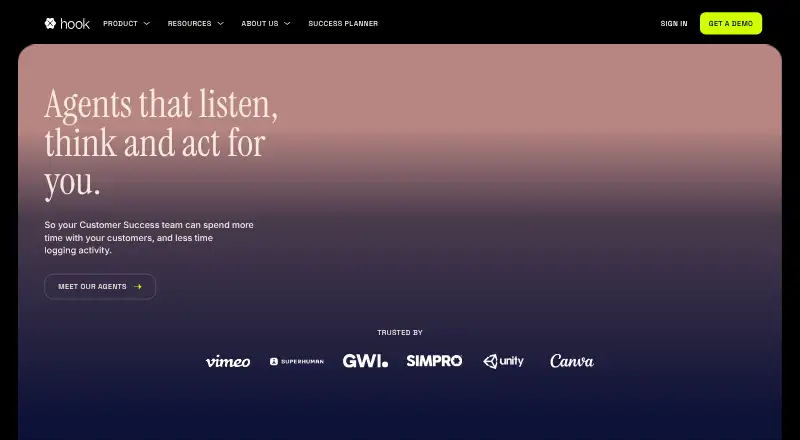
Hook is an AI app for Revenue teams that analyzes customer behavior and external sources to suggest next steps for each account. Its agents use product usage, meetings, support data and other signals to surface churn risk, renewal likelihood and expansion opportunities. Echo examines emails, meetings, support threads and usage patterns, including comparisons across the customer base. Activator builds goal-driven onboarding paths; teams can review queued actions or let them run automatically. Hook also creates account-specific playbooks and can trigger actions through Slack, email or Teams. Its account workspace gathers meetings, conversations and support tickets, with tools to draft follow-up emails and meeting invitations. Other features include account pages, customer and user reporting, alerts, news feeds, customer journeys and company goals. Hook lists integrations with CRM, data, analytics, support and collaboration services. The public API provides authenticated, organisation-scoped, read-only access to selected records. Google SSO is available by default, with Microsoft and Okta also supported. Hook is available on web and via API. Pricing is on request.
Who it suits
Hook suits Revenue and customer success teams, including CROs, Heads of Customer Success and CSMs, who want account-level risk and expansion signals alongside suggested actions.
What it does well
- Analyzes multiple customer data sources for account insights.
- Activator can queue or automatically execute onboarding actions.
- Playbooks can trigger actions through Slack, email or Teams.
- Lists ISO/IEC 27001, SOC 2 Type 2 and GDPR compliance.
- Public API access is read-only and organisation-scoped.
What to know first
- Pricing is available on request.
- Public API access is read-only.
- API tokens default to 30-day validity.
Limits
Pricing is on request. The public API provides read-only access to specified organisation-scoped data, and API tokens have a default validity period of 30 days.
Getting started
- Visit Hook's website.
- Contact Hook to request pricing.
- Use the web app or API.
- Connect relevant listed systems, such as CRM, product analytics, support, or collaboration tools.
- Set up an agent for your team; Hook says teams can go live with their first agent in 7 days.
Hook is an AI-based revenue intelligence system for customer-success and revenue organisations. It fits CROs, Heads of Customer Success and CSM teams that can connect several operational data sources and want prioritised account actions. The main reservation is commercial: pricing is custom, so smaller teams cannot assess cost without contacting the company.
Overview
Hook’s agents combine customer behaviour with outside information to recommend what a team should do next for each account. Account pages, customer and user reports, alerts, news feeds, customer journeys and company goals give teams a shared operating context. The product covers renewal risk, churn, engagement and expansion, making it more than a simple health-score view.
Its account workspace puts meetings, conversations and support tickets together and can draft follow-up emails and meeting invitations. Hook says a team can put its first agent into operation within seven days. It also reports 93% accuracy in live environments when models use customer-specific training sets; that claim points to a product intended for organisation-level tuning rather than generic answers.
Key features
Churn, renewal and expansion signals
Echo looks at conversations, product usage and behavioural patterns to identify churn risk. Its coverage includes email, meetings, support threads, product activity and comparisons with usage across the wider customer base. Real-time scanning of customer signals, product interactions and external sources can surface both declining accounts and expansion opportunities, giving leaders a basis for deciding where limited CSM time should go.
Guided and automated action
Activator builds onboarding paths around defined goals. It can place proposed actions in a CSM review queue or execute them automatically, which suits teams willing to standardise onboarding while retaining approval for sensitive steps. Hook also creates account playbooks from conversations, usage, support history and external news, then can trigger actions through Slack, email or Microsoft Teams. That breadth is useful when insight must move into existing team routines; organisations wanting every action to remain manual may find the automation excessive.
Data connections and account context
Integrations span Salesforce, HubSpot, Snowflake, Amazon Redshift, BigQuery, PostgreSQL, Databricks, Pendo, Mixpanel, Gong, Slack, Intercom, Zendesk, Jira Service Management, Google, Microsoft and Okta. This multi-source coverage is Hook’s clearest advantage for companies whose customer picture is split between CRM, warehouse, product and support systems. Google SSO is included by default, with Microsoft SSO and Okta also supported.
Security and API boundaries
Hook states that it is ISO/IEC 27001 certified, SOC 2 Type 2 attested and GDPR compliant. It describes controls including background checks, confidentiality agreements, security training, two-factor authentication, least-privilege access and automated vulnerability detection. The public API is organisation-scoped and read-only for members, customers, products, signals and notes. Tokens support expiry and rate limits, with a default 30-day validity period. That is appropriate for reporting and controlled integrations, but not for systems that require broad write-back automation.
Pricing
Hook uses paid, custom pricing. There are no published seat allowances, quotas, trial period or renewal terms, so buyers must request a commercial proposal. This approach may suit larger revenue teams that need a tailored deployment; it makes budgeting and low-risk evaluation harder for smaller companies and self-serve buyers.
Platforms
Hook is offered through a web application and an API. The platform list does not indicate a native desktop or mobile client, so teams should expect browser-based use alongside integrations and API access.
Who it's for
Hook is aimed at revenue teams, particularly CROs, Heads of Customer Success and CSM groups managing enough customers and systems to benefit from automated prioritisation. It is a strong candidate when renewal, engagement and expansion decisions need product, conversation, support and external signals in one place. It is a weaker fit for a small team seeking a free plan, transparent pricing or a standalone lightweight tracker.
Pros and cons
- Pros: Echo covers email, meetings, support and product behaviour, giving churn analysis more context than a single-source score.
- Pros: Activator and generated playbooks connect recommendations to review queues or automated actions across Slack, email and Teams.
- Pros: Broad warehouse, CRM, product and support integrations support a consolidated account view.
- Pros: ISO/IEC 27001, SOC 2 Type 2 and GDPR statements address common enterprise procurement requirements.
- Cons: Custom pricing and no published trial, limits or renewal terms make comparison and initial budgeting difficult.
- Cons: The public API is read-only, limiting teams that need Hook to update other systems automatically.
Alternatives
Bruin for Customer Success is the better choice for a free cloud tier with $100 in credits and 50 AI tasks, or for teams wanting self-hosted and desktop platform options.
Muntri suits buyers who want a free practice workspace, three practice calls and a published $299-per-month flat-price plan.
AccountLens is preferable when MIT-licensed self-hosting or a free starter allowance of up to 1,000 tracked users and 10 accounts matters most.
CSI Pro fits teams seeking a free-forever core scoring tool with offline features and three account-research searches, plus a low-cost lifetime upgrade.
Dimension Labs is an option for experimenting with a free, single-source agent capped at 1,000 records per month.
GainTrace is suited to teams wanting a free tier with explicit company, contact, event, connector and automation caps.
Custify is another paid customer-success platform with a free trial and demo-led custom pricing.
Planhat is worth considering when CRM, pipeline management, lead routing, lead scoring or email sequencing is the primary requirement and custom pricing is acceptable.
Verdict
Choose Hook if your revenue organisation needs one system to interpret multi-source account signals and turn them into renewal, churn and expansion actions. Its strongest differentiators are the breadth of listening, role-specific guidance and automation controls. Look elsewhere if transparent pricing, a free starting tier or a write-capable API is essential.
Verdict
Hook brings account signals, churn and expansion analysis, and suggested next steps into one system. Teams considering it should note that pricing is on request and API access is read-only.
Questions
How much does Hook cost?
Hook's pricing is available on request.
Which platforms does Hook support?
Hook lists web and API availability.
What data can Hook use?
Its agents analyze customer behavior and external sources, including emails, meetings, support threads, and product usage.
Which integrations does Hook list?
Integrations include Salesforce, HubSpot, Snowflake, BigQuery, Pendo, Mixpanel, Gong, Slack, Intercom, Zendesk, Jira Service Management, Google, Microsoft, and Okta, among others.
Does Hook provide a public API?
Yes. It offers authenticated, organisation-scoped, read-only access to members, customers, products, signals, and notes.
What security certifications does Hook state?
Hook states that it is ISO/IEC 27001 certified, SOC 2 Type 2 attested, and GDPR compliant.
Facts from Hook's own pages
- Account workspace
- Hook brings meetings, conversations, and support tickets into one contextual account view and can draft follow-up emails and meeting invitations. · hook.co, 1 Oct 2026
- AI agents
- Hook agents analyze customer behavior and external sources and recommend the best next step for each account. · hook.co, 2 Oct 2026
- API controls
- Hook API tokens have expiry controls, rate limiting, and a default validity period of 30 days. · help.hook.co, 1 Oct 2026
- Automated playbooks
- Hook generates tailored playbooks using conversation, product usage, support history, and external news, and can trigger actions through Slack, email, or teams. · hook.co, 1 Oct 2026
- Churn detection
- Echo identifies churn risk by analyzing customer conversations, product usage, and relevant behavioral patterns. · hook.co, 1 Oct 2026
- Company contact
- Hook lists [email protected] as its company email address. · hook.co, 1 Oct 2026
- Company location
- Hook lists 21 Great Winchester St, London, EC2N 2JA. · hook.co, 2 Oct 2026
- Core features
- Hook provides account pages, customer and user reporting, alerts, news feeds, customer journeys and company goals. · help.hook.co, 2 Oct 2026
- Core product
- Hook uses AI agents to analyze customer behavior and external sources, then recommend the best next step for each account. · hook.co, 1 Oct 2026
- Customer intelligence
- Hook combines product usage, meetings and support data to provide account insights and suggested actions. · hook.co, 2 Oct 2026
- Echo data coverage
- Echo listens to emails, meetings, support threads, product usage, and comparative usage across the customer base. · hook.co, 1 Oct 2026
- Headquarters
- London, United Kingdom · hook.co, 28 Sept 2026
- Integrations
- Hook lists integrations including Salesforce, HubSpot, Salesloft, Outreach, Slack, Intercom, Zendesk, Jira Service Management, Zoom, Gong, Snowflake, BigQuery, Redshift, PostgreSQL, Google, Microsoft and Okta. · help.hook.co, 2 Oct 2026
- Machine learning
- Hook says its agents achieve 93% accuracy in live environments with customer-specific training sets. · hook.co, 1 Oct 2026
- Onboarding
- Hook says teams can go live with their first agent in 7 days. · hook.co, 2 Oct 2026
- Onboarding automation
- Activator creates goal-driven onboarding paths and can queue actions for CSM review or execute them automatically. · hook.co, 1 Oct 2026
- Public API
- Hook's Public API provides organization-scoped, token-authenticated programmatic read access to members, customers, products, signals and notes. · help.hook.co, 2 Oct 2026
- Purpose
- Hook is an AI machine-learning app for Revenue teams to predict which customers to focus on for faster revenue growth. · help.hook.co, 2 Oct 2026
- Real-time signals
- Hook scans customer signals, product interactions, and external sources in real time to surface churn and expansion opportunities. · hook.co, 1 Oct 2026
- Risk and expansion
- Hook identifies churn risk, renewal likelihood and upsell opportunities using machine-learning models trained on user, subscription and product-usage data. · help.hook.co, 2 Oct 2026
- Security certifications
- Hook states that it is ISO/IEC 27001 certified, SOC 2 Type 2 attested and GDPR compliant. · hook.co, 2 Oct 2026
- Security practices
- Hook describes background checks, NDAs, security training, strong passwords, approved password-manager use, two-factor authentication, least-privilege access and automated vulnerability detection. · hook.co, 2 Oct 2026
- Single sign-on
- Google SSO is available by default, with Microsoft SSO and Okta also supported. · help.hook.co, 2 Oct 2026
- Support contact
- Hook publishes [email protected] for company contact and [email protected] for vulnerability reports. · hook.co, 2 Oct 2026
Where Hook stands on Freedom251
- Customer Success Analytics Software#18 of 21