Freedom251 › Honeypot Software
Honeyd
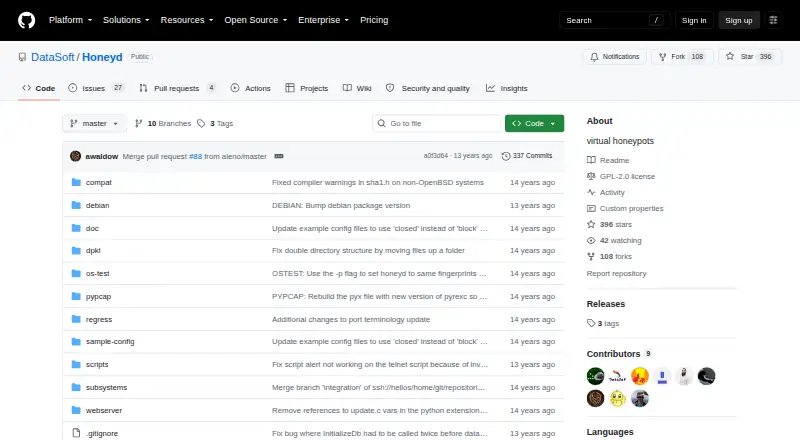
What Honeyd is
Honeyd is a self-hosted daemon for creating virtual hosts and honeypots for threat detection, assessment, network simulation, and monitoring. A single host can represent up to 65,536 IP addresses, and Honeyd can simulate thousands of virtual hosts at once. Simulated hosts can provide services defined in configuration files or proxy services to another machine. Honeyd can adjust TCP/IP behavior to imitate operating system personalities detectable by Nmap or Xprobe. For network simulation, it supports virtual routing topologies with configurable latency, packet loss, asymmetric routes, physical hosts, and GRE tunnels. Its flow log records connections and packets, with protocol and connection details and passive OS-identification comments. Honeyd does not direct traffic to itself automatically; users must configure routing, proxy ARP, or arpd. The maker recommends sandboxing it with Systrace because it interacts with potentially malicious adversaries and scripts. Honeyd is free, GPL-licensed, and self-hosted. The latest listed release is version 1.5c, dated 2007-05-27.
Who it suits
Honeyd suits users building host-based or network-based honeypots, virtual honeynets, or network monitoring setups. It is available for Linux and Windows, with maker documentation also describing *BSD, GNU/Linux, and Solaris support.
What it does well
- Simulates thousands of virtual hosts at once
- Supports configurable virtual routing topologies
- Flow logs include connection details and OS comments
- Free and GPL-licensed
What to know first
- Traffic must be directed to Honeyd manually
- Maker recommends sandboxing because it interacts with malicious traffic
- Latest listed release dates to 2007
Limits
Honeyd is free and GPL-licensed. Its latest listed release is Honeyd 1.5c, released 2007-05-27; traffic must be directed to it using routing, proxy ARP, or arpd.
Plans
| Plan | Billed and limits | Price |
|---|---|---|
| Honeyd | Distributed free of charge; GPL-licensed | Free |
As github.com lists them, read 7 Oct 2026. The maker's own page has the final word.
Getting started
- Open the Honeyd project website.
- Choose a supported self-hosted platform.
- Install Honeyd and its documented dependencies.
- Configure virtual hosts and services.
- Direct network traffic to Honeyd through routing, proxy ARP, or arpd.
- Consider the maker's Systrace sandboxing recommendation.
Overview
Honeyd is a self-hosted daemon for creating virtual hosts and network honeypots for threat detection, assessment, and simulation. It suits network operators who can configure routing and want to model many hosts; it is a poor fit for anyone seeking a ready-to-run decoy.
Its GPL license and free price remove procurement barriers, while the combination of large-scale address claims, service emulation, and controllable network behavior gives experienced defenders an unusually broad simulation tool. The trade-off is operational: Honeyd does not receive traffic by itself, and running an exposed deception system demands isolation.
Key features
Virtual hosts and services
A single Honeyd host can claim up to 65,536 IP addresses, and the daemon can simulate thousands of virtual hosts concurrently. Each virtual host can imitate arbitrary services from configuration files or proxy a service to another machine. This is a strong fit for network-level deception, monitoring, and assessment environments where many decoys matter. It is more work than a focused single-service honeypot because the operator must define the personalities and services.
Operating-system and network behavior
Honeyd changes TCP/IP behavior to emulate operating-system personalities that Nmap or Xprobe can identify. It can also construct virtual routing topologies with configurable latency, packet loss, asymmetric routes, physical hosts, and GRE tunnels. Those controls support realistic test networks and honeynets rather than merely changing banners. They reward administrators comfortable with routing and tunnel configuration, but add little value for someone who only wants to expose one instrumented service.
Logging, routing, and isolation
The -l option writes flow logs for connections and packets, including protocol and connection details plus passive OS-identification comments. Honeyd does not intercept traffic automatically: traffic must be directed to it through routing, proxy ARP, or arpd. That separation gives an operator control over deployment, but makes network design a prerequisite rather than a setup detail. Because scripts and adversaries can be malicious, the maker recommends sandboxing Honeyd with Systrace; this is a necessary part of a responsible deployment.
Pricing
Honeyd — free. It is distributed free of charge under the GNU General Public License, with self-hosted deployment and no paid tier. That makes it suitable for laboratories, academic work, and teams able to supply their own hosts and network controls. The price does not remove the administrative cost of configuring traffic delivery, writing decoy definitions, and securing the daemon.
Platforms
Honeyd is self-hosted on Linux and Windows, and the download guidance says it should compile and run on *BSD, GNU/Linux, and Solaris. The FAQ describes a Windows port for Honeyd 0.5. Dependencies and integrations include libevent, libdnet, libpcap, Nmap, Xprobe, and GRE tunneling. The latest listed release is Honeyd 1.5c from May 27, 2007, so organizations should account for the age of the release when selecting it for current environments.
Who it's for
Honeyd is aimed at security teams, researchers, and network operators building host-based or network-based virtual honeypots, virtual honeynets, monitoring systems, or controlled network simulations. It is a good choice when scale, fingerprintable OS behavior, and topology control are central requirements. It is not the right choice for users who need automatic traffic capture, an appliance-like workflow, or a narrowly scoped SSH or Telnet decoy.
Pros and cons
- Pro: One host can represent up to 65,536 IP addresses and thousands of virtual hosts, enabling broad network deception.
- Pro: Configurable services, OS fingerprints, routing conditions, physical hosts, and GRE tunnels support detailed simulations.
- Pro: Free, GPL-licensed software can be deployed without per-seat or usage charges.
- Con: Traffic requires routing, proxy ARP, or arpd configuration; Honeyd will not automatically intercept it.
- Con: Safe operation calls for sandboxing with Systrace because the daemon handles hostile traffic and scripts.
- Con: The latest listed release dates to 2007, making release currency a serious consideration for new deployments.
Alternatives
For a broader directory of choices, see Honeypot Software.
- Canarytokens is the better pick for free tokens across web, mobile, Windows, and self-hosted environments rather than large virtual networks.
- OpenCanary suits Linux, macOS, and self-hosted deployments when an open-source honeypot with a narrower footprint is preferable.
- T-Pot is a free, open-source self-hosted option for teams prepared to meet its hardware and network requirements.
- Beelzebub offers a free open-source core with self-hosted deployment and a trial option.
- Cowrie is the focused choice for a free SSH and Telnet honeypot.
- Endlessh is a standalone SSH tarpit with a default maximum of 4,096 clients.
- Honeytrap provides free Apache-licensed, self-managed honeypot software.
- MedPot is a free open-source repository for Linux and self-hosting, requiring Go 1.17 or newer.
Verdict
Choose Honeyd if you need a free, self-hosted framework for simulating many network hosts, identifiable operating-system behaviors, and configurable topologies. Its main reason to choose it is breadth without licensing cost; its main reason to look elsewhere is the combination of manual traffic plumbing, required isolation, and a latest listed release from 2007.
Verdict
Honeyd offers extensive virtual-host and network simulation capabilities for self-hosted honeypot setups. Traffic routing requires separate configuration, and the latest listed release is dated 2007.
Questions
How much does Honeyd cost?
Honeyd is distributed free of charge under the GNU General Public License.
Which platforms does Honeyd support?
The listed platforms include Linux, self-hosted deployment, and Windows. The download page also says it should compile and run on *BSD, GNU/Linux, and Solaris.
What can Honeyd simulate?
It can simulate thousands of virtual hosts and operating system profiles, as well as virtual routing topologies with configurable network conditions.
Does Honeyd include integrations?
The project documents Nmap and Xprobe fingerprinting, GRE tunneling, and dependencies on libevent, libdnet, and libpcap.
How is traffic sent to Honeyd?
Traffic is not intercepted automatically. It must be directed to Honeyd through routing, proxy ARP, or arpd.
What is the latest listed Honeyd release?
The maker's releases page lists Honeyd 1.5c, released 2007-05-27.
Facts from Honeyd's own pages
- Integrations
- The project documents Nmap and Xprobe fingerprinting, GRE tunneling, and dependencies on libevent, libdnet, and libpcap. · honeyd.org, 7 Oct 2026
- Intended users
- The maker describes Honeyd for creating host-based and network-based virtual honeypots, virtual honeynets, and general network monitoring. · honeyd.org, 7 Oct 2026
- Latest listed release
- The maker's releases page lists Honeyd 1.5c, released 2007-05-27, as its latest release. · honeyd.org, 7 Oct 2026
- License
- Honeyd is open source software released under the GNU General Public License. · honeyd.org, 7 Oct 2026
- Logging
- Honeyd's -l option creates a flow log for connections and packets, including protocol, connection details, and passive OS identification comments. · honeyd.org, 7 Oct 2026
- Network simulation
- It supports virtual routing topologies with configurable latency, packet loss, asymmetric routes, physical hosts, and GRE tunnels. · honeyd.org, 7 Oct 2026
- OS emulation
- Honeyd adapts TCP/IP behavior to emulate operating system personalities that Nmap or Xprobe can identify. · honeyd.org, 7 Oct 2026
- Platform support
- The download page says Honeyd should compile and run on *BSD, GNU/Linux, and Solaris; the FAQ also describes a Windows port of Honeyd 0.5. · honeyd.org, 7 Oct 2026
- Purpose
- Honeyd is a daemon for creating virtual hosts and honeypots on a network for threat detection, assessment, and network simulation. · honeyd.org, 7 Oct 2026
- Security guidance
- The maker recommends sandboxing Honeyd with Systrace because it interacts with potentially malicious adversaries and scripts. · honeyd.org, 7 Oct 2026
- Services
- Hosts can simulate arbitrary services from configuration files or proxy services to another machine. · honeyd.org, 7 Oct 2026
- Support
- The FAQ invites users whose questions are unanswered to contact the maintainer by email. · honeyd.org, 7 Oct 2026
- Traffic setup
- Honeyd does not intercept network traffic automatically; users must direct traffic to it using routing, proxy ARP, or arpd. · honeyd.org, 7 Oct 2026
- Virtual hosts
- A single host can claim as many as 65,536 IP addresses, and Honeyd can simulate thousands of virtual hosts at once. · honeyd.org, 7 Oct 2026
Where Honeyd stands on Freedom251
- Honeypot Software#6 of 21