Freedom251 › Honeypot Software
Honeytrap
What Honeytrap is
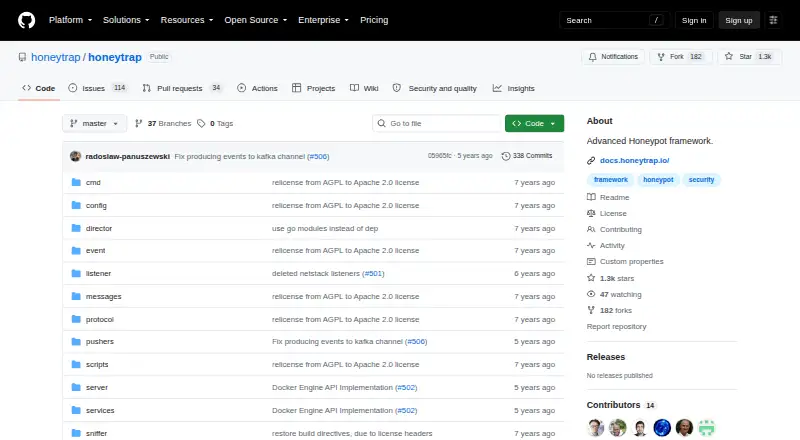
Honeytrap is a self-hosted Linux system for running and managing honeypots, from low- to high-interaction setups. It can combine services such as a LAMP server in one honeypot, and its agents can redirect traffic between networks. Agents download their configuration from a Honeytrap Server, which can coordinate many agents and collect logs centrally. Payload detection can route requests to the appropriate service and let one port handle multiple protocols. A Sensor listener can finish a TCP handshake and save the payload to help monitor lateral movement inside a network. For high-interaction honeypots, LXC or remote-host directors proxy traffic and extract information. Honeytrap can also add its listening and logging framework to existing honeypots such as Cowrie or Glutton. Logging can filter data and send it to Elasticsearch, Kafka, Splunk, Raven, files, or the console. The project uses the Apache License 2.0 and directs users to a mailing list for discussion. Its GitHub releases page currently lists no releases.
Who it suits
Honeytrap suits teams running self-managed honeypots across Linux systems, including deployments that need centralized configuration and logging. It can also extend existing honeypots such as Cowrie or Glutton.
What it does well
- Combines multiple services in one honeypot.
- Centralizes configuration and logging across agents.
- Routes multiple protocols through one port.
- Supports low- through high-interaction honeypots.
- Offers several logging destinations and filters.
What to know first
- Linux and self-hosted deployment only.
- GitHub currently lists no repository releases.
Plans
| Plan | Billed and limits | Price |
|---|---|---|
| Open-source software | Apache License 2.0 · Self-managed deployment | Free |
As github.com lists them, read 7 Oct 2026. The maker's own page has the final word.
Getting started
- Visit https://github.com/honeytrap/honeytrap
- Prepare a self-hosted Linux deployment
- Use the Apache License 2.0 code
- Set up a Honeytrap Server and agents to distribute configuration and centralize logs
- Use the honeytrap-users mailing list for community discussion
Verdict
Honeytrap provides flexible honeypot deployment and logging options, including centralized management for multiple agents. The lack of listed releases is worth noting before choosing it.
Questions
Is Honeytrap free?
Yes. The listed open-source plan is free, with self-managed deployment.
What license does Honeytrap use?
The project releases its code under the Apache License, Version 2.0.
Which platforms does it support?
The listed platform is Linux, and the deployment model is self-hosted.
How does Honeytrap manage multiple agents?
Agents download configuration from a Honeytrap Server, which can also centralize logging across many agents.
Where can Honeytrap send logs?
Its logging system supports Elasticsearch, Kafka, Splunk, Raven, files, and the console.
How can users discuss Honeytrap?
The project directs users to the honeytrap-users mailing list.
Facts from Honeytrap's own pages
- Agent and server
- Honeytrap agents download configuration from a Honeytrap server, which can centralize logging across many agents. · github.com, 7 Oct 2026
- Agent configuration
- Honeytrap Agent downloads its configuration from the Honeytrap Server. · github.com, 4 Oct 2026
- Centralized deployment
- The project describes deploying many agents with one server, automatic configuration downloads, and centralized logging. · github.com, 4 Oct 2026
- Community support
- The project points users to its documentation and a honeytrap-users mailing list. · github.com, 7 Oct 2026
- Existing honeypots
- Honeytrap can extend existing honeypots including Cowrie and Glutton using its logging and listening framework. · github.com, 7 Oct 2026
- High-interaction honeypots
- LXC or remote-host directors can create high-interaction honeypots by proxying traffic and extracting information. · github.com, 7 Oct 2026
- Interaction levels
- It supports low- to high-interaction honeypots and can seamlessly upgrade connections to high interaction. · github.com, 7 Oct 2026
- Lateral movement monitoring
- The Sensor listener can complete a TCP handshake and store the payload to monitor lateral movement. · github.com, 7 Oct 2026
- License
- The code is released under the Apache License, Version 2.0. · github.com, 7 Oct 2026
- Logging integrations
- Its filtering and logging system supports Elasticsearch, Kafka, Splunk, Raven, files, and console output. · github.com, 7 Oct 2026
- Multiple services
- It can combine multiple services into one honeypot, such as a LAMP server. · github.com, 4 Oct 2026
- Multi-service honeypots
- It can combine multiple services into one honeypot, such as a LAMP server. · github.com, 7 Oct 2026
- Payload detection
- Payload detection selects which service handles a request, and one port can handle multiple protocols. · github.com, 4 Oct 2026
- Protocol detection
- Payload detection can select a service to handle a request and lets one port handle multiple protocols. · github.com, 7 Oct 2026
- Purpose
- Honeytrap is an extensible open-source system for running, monitoring, and managing honeypots. · github.com, 7 Oct 2026
- Release availability
- The GitHub releases page currently says there are no releases. · github.com, 7 Oct 2026
- Traffic routing
- Agents can redirect traffic from one network to a separate network. · github.com, 7 Oct 2026
Where Honeytrap stands on Freedom251
- Honeypot Software#9 of 21