Freedom251 › Honeypot Software
MedPot
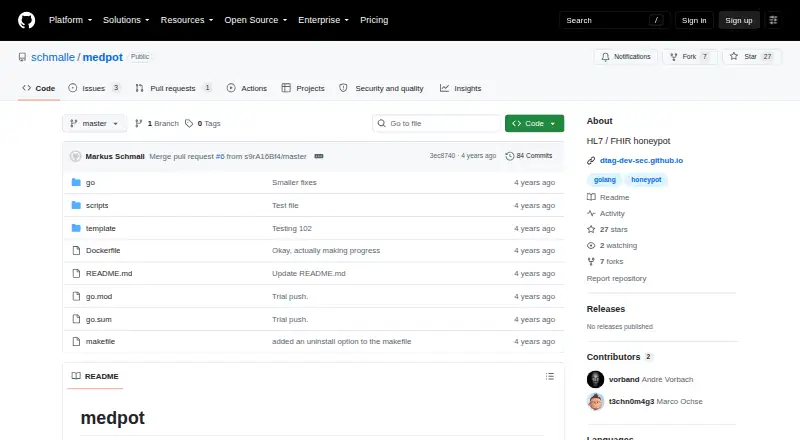
What MedPot is
MedPot is a free, self-hosted honeypot that emulates HL7 and FHIR services on Linux. The project documents running it with Go or a script, compiling it into a binary, and building a Docker container. Installation requires Go 1.17 or newer. By default, MedPot listens on port 2575 and writes logs to /var/log/medpot.log; command-line arguments can change the port and log location. Templates and configuration files are located at /etc/medpot/. An example log record includes a timestamp, port, IP address, message, level, and captured data. A command-line option also selects between two boot logos. Docker is documented as a deployment choice, while the README does not list other product integrations. The project describes its purpose as an HL7/FHIR honeypot but does not identify a narrower intended user group. Its README does not specify support terms, security certifications, or compliance standards.
Who it suits
MedPot is for people who need to deploy an HL7/FHIR honeypot and can manage a self-hosted Linux setup. Installation requires Go 1.17 or newer, or use of the documented build and run options.
What it does well
- Free, open-source, self-hosted deployment
- Emulates HL7 and FHIR services
- Can run as a binary or Docker container
- Port and log location can be changed
What to know first
- Requires Go 1.17 or newer
- Default configuration listens on port 2575
- README specifies no support terms or security certifications
Plans
| Plan | Billed and limits | Price |
|---|---|---|
| MedPot | Open-source repository; Go 1.17 or newer required | Free |
As github.com lists them, read 8 Oct 2026. The maker's own page has the final word.
Getting started
- Open the MedPot GitHub repository.
- Install Go 1.17 or newer.
- Follow the documented instructions to run MedPot with Go or a script, or compile it into a binary.
- Alternatively, use the provided script to build a Docker container.
- Use command-line arguments to change the listening port or log location, or select a boot logo.
Verdict
MedPot provides an application-level decoy for HL7 and FHIR services with configurable listening and logging options. Its README leaves support and security-certification details unspecified, so deployment decisions depend on the project’s documented setup and the user’s requirements.
Questions
How much does MedPot cost?
The listed plan is free. The project is open source.
Which platforms does MedPot support?
It is listed for Linux and is self-hosted.
How can I run MedPot?
The README documents running it with Go or a script, compiling a binary, and building a Docker container. Installation requires Go 1.17 or newer.
What does MedPot emulate?
It emulates HL7 and FHIR services as an application-level decoy.
What information can its logs contain?
An example record includes a timestamp, port, IP address, message, level, and captured data.
What integrations are documented?
Docker is documented as a deployment option.
Facts from MedPot's own pages
- Captured connection data
- The README's example log entry includes a message, time, port, IP address, and encoded data. · github.com, 4 Oct 2026
- Configuration
- Templates and configuration files are located at /etc/medpot/. · github.com, 8 Oct 2026
- Container
- The installation instructions include a script to build a Docker container. · github.com, 8 Oct 2026
- Customization
- A command-line argument lets users choose between two boot logos. · github.com, 4 Oct 2026
- Default port
- By default, MedPot attempts to bind and listen on port 2575. · github.com, 8 Oct 2026
- Go requirement
- Installation requires Go 1.17 or newer. · github.com, 4 Oct 2026
- Installation
- The project requires Go 1.17 or newer and provides instructions to run it or compile it into a binary. · github.com, 8 Oct 2026
- Integrations
- The maker's README documents Docker as a deployment option and does not list other product integrations. · github.com, 4 Oct 2026
- Intended use
- The project describes MedPot as an HL7/FHIR honeypot; it does not specify a narrower target audience. · github.com, 4 Oct 2026
- Intended users
- The project describes itself as an HL7 / FHIR honeypot; its README does not specify a narrower user group. · github.com, 8 Oct 2026
- Log data
- The README's example log record includes a timestamp, port, IP address, message, level, and captured data. · github.com, 8 Oct 2026
- Logging
- The README gives /var/log/medpot.log as the default log file location and says it can be changed with the -sll flag. · github.com, 8 Oct 2026
- Purpose
- MedPot is a honeypot that emulates HL7 / FHIR. · github.com, 8 Oct 2026
- Run and build
- The README documents running MedPot with Go or a script, compiling it into a binary, and building a Docker container. · github.com, 4 Oct 2026
- Runtime options
- Supported arguments include options to select a boot logo, change the listening port, and change the log location. · github.com, 8 Oct 2026
- Support and security details
- The repository README does not specify support terms, security certifications, or compliance standards. · github.com, 4 Oct 2026
Where MedPot stands on Freedom251
- Honeypot Software#12 of 21