Freedom251 › Honeypot Software

Beelzebub
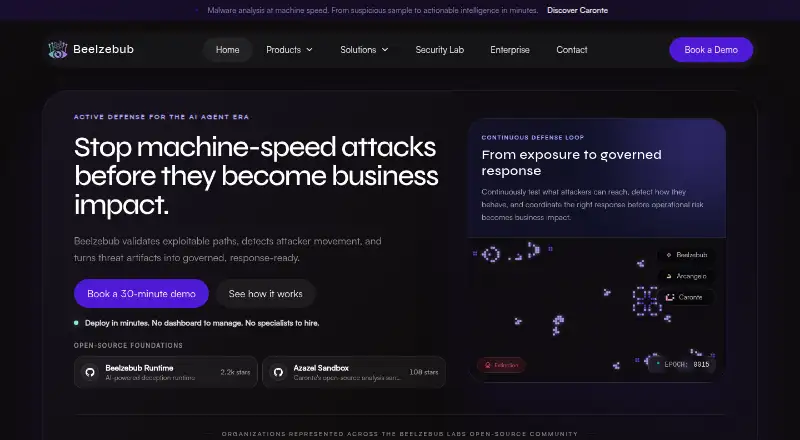
What Beelzebub is
Beelzebub is a security platform that deploys decoys and canary credentials to reveal attacker movement and give security teams material for investigation. It supports decoys for HTTP, SSH, Telnet, MCP and other protocols. Specialized agents investigate decoy sessions for triage, threat hunting, malware analysis, incident response and reporting. For each session, it creates a plain-language summary of actions, techniques and captured artifacts linked to that session. Events and investigation context can be sent through APIs and webhooks, with integrations listed for SIEM, SOAR, identity, firewall and cloud tools. The platform can run in Docker or Kubernetes in cloud or on-premises settings, and local model options are available for restricted or air-gapped evaluation. Active testing can be limited to an approved scope; exploitation requires human approval, and evidence is preserved for review. The core framework is open source and free to self-host. The managed platform has a 14-day free trial; enterprise customers can request a 30-day proof of concept.
Who it suits
Beelzebub is suited to security teams investigating attacker activity through decoys and canary credentials. Its deployment options include self-hosted use and cloud or on-premises environments.
What it does well
- Decoys cover HTTP, SSH, Telnet, MCP and other protocols.
- Session reports link actions and artifacts to the source session.
- Events can flow through APIs and webhooks.
- Active testing can be restricted to approved scope.
- Core framework is open source and free to self-host.
What to know first
- The core framework requires self-hosted deployment.
- Managed platform trial lasts 14 days.
- 24/7 phone and chat support is listed for enterprise customers.
Limits
The managed platform's free trial lasts 14 days. The open-source plan is the core framework with self-hosted deployment; enterprise customers can request a 30-day proof of concept.
Plans
| Plan | Billed and limits | Price |
|---|---|---|
| Open source | Core framework · self-hosted deployment | Free |
As beelzebub.ai lists them, read 30 Sept 2026. The maker's own page has the final word.
Getting started
- Visit https://beelzebub.ai/.
- Choose the free, self-hosted open-source core or evaluate the managed platform's 14-day free trial.
- Deploy the self-hosted platform with Docker or Kubernetes on Linux.
- Configure decoys and canary credentials for the protocols and scope you want to cover.
Beelzebub is a security deception platform that uses protocol decoys and canary credentials to surface attacker activity. It suits security teams seeking investigation context as well as detection, especially those able to operate a self-hosted deployment. Its strongest case is the free, open-source core; teams wanting managed service or enterprise support should consider the trial and enterprise options.
Overview
Beelzebub combines multi-layer decoys, credential lures and cloud decoys, covering HTTP, SSH, Telnet, MCP and other protocols. That range is useful for teams looking to observe activity across different services rather than deploy a single-purpose honeypot. The free core is self-hosted, which avoids a license charge but leaves deployment and operation with the team.
Key features
Session investigation
Specialized agents investigate decoy sessions for triage, threat hunting, malware analysis, incident response and reporting. Each session yields a plain-English account of attacker actions, observed techniques and captured artifacts, linked to the original session. This gives analysts context to review after a decoy is triggered, while keeping the evidence tied to the event rather than presenting only a bare alert.
Integrations and controls
APIs and webhooks route structured events and investigation context into workflows, with integrations spanning SIEM, SOAR, identity, firewall and cloud systems. The maker says deployments can run through Docker or Kubernetes in cloud and on-premises environments, with local model options for restricted and air-gapped evaluation. Active testing can be restricted to an approved scope, and exploitation requires human approval with evidence preserved for review; those controls suit deliberate evaluation, though they do not remove the need for human oversight.
Reporting and assurance
Findings can be mapped to MITRE ATT&CK, NIST CSF, ISO 27001, DORA and NIS2. The site lists ISO 9001:2015 and ISO/IEC 27001:2022 certifications. These are useful for teams that need findings organized against established frameworks, but the practical value depends on how those mappings fit the team's own reporting process.
Pricing
Open source
The Open source plan costs nothing and includes the core framework with self-hosted deployment. The FAQ says the core framework is open source and can be self-hosted for free, making this the natural starting point for teams prepared to run it themselves. A 14-day free trial of the managed platform includes enterprise features, while enterprise customers can request a 30-day proof of concept with guided evaluation and dedicated technical support. Enterprise pricing is custom pricing.
Community support is through GitHub issues and documentation. Enterprise customers have 24/7 phone and chat support, a meaningful distinction for teams that need direct assistance rather than community channels.
Platforms
Beelzebub lists API, Linux and self-hosted support. The maker describes Docker and Kubernetes deployment across cloud and on-premises environments. Local model options are intended for restricted or air-gapped evaluation, while the free plan specifically uses self-hosted deployment.
Who it's for
Beelzebub is a good fit for security teams that want multi-protocol deception and session-level investigation in one system, and that can manage a self-hosted core or evaluate the managed platform. Its reporting and framework mapping also suit teams that need findings organized for investigation and security programs. It is less suitable for users seeking a simple standalone decoy with no operational burden or for teams that require enterprise support without moving beyond the community route.
Pros and cons
- Pros: Decoys span HTTP, SSH, Telnet, MCP and other protocols, with multi-layer scope, credential lures and cloud decoys.
- Pros: Session summaries connect attacker actions, techniques and artifacts to the original decoy session, supporting investigation rather than detection alone.
- Pros: The open-source core is free to self-host, and the managed platform offers a 14-day trial with enterprise features.
- Cons: The free core is self-hosted, so teams must take responsibility for operating the deployment.
- Cons: Community support relies on GitHub issues and documentation; 24/7 phone and chat support is for enterprise customers.
Alternatives
For a broader set of honeypot software, compare tools by deployment and investigation needs. Canarytokens is a free hosted-token option, with no free trial, for readers who want tokens deployed through its hosted service. OpenCanary is free, open-source and self-hosted on Linux or macOS, a simpler fit for readers prioritizing a self-managed honeypot. T-Pot is a free open-source self-hosted choice across Linux, macOS and Windows, though hardware and network requirements apply. Cowrie is a free, BSD-licensed SSH and Telnet honeypot for readers focused on those protocols. Endlessh is a free SSH tarpit, suitable when that narrower role is the goal; it defaults to a maximum of 4096 clients. Honeyd is distributed free of charge under the GPL for readers seeking that licensed option. Honeytrap is free Apache-licensed software for self-managed Linux deployment. MedPot is a free open-source repository for Linux self-hosting that requires Go 1.17 or newer.
Verdict
Choose Beelzebub if your security team wants broad decoy coverage paired with session investigation and can operate the free self-hosted core. The combination of forensic summaries, workflow integrations and framework mapping gives it a stronger investigation focus than a basic decoy. Look elsewhere if you want a narrowly focused honeypot or cannot take on self-hosting and need community support alone.
Verdict
Beelzebub combines protocol decoys with session investigation and reporting, with deployment options for cloud, on-premises and self-hosted use. The open-source core is free; the managed platform offers a 14-day trial.
Questions
Is Beelzebub free?
The open-source core framework is free to self-host. Its listed Open source plan is free.
Does Beelzebub have a free trial?
Yes. The managed platform includes a 14-day free trial with enterprise features.
Which platforms does Beelzebub support?
It lists API, Linux, and self-hosted platforms. Deployment can use Docker or Kubernetes across cloud and on-premises environments.
Is Beelzebub open source?
Yes. Its core framework is open source and can be self-hosted for free.
What integrations does it list?
It routes structured events and investigation context through APIs and webhooks, and lists SIEM, SOAR, identity, firewall, and cloud integrations.
What support is available?
Community support includes GitHub issues and documentation. Enterprise customers have 24/7 phone and chat support.
Facts from Beelzebub's own pages
- AI investigation
- Specialized agents for triage, threat hunting, malware analysis, incident response, and reporting investigate decoy sessions. · beelzebub.ai, 30 Sept 2026
- Certifications
- The site lists ISO 9001:2015 and ISO/IEC 27001:2022 certifications. · beelzebub.ai, 30 Sept 2026
- Contact
- The site gives a legal address of Via Giuseppe Ripamonti 190, 20141 MI. · beelzebub.ai, 30 Sept 2026
- Deployment
- The maker says the platform can run with Docker or Kubernetes across cloud and on-premises environments, with local model options for restricted and air-gapped evaluation. · beelzebub.ai, 30 Sept 2026
- Forensic reports
- Each decoy session produces a plain-English summary of attacker actions, observed techniques, and captured artifacts linked to the original session. · beelzebub.ai, 30 Sept 2026
- Framework mapping
- The maker says findings can be mapped to MITRE ATT&CK, NIST CSF, ISO 27001, DORA, and NIS2. · beelzebub.ai, 30 Sept 2026
- Integrations
- The platform routes structured events and investigation context through APIs and webhooks and lists SIEM, SOAR, identity, firewall, and cloud integrations. · beelzebub.ai, 30 Sept 2026
- Open-source option
- The FAQ says the core framework is open source and can be self-hosted for free. · beelzebub.ai, 30 Sept 2026
- Proof of concept
- The maker offers enterprise customers a 30-day proof of concept with guided evaluation and dedicated technical support. · beelzebub.ai, 30 Sept 2026
- Protocols
- The platform supports decoys for HTTP, SSH, Telnet, MCP, and other protocols. · beelzebub.ai, 30 Sept 2026
- Purpose
- Beelzebub deploys realistic decoys and canary credentials to detect attacker movement and provide investigation context to security teams. · beelzebub.ai, 30 Sept 2026
- Security controls
- Active testing can be limited to an approved scope, and exploitation requires human approval with evidence preserved for review. · beelzebub.ai, 30 Sept 2026
- Support
- The FAQ lists GitHub issues and documentation for community support, and 24/7 phone and chat support for enterprise customers. · beelzebub.ai, 30 Sept 2026
- Trial
- The FAQ says the managed platform includes a 14-day free trial with enterprise features. · beelzebub.ai, 30 Sept 2026
Where Beelzebub stands on Freedom251
- Honeypot Software#2 of 21