
Happo
What Happo is
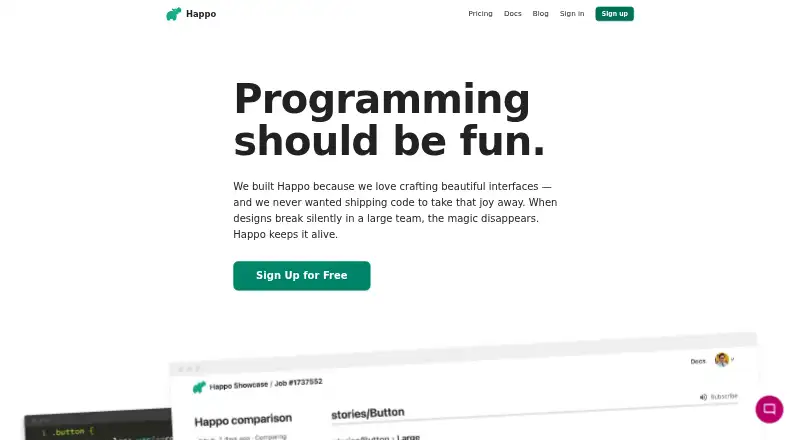
Happo is a visual and accessibility regression testing platform for checking interface changes. A snapshot captures one component variant in one browser, and a Happo run usually takes place once per CI build. Teams can connect Storybook, Playwright, Cypress or a custom setup through the API. Repository integrations include GitHub, GitHub Enterprise, Bitbucket, Azure DevOps and GitLab; GitLab support is marked experimental and includes self-managed instances. The CLI can detect CI providers such as GitHub Actions, CircleCI, Travis CI and Azure DevOps. Listed browser coverage includes Chrome, Firefox, Safari, Microsoft Edge and iOS Safari, with availability varying by plan. Accessibility testing is included on every plan. The free plan includes 5,000 snapshots per month and no credit card or time limit, but an account pauses when it reaches quota until the next cycle or an upgrade. Paid plans start at $149 a month, with charges for additional snapshots. Happo says data is encrypted in transit and at rest and customer screenshots are treated as confidential with account-level access controls.
Who it suits
Happo suits development teams that want to check visual and accessibility changes in CI workflows. Teams should consider their expected snapshot volume and required browser coverage when choosing a plan.
What it does well
- Accessibility testing is included on every plan.
- Free plan includes 5,000 monthly snapshots.
- Connects with Storybook, Playwright and Cypress.
- Supports several repository and CI integrations.
- Customer screenshots receive account-level access controls.
What to know first
- Free accounts pause after reaching their monthly quota.
- Paid plans charge $0.006 per additional snapshot.
- GitLab support is labeled experimental.
- Browser availability depends on plan.
Plans
| Plan | Billed and limits | Price |
|---|---|---|
| Free | monthly · 5,000 snapshots/month · Chrome · unlimited users · visual and accessibility testing · no credit card | Free |
| Starter | monthly · 50,000 snapshots · Chrome and Firefox · $0.006 per additional snapshot · unlimited users and concurrent runs · accessibility testing · API access | $149 a month |
| Growth | monthly · 150,000 snapshots · Chrome, Firefox and Safari · $0.006 per additional snapshot · unlimited users and concurrent runs · accessibility testing · API access | $399 a month |
| Pro | monthly or annual · 300,000 snapshots · Chrome, Firefox, Safari, iOS-Safari and Microsoft Edge · $0.006 per additional snapshot · unlimited users and concurrent runs · accessibility testing · API access | $749 a month |
| Enterprise | annual plans available · 1M+ snapshots · all listed browsers · unlimited users and concurrent runs · SSO · SLAs · US and EU timezone support · accessibility testing · API access | On request |
As happo.io lists them, read 14 Oct 2026. The maker's own page has the final word.
Happo is a visual and accessibility regression testing service built around screenshots of interface components. It is best suited to development teams that want those checks inside an existing CI workflow. Its strongest advantage is that accessibility testing is included on every tier; the main constraint is that browser choice and snapshot volume depend on the plan.
Overview
Happo brings pixel-based visual comparisons and accessibility checks together, with integrations for common component, browser-automation, repository, and CI workflows. The product has its roots in a project started by its founders in 2014 and became a commercial service in 2017. For teams comparing UI changes as part of regular builds, it offers a clear path from a free allowance to higher-volume paid plans. Teams needing broad browser coverage at no cost will find the free tier restrictive.
Key features
A snapshot is one screenshot of one component variant in one browser, and a run usually happens once per CI build. That definition matters when estimating usage: covering more variants or browsers, or running builds frequently, increases snapshot consumption. Pixel diffs, cross-browser capture, and an approval workflow support review of visual changes.
Accessibility testing is included on all plans, including Free, so it is not reserved for higher tiers. Teams can connect Storybook, Playwright, Cypress, or a generic API for custom setups. Repository integrations include GitHub, GitHub Enterprise, Bitbucket, Azure DevOps, and GitLab; GitLab support is experimental, including for self-managed instances. The CLI auto-detects CI providers including GitHub Actions, CircleCI, Travis CI, and Azure DevOps.
Happo lists Chrome, Firefox, Safari, Microsoft Edge, and iOS Safari, but browser availability varies by plan. Free provides Chrome only, while the paid tiers progressively add browser options. Happo says data is encrypted in transit and at rest, conducts regular penetration testing, and keeps screenshots and related data confidential with account-level access controls. It delegates payment-card processing to Stripe rather than storing card data. Support is founder-led, with customers communicating directly with Henric Persson or Joe Lencioni.
Pricing
The Free plan costs nothing and includes 5,000 snapshots per month, Chrome, and visual and accessibility testing. It has no credit-card requirement or time limit, making it a practical way to run a modest workflow indefinitely. The trade-off is a Chrome-only browser option and a hard quota: once reached, the account pauses until the next cycle or an upgrade.
Starter costs $149 a month, billed monthly. It raises the allowance to 50,000 snapshots, adds Firefox and API access, and includes unlimited users and concurrent runs. Additional snapshots cost $0.006 each. This is the entry paid tier for teams whose monthly usage exceeds Free or need more than Chrome; overages mean it is important to estimate build and component volume.
Growth costs $399 a month, billed monthly, for 150,000 snapshots, Chrome, Firefox, and Safari, plus the same unlimited users and concurrent runs, API access, and accessibility testing. It suits teams that need Safari coverage or substantially more monthly volume than Starter, but still charges $0.006 per additional snapshot.
Pro costs $749 a month, billed monthly, with annual billing available. Its 300,000 snapshots include Chrome, Firefox, Safari, iOS Safari, and Microsoft Edge, as well as unlimited users and concurrent runs, API access, and accessibility testing. It is the tier for teams needing the widest listed browser set short of Enterprise; extra snapshots remain $0.006 each.
Enterprise has custom pricing, with annual plans available. It starts at 1M+ snapshots and adds SSO, SLAs, enterprise support in US and EU timezones, and all listed browsers, alongside unlimited users and concurrent runs, API access, and accessibility testing. It is the fit for larger organizations that need those enterprise provisions and volume.
Platforms
Happo lists Android, iOS, API, and web platforms. Browser coverage is tier-dependent: Chrome is included in Free, Firefox begins with Starter, Safari with Growth, and iOS Safari and Microsoft Edge with Pro; Enterprise includes all listed browsers.
Who it's for
Happo makes the most sense for teams already using component stories, browser automation, or CI builds and that want accessibility testing alongside visual regression checks. The free tier can suit smaller or less frequent workflows that fit within 5,000 monthly snapshots and need only Chrome. Teams with broader browser requirements or higher build volume should weigh the paid tiers and their per-snapshot overage charges. It is a weaker fit for teams that need a fixed, uncapped paid usage cost or broad browser access without moving up tiers.
Pros and cons
- Pro: Accessibility testing is included even on Free, so teams can pair it with visual checks without paying for that capability separately.
- Pro: Unlimited users and concurrent runs on paid plans avoid seat and concurrency caps as teams expand within a tier.
- Pro: Integrations span popular frameworks, repositories, and CI providers, with a generic API for custom setups.
- Con: Free usage stops when the 5,000-snapshot monthly quota is reached, pausing the account until renewal or upgrade.
- Con: Paid overages cost $0.006 per snapshot, so frequent builds or broad component coverage can increase the bill beyond the plan price.
- Con: Browser availability is gated by tier, with iOS Safari and Edge only appearing at Pro or Enterprise.
- Con: GitLab integration is experimental, which may be a concern for teams relying on it.
Alternatives
Consider Diffy if a free allowance of 500 screenshots per month, two environments, team management, and one-month data retention better match a smaller comparison workflow. Percy may be a better fit for a free tier with 5,000 screenshots per month, unlimited users, and unlimited projects; its listed Desktop plan is $199 a month billed annually for 10,000 screenshots. SmartUI offers a different free model: 2,000 screenshots valid for a lifetime, one month of build history, and limited user seats.
For teams preferring locally run or self-hosted open-source software, BackstopJS is an MIT-licensed project installed with npm, while Frontend Regression Validator is Apache-2.0 licensed and can run locally or with Docker. Screenster is another freemium option with a free tier limited to one user and one concurrent test. Argos is worth considering if an open-source, MIT-licensed SDK and platform is a priority. Chromatic is another option; its Starter plan is $179 a month for 35,000 billed snapshots and lists Safari, Firefox, and Edge testing.
Browse more options in Visual Regression Testing Software or Browser Testing Software.
Verdict
Choose Happo if your team wants visual and accessibility regression checks together, can integrate them into CI, and values unlimited users and concurrent runs on paid tiers. The free plan is a credible starting point for Chrome-only work within its monthly cap. Look elsewhere if your budget requires predictable costs beyond the snapshot allowance or you need broader browser coverage without paying for higher tiers.
Verdict
Happo combines screenshot comparisons with accessibility testing and integrations for common development workflows. The free quota may suit limited use; higher snapshot volumes require a paid plan or an upgrade.
Facts from Happo's own pages
- Accessibility testing
- Accessibility checks run alongside visual tests and can report violations such as insufficient color contrast. · happo.io, 14 Oct 2026
- Animation testing
- Happo can capture animations at synchronized moments and compare changed frames. · happo.io, 14 Oct 2026
- API authentication
- API requests support JWT bearer authentication or HTTP Basic authentication using API credentials. · happo.io, 14 Oct 2026
- Browser coverage
- Supported targets include Chrome, Firefox, Safari, Microsoft Edge, iOS Safari and iPad Safari, with availability depending on plan. · admin.happo.io, 14 Oct 2026
- CI providers
- The CLI auto-detects providers including GitHub Actions, CircleCI, Travis CI and Azure DevOps. · admin.happo.io, 14 Oct 2026
- CI support
- The Happo CLI auto-detects CI providers including GitHub Actions, CircleCI, Travis CI, and Azure DevOps. · happo.io, 28 Sept 2026
- Company facts
- LinkedIn lists Happo as privately held, founded in 2017, headquartered in Northfield, Minnesota, with 2–10 employees and a Stockholm location. · linkedin.com, 14 Oct 2026
- Company history
- The founders began the DiffUX project in 2014, launched an open-source project in 2015 and commercial Happo in 2017. · happo.io, 14 Oct 2026
- Cypress integration
- Happo injects screenshots into existing Cypress tests and runs them in CI. · happo.io, 14 Oct 2026
- Data handling
- The service processes screenshots, Git SHAs, commit metadata, pull-request titles, authors and internal links, with account-level access controls. · happo.io, 14 Oct 2026
- Documentation
- The repository directs users to docs.happo.io for comprehensive documentation and provides setup examples, configuration files and target options. · github.com, 14 Oct 2026
- Founded
- 2014 · happo.io, 28 Sept 2026
- Framework integrations
- Happo lists Storybook, Playwright, Cypress, and a generic API for custom setups. · happo.io, 28 Sept 2026
- Funding
- Happo describes itself as self-bootstrapped with no venture-capital funding. · happo.io, 14 Oct 2026
- GitLab integration
- Happo added experimental GitLab support with merge-request statuses, historical baseline lookup and cancellation of superseded jobs; self-managed GitLab is supported. · happo.io, 14 Oct 2026
- Headquarters
- Stockholm, Sweden; Minneapolis, Minnesota, United States · happo.io, 28 Sept 2026
- Independent package activity
- The npm listing shows happo version 6.24.0, 102 published versions and built-in TypeScript declarations. · npmjs.com, 14 Oct 2026
- Independent package popularity
- The npm listing reports about 14,962 weekly downloads for the happo package. · npmjs.com, 14 Oct 2026
- Independent praise: workflow confidence
- LinkedIn users are presented with Happo's benefit of catching visual and accessibility issues in pull requests through automatic cross-browser screenshot comparisons. · linkedin.com, 14 Oct 2026
- Independent repository adoption
- The main GitHub happo repository shows 513 stars and 15 forks. · github.com, 14 Oct 2026
- Independent repository description
- GitHub describes Happo as a cross-browser screenshot-testing service for continuous integration that works standalone or with Storybook, Cypress and Playwright. · github.com, 14 Oct 2026
- Independent repository status
- The legacy happo.io GitHub repository was archived on May 11, 2026 and tells users to install the newer happo package. · github.com, 14 Oct 2026
- License
- The public Happo integration library and legacy happo.io repository are released under the MIT License. · github.com, 14 Oct 2026
- Limit: browser gating
- Safari, iOS Safari and Edge coverage is restricted to higher plans rather than included in the free and Starter tiers. · admin.happo.io, 14 Oct 2026
Where Happo stands on Freedom251
- Visual Testing#1 of 17
- Visual Regression Testing Software#5 of 26
- Browser Testing Software#10 of 34