Freedom251 › Social Media Archiving Software

Global Relay Event Archiving API
What Global Relay Event Archiving API is
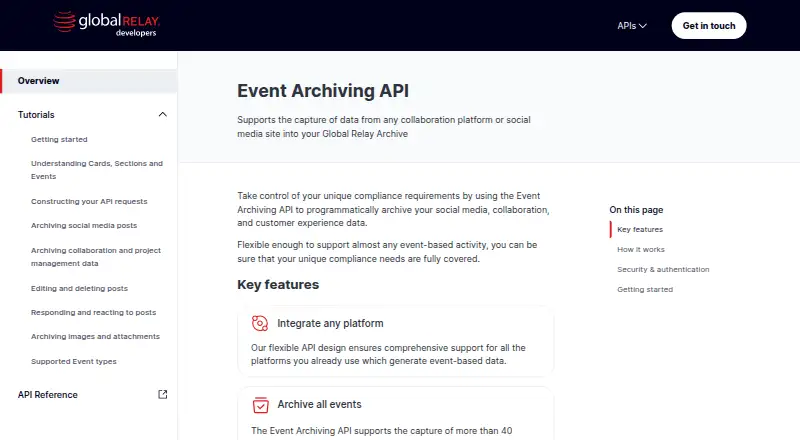
Global Relay Event Archiving API sends social media, collaboration, and customer experience data into Global Relay Archive, where users can discover and analyze it. It is designed for platforms that generate event-based data and supports more than 40 event types, including posts, replies, profile updates, and other user activity. Global Relay authenticates, validates, transforms, and stores submitted data. The API uses OAuth 2.0 Client Credentials authentication, requires HTTPS, and can be used with any language that has an HTTP library. Before making calls, applications must be registered and specify the data types they plan to archive; each source platform requires its own credential set. File attachments must be uploaded to the files endpoint before they can be referenced in an event. Global Relay lists connectors for services including Jira Cloud, LinkedIn, Microsoft Teams, Slack, Salesforce Chatter, WhatsApp Business, Zoom, and Webex. Archive capabilities include configurable retention, legal hold, advanced search, and export to PST or EML, or through FTP, DVD, or hard drive. Pricing is available on request.
Who it suits
The API suits organizations archiving social, collaboration, or customer experience data, particularly those in regulated industries. It is also relevant to developers integrating event-based data sources with Global Relay Archive.
What it does well
- Supports more than 40 event types
- Works with any language that has an HTTP library
- Offers configurable retention and legal hold
- Archive exports include PST and EML
What to know first
- Pricing is available on request
- Applications must be registered before calling the API
- Each source platform needs separate credentials
Plans
| Plan | Billed and limits | Price |
|---|---|---|
| Event Archiving API | application enrollment required · credentials per platform/data type | On request |
As developers.globalrelay.com lists them, read 30 Sept 2026. The maker's own page has the final word.
Getting started
- Visit the Event Archiving API page at https://developers.globalrelay.com/api/event-archiving-api/.
- Request pricing from Global Relay.
- Register an application and specify the data types it will archive.
- Obtain a separate credential set for each source platform.
- Authenticate with OAuth 2.0 Client Credentials and send requests over HTTPS.
- Upload attachments to PUT /files before referencing them in an event.
Overview
Global Relay Event Archiving API moves event-based data from social, collaboration and customer experience platforms into Global Relay Archive. It is best for organizations able to build integrations and needing centralized communications archiving, particularly in regulated sectors. Its event coverage and archive controls are strong; the trade-off is platform-specific setup and custom pricing.
Key features
The API supports more than 40 event types, including posts, replies, profile updates and other user activity. Global Relay authenticates, validates and transforms submissions before storing them in its archive for discovery and analysis. This breadth can help organizations consolidate varied communication streams, but it is an integration interface rather than a turnkey capture product.
Before making calls, an application must be registered and its intended data types declared. OAuth 2.0 Client Credentials provides authentication, while HTTPS endpoints use HTTP/1.1. Any language with an HTTP library can connect, giving engineering teams flexibility in implementation. Each source platform requires its own credential set, however, so adding platforms such as Jira and LinkedIn entails separate credentials and setup.
Attachments require a separate upload to the PUT /files endpoint before an event can reference them. Global Relay lists connectors for Jira Cloud, LinkedIn, Microsoft Teams, Slack, Salesforce Chatter, WhatsApp Business, Zoom and Webex. For other communication sources, its archive can accept standardized open-source formats delivered through secure SMTP, with custom integrations available.
Retention is configurable, and the archive supports legal hold, advanced search, and export to PST or EML, with delivery by FTP, DVD or hard drive. Global Relay says content is held in a WORM-compliant, tamper-proof format with continuous integrity checks, chain-of-custody tracking and encrypted storage. Its Trust Portal displays SOC 2 Type II, ISO 27001, GDPR and CCPA badges. Technical support, training, professional services and 24/7 expert advice and support are also provided.
Pricing
Event Archiving API
This paid plan has custom pricing. Application enrollment is required, and credentials are needed for each platform and data type. That structure suits organizations planning a defined integration program, but buyers should account for the operational work of connecting each source as well as the subscription cost. There is no stated seat or usage allowance to compare.
Platforms
The API is available through API and web platforms. Its HTTP-based transport is language-agnostic for systems with an HTTP library, while the listed connectors cover several major collaboration, social and customer communication services.
Who it's for
Choose it if your organization needs event-based communications archived centrally, can register applications and manage separate credentials for each source, and values retention controls, legal hold and search. Global Relay identifies financial services and other highly regulated industries as its target customers. It is a weaker fit for individuals or small teams seeking a self-contained archive without integration work or a published price.
Pros and cons
- Pros: More than 40 event types and connectors for widely used platforms give integration teams a broad starting point.
- Pros: Configurable retention, legal hold, advanced search and multiple export formats support ongoing archive and review needs.
- Pros: WORM-compliant storage, integrity checks and chain-of-custody tracking address preservation concerns in regulated environments.
- Cons: Enrollment and separate credentials per platform make onboarding more involved as sources multiply.
- Cons: Attachments need a separate upload step, adding work to event submission.
- Cons: Custom pricing makes cost comparison harder before a buyer engages Global Relay.
Alternatives
Social Media Archiving Software is a broader category to explore when you want to compare social archiving options. Pick Social Archiver instead if a free plan and mobile or browser access matter more than enterprise-focused archive controls; its free tier allows 10 successful archives per month, with duplicate saves excluded from the count.
Jatheon Cloud is worth considering for an archive billed per user annually, with unlimited storage and no egress fees at exit. Choose Aleph Archives if published starting tiers and a free trial suit your evaluation: Basic is $19 a month and Standard is $39 a month.
MirrorWeb Insight, Orlo, Proofpoint Enterprise Archive, Smarsh Archive and Arkiwera are other paid options to compare. Orlo offers sector-tailored pricing and selectable social media management, voice-of-community and customer-service modules; Arkiwera prices annual licenses by channel or domain count and includes at least 50 GB storage, three or more users and unlimited collections.
Verdict
Global Relay Event Archiving API is a sound choice for regulated organizations with engineering capacity that need to route varied event data into a controlled archive. Its strongest case is the combination of broad event support and preservation, search and export controls. Look elsewhere if you need a ready-to-use archive, simpler per-platform onboarding or pricing you can assess without requesting a quote.
Verdict
The API provides a defined path for moving event-based data into Global Relay Archive, with support for discovery, search, retention, and export. Enrollment, platform-specific credentials, and pricing on request are important requirements to consider.
Questions
How is the API priced?
Pricing is available on request.
What authentication does it use?
The API uses OAuth 2.0 Client Credentials grant authentication, and its endpoints require HTTPS.
Which platforms can connect to it?
Global Relay lists connectors including Jira Cloud, LinkedIn, Microsoft Teams, Slack, Salesforce Chatter, WhatsApp Business, Zoom, and Webex. Custom integrations are also available for communication data sources using a standardized open-source format and secure SMTP delivery.
What archive controls and exports are available?
The listed archive features include configurable retention, legal hold, and advanced search. Exports include PST and EML, as well as FTP, DVD, or hard drive delivery.
Does each platform need separate credentials?
Yes. A new credential set is required for every platform from which data is archived.
Who makes Global Relay Event Archiving API?
Global Relay is headquartered in Vancouver, British Columbia, Canada, and was founded in 1999.
Facts from Global Relay Event Archiving API's own pages
- Archive workflow
- Global Relay authenticates, validates, transforms, and stores submitted data in Global Relay Archive, where archive users can discover and analyze it. · developers.globalrelay.com, 30 Sept 2026
- Attachments
- File attachments must be uploaded to the PUT /files endpoint before they are referenced in an event request. · developers.globalrelay.com, 30 Sept 2026
- Authentication
- The API uses OAuth 2.0 Client Credentials grant authentication. · developers.globalrelay.com, 30 Sept 2026
- Certifications
- Global Relay’s Trust Portal displays SOC 2 Type II, ISO 27001, GDPR, and CCPA badges. · trust.globalrelay.com, 30 Sept 2026
- Compliance archive
- Global Relay says archived content is stored in a WORM-compliant, tamper-proof format with continuous integrity checks, chain-of-custody tracking, and encrypted storage. · globalrelay.com, 30 Sept 2026
- Credential scope
- A new credential set is required for every platform from which data is archived; Global Relay gives Jira and LinkedIn as examples requiring separate credentials. · developers.globalrelay.com, 30 Sept 2026
- Custom integration
- Global Relay Archive supports any communication data source using a standardized open-source format and secure SMTP delivery, with custom integrations available. · globalrelay.com, 30 Sept 2026
- Encryption
- Global Relay states that data is end-to-end encrypted in transit and at rest. · developers.globalrelay.com, 30 Sept 2026
- Enrollment
- Applications must be registered and specify the data types they plan to archive before calling the API. · developers.globalrelay.com, 30 Sept 2026
- Event types
- The API supports more than 40 event types, including posts, replies, profile updates, and other user activity. · developers.globalrelay.com, 30 Sept 2026
- Founded
- 1999 · developers.globalrelay.com, 28 Sept 2026
- Headquarters
- Vancouver, British Columbia, Canada · developers.globalrelay.com, 28 Sept 2026
- Integrations
- Global Relay lists connectors for platforms including Jira Cloud, LinkedIn, Microsoft Teams, Slack, Salesforce Chatter, WhatsApp Business, Zoom, and Webex. · globalrelay.com, 30 Sept 2026
- Platform coverage
- The API is designed to support platforms that generate event-based data, including collaboration platforms and social media sites. · developers.globalrelay.com, 30 Sept 2026
- Purpose
- The API programmatically archives social media, collaboration, and customer experience data into Global Relay Archive. · developers.globalrelay.com, 30 Sept 2026
- Support
- Global Relay provides technical support, training, professional services, and 24/7 expert advice and support. · globalrelay.com, 30 Sept 2026
- Target customers
- Global Relay describes its solutions as serving the global financial sector and other highly regulated industries. · globalrelay.com, 30 Sept 2026
- Transport
- Global Relay API endpoints require HTTPS and conform to HTTP/1.1, and the Event Archiving API works with any language that has an HTTP library. · developers.globalrelay.com, 30 Sept 2026
Where Global Relay Event Archiving API stands on Freedom251
- Social Media Archiving Software#16 of 38