Freedom251 › PDF Accessibility Software
Fruition PDF Accessibility
What Fruition PDF Accessibility is
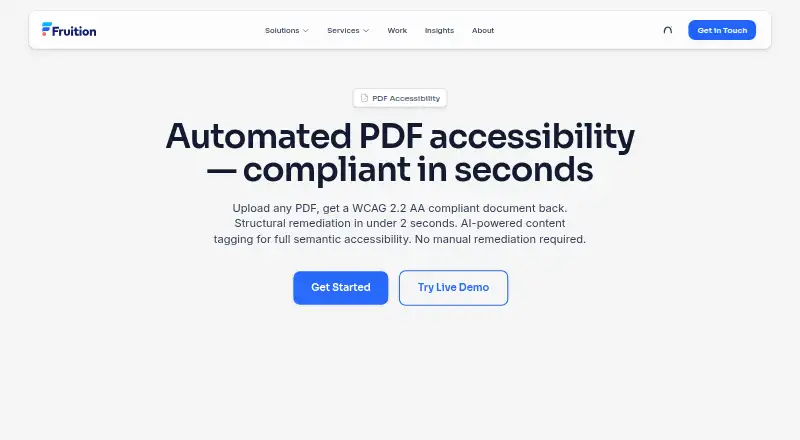
Fruition PDF Accessibility is a web and API service for remediating PDF structure and adding AI-generated content tags. Upload a valid PDF to receive structural fixes such as metadata, tagged-document status, a PDF/UA-1 identifier, tab order, structure trees, page resources, and bookmarks. AI analysis can identify headings, paragraphs, lists, and tables, build semantic structure, generate image alt text, and analyze color contrast. The service targets WCAG 2.2 AA, PDF/UA-1, Section 508, and ADA compliance. Structural remediation is listed at under 2 seconds per document; AI content tagging takes 30–60 seconds. Its REST API accepts PDFs through POST /api/v1/remediate, uses X-API-Key authentication, and allows up to 100 pages per request. The free plan costs nothing for 10 pages per month, with basic structural remediation and no credit card required. After that allowance, Basic structural remediation is $0.50, paid once; Full AI is $2, paid once.
Who it suits
It suits organizations managing PDFs at scale, including government, higher education, healthcare, legal, enterprise, and financial-services teams. The API and web options serve teams that need either programmatic or upload-based remediation.
What it does well
- Free plan covers 10 pages monthly.
- Structural remediation takes under 2 seconds per document.
- AI tagging covers tables, lists, and image alt text.
- API accepts PDFs up to 100 pages per request.
- Supports PDF/UA and reading-order tools.
What to know first
- AI content tagging takes 30–60 seconds per document.
- Free plan is limited to 10 pages per month.
- API requests are capped at 100 pages.
Limits
The free plan covers 10 pages per month and basic structural remediation. The API accepts up to 100 pages per request; after the free monthly pages, Basic costs $0.50, paid once and Full AI costs $2, paid once.
Plans
| Plan | Billed and limits | Price |
|---|---|---|
| Free — Get Started | 10 pages/mo · basic structural remediation · no credit card required · under 2 seconds per page | Free |
| Free | 10 basic pages/month · no credit card · structural fixes · under 2 seconds/page | Free |
| Basic — Structural Remediation | after 10 free pages per month · metadata · tags · bookmarks · tab order · color space | $0.50, paid once |
| Basic | per page after free allowance · structural remediation · metadata · tags · bookmarks · tab order · PDF/UA metadata | $0.50, paid once |
| Full AI — Complete WCAG 2.2 AA | includes all structural fixes · AI alt text · semantic tagging · tables · color contrast correction · reading order · validation report | $2, paid once |
| Full AI | per page · WCAG 2.2 AA remediation · AI alt text · semantic tagging · tables · contrast correction · reading-order fixes · validation report | $2, paid once |
As fruition.net lists them, read 1 Oct 2026. The maker's own page has the final word.
Getting started
- Visit https://fruition.net/ai-platforms/pdf-accessibility/.
- Choose the web service or use the REST API at POST /api/v1/remediate.
- For API use, provide a valid PDF as multipart/form-data and authenticate with an X-API-Key.
- Start with the free plan for up to 10 pages per month; no credit card is required.
- Choose Basic structural remediation or Full AI when processing beyond the free allowance.
Overview
Fruition PDF Accessibility remediates PDFs through a web service and REST API, with a choice between structural fixes and fuller AI-assisted tagging. It is best suited to organizations managing recurring PDF work, particularly those integrating remediation into a document pipeline. The split between a low-cost structural option and a more capable AI workflow is useful, but the monthly free allowance is small for sustained use.
Key features
Structural remediation updates metadata, marks the PDF as tagged, adds a PDF/UA-1 identifier, sets tab order, builds structure and parent trees, ensures page resources, and creates bookmarks. It is listed at under two seconds per page, making it the practical choice for basic repairs where speed and cost matter more than semantic analysis.
Full AI processing identifies headings, paragraphs, lists, and tables, adds marked-content tags, builds a semantic structure tree, generates image alt text, and analyzes color contrast. The workflow uses Claude Sonnet for content semantics; image alt text uses GPT-4o with Claude fallback. At 30–60 seconds per document, this takes substantially longer than structural remediation, but adds the content-level work that basic repair omits.
The service targets WCAG 2.2 AA, PDF/UA-1, Section 508, and ADA compliance. The API accepts any valid PDF through POST /api/v1/remediate, using multipart/form-data input and X-API-Key authentication, and returns a remediated PDF as binary output. Each request is capped at 100 pages, which matters for longer documents. PDF tagging, reading order, alternative-text tools, and PDF/UA support are also included in its capabilities.
Pricing
The Free plan costs free, covers 10 pages per month, requires no credit card, and provides basic structural remediation at under two seconds per page. It is a useful way to handle occasional, short jobs, but the page cap makes it a limited fit for regular organizational workloads.
After the first 10 free pages in a month, Basic structural remediation costs $0.50, paid once. It covers metadata, tags, bookmarks, tab order, and color space. This is the economical choice when structural repair is enough; it does not include the AI content work.
Full AI costs $2, paid once and includes all structural fixes, AI alt text, semantic tagging, tables, color contrast correction, reading order, and a validation report. Choose it when those additions justify the higher per-use charge and longer processing time. Volume pricing is available for government and enterprise customers.
Platforms
Fruition supports web and API workflows. The API's 100-page request limit and key-based authentication suit integration, while the web option provides a route for work that does not need to be sent through an API. Fruition's Trust Center includes SOC 2, ISO/IEC 27001, HIPAA, and PCI DSS compliance materials. Its contact page says inquiries receive a personal follow-up within the hour.
Who it's for
Fruition describes the platform for government, higher education, healthcare, legal, enterprise, and financial-services organizations managing PDFs at scale. Its standards targets and API make it relevant to teams with recurring document workflows; the 10-page monthly free cap is better suited to limited use than ongoing volume.
Pros and cons
Pros
- Two distinct service levels: teams can pay for structural fixes alone or choose AI tagging and additional remediation work.
- API workflow: authenticated PDF input and binary output support integration, with requests up to 100 pages.
- Broad standards targets: the service targets WCAG 2.2 AA, PDF/UA-1, Section 508, and ADA compliance.
Cons
- Small free allowance: 10 pages per month will not stretch far for organizations processing PDFs regularly.
- AI work takes longer: 30–60 seconds per document, compared with under two seconds per page for structural remediation.
- Basic remediation is narrower: the lower-cost option does not include AI alt text, semantic tagging, or the validation report.
Alternatives
PDF Accessibility Software is the broader category directory for comparing tools. Choose Grackle GO instead for a free web or desktop option with a 25 MB maximum file size and 10 validations per hour for unauthenticated users.
PDFix Desktop is worth considering when desktop PDF/UA validation and WCAG 2.1 and 2.2, Section 508, or European Accessibility Act checks are the priority. Choose veraPDF instead for a free, open-source validator with downloadable releases and development builds.
DocAccessible may suit users who need a free allowance of three documents per month alongside two active Exchange cases, one website, and monitoring for 20 PDFs. Normfluss is another freemium alternative for web and API workflows.
PDFAccessibility.ai offers a free tier with 10 accessible PDF exports, unlimited accessibility checks, uploads up to 10 MB, and seven-day file retention. Adobe PDF Services API may be preferable to teams seeking a service with a 500-transaction monthly free tier and custom-priced paid plans. Nutrient DWS Accessibility API offers API and self-hosted options, including a free allowance of 20 auto-tagged pages and 100 validations per month.
Verdict
Fruition PDF Accessibility is a strong fit for organizations that need API-based PDF remediation and want to choose between fast structural fixes and broader AI tagging. Its clearest advantage is that those workflows have separate scopes and prices. Look elsewhere if 10 free pages a month is too little, or if the AI workflow's 30–60-second processing time does not suit the volume or pace of your work.
Verdict
Fruition PDF Accessibility offers structural remediation and AI tagging through web and API workflows, with stated targets covering several accessibility standards. Check the monthly free-page allowance and the separate listed charges for Basic and Full AI work when estimating use.
Questions
Is there a free plan?
Yes. The free plan costs nothing, covers 10 pages per month, and includes basic structural remediation without a credit card.
What do the paid plans cost?
Basic — Structural Remediation is $0.50, paid once after the 10 free pages per month. Full AI — Complete WCAG 2.2 AA is $2, paid once.
Which platforms are available?
Fruition PDF Accessibility is listed for web and API.
What is the API page limit?
The API accepts up to 100 pages per request and returns a binary remediated PDF.
What standards does the service target?
It targets WCAG 2.2 AA, PDF/UA-1, Section 508, and ADA compliance.
Is volume pricing available?
Volume pricing is available for government and enterprise customers.
Facts from Fruition PDF Accessibility's own pages
- AI components
- The production workflow uses pdf-lib for parsing, Claude Sonnet for semantic analysis and GPT-4o for image alt text. · fruition.net, 15 Oct 2026
- AI models
- Image alt text uses GPT-4o with Claude fallback; the production workflow says Claude Sonnet analyzes content semantics. · fruition.net, 1 Oct 2026
- AI tagging
- AI analysis identifies headings, paragraphs, lists, and tables, injects marked-content tags, builds a semantic structure tree, generates image alt text, and analyzes color contrast. · fruition.net, 1 Oct 2026
- Alternative text
- Image descriptions are generated with GPT-4o and Claude fallback models. · fruition.net, 15 Oct 2026
- API
- The REST API uses POST /api/v1/remediate with multipart/form-data PDF input, binary remediated-PDF output, and X-API-Key authentication. · fruition.net, 1 Oct 2026
- API authentication
- API requests use an X-API-Key header and multipart/form-data PDF uploads. · ada.fru.io, 15 Oct 2026
- API documentation
- The documentation provides a base URL, account and key setup, curl example and authentication guidance, but no SDK listings are shown. · ada.fru.io, 15 Oct 2026
- API endpoint
- The public API exposes POST /api/v1/remediate at ada.fru.io. · ada.fru.io, 15 Oct 2026
- API limit
- Each API request supports PDFs of up to 100 pages. · fruition.net, 15 Oct 2026
- API response
- The API returns a remediated PDF binary and compliance metrics in response headers. · ada.fru.io, 15 Oct 2026
- Company founding
- Fruition is listed as founded in January 2003. · crunchbase.com, 15 Oct 2026
- Company headquarters
- Fruition is based in Denver, Colorado. · crunchbase.com, 15 Oct 2026
- Company security
- Fruition's Trust Center lists SOC 2, ISO/IEC 27001, HIPAA, and PCI DSS compliance materials. · security.fruition.net, 1 Oct 2026
- Company size
- LinkedIn lists Fruition's company size as 11–50 employees and says it has more than 30 full-time professionals. · linkedin.com, 15 Oct 2026
- Contrast checking
- The AI phase analyzes color contrast using WCAG luminance ratios and can correct low-contrast elements. · fruition.net, 15 Oct 2026
- Deployment
- The service is presented as a hosted web/API product at ada.fru.io, with no self-hosting package described. · ada.fru.io, 15 Oct 2026
- Founded
- 2003 · fruition.net, 28 Sept 2026
- Funding
- Crunchbase lists Fruition as private and does not expose a disclosed funding total on the public profile. · crunchbase.com, 15 Oct 2026
- Headquarters
- Denver, Colorado, United States · fruition.net, 28 Sept 2026
- Input formats
- The API accepts any valid PDF document. · fruition.net, 1 Oct 2026
- Integrations
- The documented integration method is a REST API; no native connectors for other business applications are listed. · fruition.net, 15 Oct 2026
- Legal name
- Crunchbase identifies the maker's legal name as Fruition Growth LLC. · crunchbase.com, 15 Oct 2026
- Licence
- The reviewed product pages do not publish an open-source licence or downloadable source code. · fruition.net, 15 Oct 2026
- Limit: AI verification
- An independent WCAG.World test found an AI model could infer reading order but could not modify the original PDF tag structure, showing why generated files still need validation. · wcag.world, 15 Oct 2026
Where Fruition PDF Accessibility stands on Freedom251
- PDF Accessibility Software#5 of 26