Freedom251 › PDF Accessibility Software
PDFAccessibility.ai
What PDFAccessibility.ai is
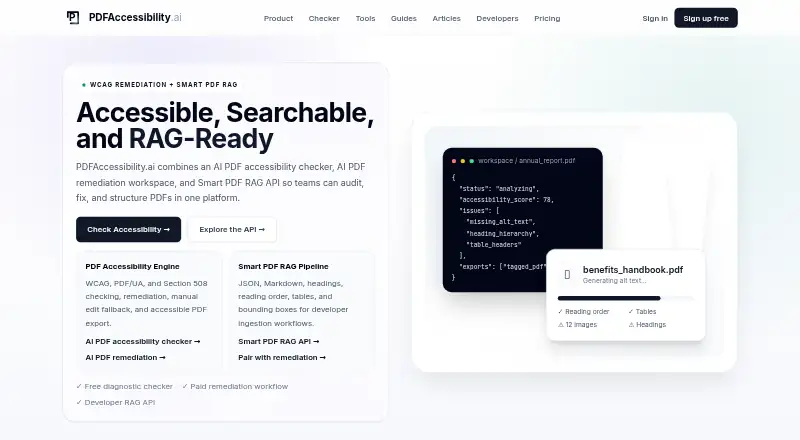
PDFAccessibility.ai combines PDF accessibility checks, remediation, manual editing, accessible PDF export, and a structured-data API. Its checks report issues against WCAG, PDF/UA, Section 508, ADA, and EN 301 549 expectations. The remediation workflow tags document structure, improves reading order, and detects headings and tables to prepare files for assistive technology. Users can edit tag types, heading levels, content, and image alt text when automation flags complex items. Batch workflows provide per-file actions and ZIP downloads. The Smart PDF RAG API returns JSON and Markdown with typed elements, tables, reading order, page references, and bounding boxes; documented API processing uses asynchronous uploads and polling. The free PDF Accessibility plan includes 10 accessible exports, unlimited checks, and seven-day file retention. Paid plans start at $29 a month. The privacy policy says uploads are not used to train public AI models, though some workflows may send necessary information to infrastructure or AI providers. Complex layouts, unusual tables, scanned pages, or ambiguous reading order may need manual review.
Who it suits
The listed PDF remediation users include compliance, agency, education, government, legal, and healthcare teams. Developers and AI teams may use the structured PDF data API.
What it does well
- Checks against WCAG, PDF/UA, and other listed expectations.
- Includes manual editing for tags and image alt text.
- Batch remediation supports ZIP downloads.
- Free PDF plan includes 10 accessible exports.
What to know first
- Free-plan files are retained for seven days.
- Complex layouts may need manual review.
- API documentation uses polling as its current baseline.
- Some workflows may send necessary information to providers.
Limits
PDF Accessibility Free includes 10 accessible PDF exports and uploads up to 10 MB, with files retained for 7 days. Developer API Starter includes 100 parsed pages per month and preview output, with no production volume or organization API keys.
Plans
| Plan | Billed and limits | Price |
|---|---|---|
| PDF Accessibility Free | forever · 10 accessible PDF exports · Unlimited accessibility checks · PDF uploads up to 10 MB · Files retained for 7 days · All converter tools | Free |
| Developer API Starter | forever · 100 parsed pages/month · JSON and Markdown preview · Reading order and heading structure · Bounding box preview · No production volume or organization API keys | Free |
| PDF Accessibility Enterprise | monthly · 5,000 accessible PDF exports/month · Unlimited checks · 10 GB retained storage · Higher-volume batch remediation · Team workflow · Priority remediation support | $199 a month |
| API Scale | monthly · 250,000 parsed pages/month · Organization API keys · Usage by key and member · Developer roles and team controls · Custom API volume available · Integration support | $199 a month |
| PDF Accessibility Pro | monthly · 500 accessible PDF exports/month · Unlimited checks · 50 MB PDF uploads · 1 GB retained storage · Manual editor · Batch remediation and ZIP export | $29 a month |
| Developer Pro | monthly · 50,000 parsed pages/month · Parse API access · API key management · JSON, Markdown, tables, headings, and bboxes · Usage dashboard · Layout-aware RAG chunks | $29 a month |
As pdfaccessibility.ai lists them, read 30 Sept 2026. The maker's own page has the final word.
Getting started
- Open https://pdfaccessibility.ai/
- Choose the PDF Accessibility Free or Developer API Starter free plan, or a paid plan starting at $29 a month
- Use the web platform for PDF accessibility workflows or the API for structured parsing
- For API parsing, upload a PDF to the asynchronous parse endpoint and poll for completed output
- Keep API keys server-side and send them in an X-API-Key header
PDFAccessibility.ai is a combined PDF compliance workspace and structured-data API. It fits compliance, publishing, education, government, legal, healthcare, developer, and AI teams that process documents repeatedly. Its value is breadth—checking, repair, editing, export, and parsing in one service—but difficult PDFs still require human judgment.
Overview
The service checks PDFs against WCAG, PDF/UA, Section 508, ADA, and EN 301 549 expectations, then offers automated remediation and an editor for exceptions. A separate Smart PDF RAG API turns document content into structured output. That combination is compelling when accessible delivery and machine-readable extraction belong in the same workflow; it is less suitable if you only need occasional validation or a general-purpose PDF editor.
Key features
Automatic remediation tags document structure, improves reading order, identifies headings and tables, and prepares files for assistive technology. The FAQ describes roughly 90% accuracy across common PDFs. Complex layouts, unusual tables, scanned pages, and unclear reading order can still be wrong, so a compliance sign-off should include manual inspection rather than treating the automated pass as final.
The manual editor provides control over tag types, heading levels, text content, and image alt text. Those controls address exactly the cases automation can miss, although they also mean teams need accessibility expertise for reliable corrections. Batch remediation supports per-file actions and ZIP downloads of accessible PDFs, making it more practical for recurring queues than for a single ad hoc document.
The Smart PDF RAG API returns JSON and Markdown containing typed elements, tables, reading order, page references, and bounding boxes. Its asynchronous parse endpoint accepts PDF uploads and requires polling for completion. The documentation advises keeping keys on the server and sending them in an X-API-Key header; polling is the current baseline, so webhook-dependent designs should wait for a supported integration.
Privacy safeguards include a statement that uploaded documents are not used to train public AI models, alongside administrative, technical, and organizational controls. Some processing may send necessary information to infrastructure or AI providers for analysis, text generation, or document intelligence. Free PDF Accessibility files are retained for seven days; retention can vary by plan, workflow, workspace, and operational needs.
Pricing
PDF Accessibility Free costs nothing, billed forever. It includes unlimited checks, all converter tools, uploads up to 10 MB, and 10 accessible PDF exports. That is a useful evaluation tier, but the export ceiling and seven-day retention make it unsuitable for a sustained production queue.
Developer API Starter is free, billed forever, with 100 parsed pages per month, JSON and Markdown previews, reading-order and heading structure, and bounding-box previews. It has no production volume or organization API keys, so it is for prototyping rather than a live integration.
PDF Accessibility Pro is $29 a month, billed monthly. It raises capacity to 500 exports per month, 50 MB uploads, and 1 GB retained storage, while adding the manual editor, batch remediation, and ZIP export. Choose it for an individual or small team with regular remediation; larger document operations will outgrow its quotas.
Developer Pro is $29 a month, billed monthly, with 50,000 parsed pages per month, Parse API access, API-key management, JSON, Markdown, tables, headings and bounding boxes, a usage dashboard, and layout-aware RAG chunks. It is the practical production tier for a moderate API workload, but not for organization-wide volume.
PDF Accessibility Enterprise costs $199 a month, billed monthly. It provides 5,000 exports, 10 GB storage, higher-volume batch remediation, team workflow, and priority remediation support. API Scale costs $199 a month, billed monthly, and includes 250,000 parsed pages, organization keys, usage by key and member, developer roles, team controls, custom API volume, and integration support. These tiers fit established teams that need governance or support rather than simply more individual capacity.
Platforms
PDFAccessibility.ai is offered through web and API access. The API model suits server-side document pipelines, while the web workspace supports review, editing, and batch export.
Who it's for
Compliance teams, agencies, education, government, legal, and healthcare groups get a focused remediation workflow with standards-based checks and export controls. Developers and AI teams benefit from typed, location-aware JSON and Markdown. It is a poor fit when every document is highly irregular and there is no time or expertise for manual review.
Pros and cons
- Pros: Covers five major accessibility expectations in one checking workflow.
- Pros: Combines automated tagging with manual control over structure, headings, text, and alt text.
- Pros: Batch ZIP export and separate RAG output support operational and engineering workflows.
- Cons: About 90% stated accuracy leaves complex, scanned, or ambiguous PDFs for manual correction.
- Cons: The free plan allows only 10 exports and retains files for seven days.
- Cons: API integrations must currently poll, and some processing may involve external infrastructure or AI providers.
Alternatives
Pick PDF Accessibility Software to compare the wider category. Grackle GO is a free web and desktop option with 25 MB files and 10 unauthenticated validations per hour. Choose PDFix Desktop for a desktop workflow with PDF/UA, WCAG 2.1/2.2, Section 508, and European Accessibility Act checks. veraPDF is the free, open-source validator for downloadable local tooling. DocAccessible suits monitoring and exchange workflows, while Fruition PDF Accessibility offers a free 10-pages-per-month starting tier. Normfluss is another freemium web/API choice with a free check. Choose Adobe PDF Services API when a vendor-managed API and custom-priced plans fit better. Nutrient DWS Accessibility API is worth considering for API or self-hosted deployments with a 20 auto-tagged-pages-per-month free tier.
Verdict
Choose PDFAccessibility.ai if your team needs recurring accessible PDF production plus structured extraction in one web/API platform. The main reason to choose it is the combination of standards checks, repair, manual correction, batch export, and typed RAG output. Look elsewhere if your workload is tiny, your files are routinely complex without reviewer capacity, or an integration cannot accommodate asynchronous polling.
Verdict
PDFAccessibility.ai covers document checks, remediation, editing, exports, and structured data for API workflows. Review complex files manually when needed, and account for the free plan’s export and retention limits.
Questions
Is PDFAccessibility.ai free?
Yes. PDF Accessibility Free and Developer API Starter are each free, billed forever, with different plan limits.
How much do paid plans cost?
PDF Accessibility Pro and Developer Pro cost $29 a month, billed monthly. PDF Accessibility Enterprise and API Scale cost $199 a month, billed monthly.
Which platforms does it support?
The listed platforms are web and API.
What does the API return?
It returns structured JSON and Markdown that can include typed elements, tables, reading order, page references, and bounding boxes.
Are uploaded documents used to train public AI models?
The privacy policy says uploaded documents are not used to train public AI models. Some workflows may send necessary information to infrastructure or AI providers for document analysis, accessible text generation, or document intelligence.
Who makes PDFAccessibility.ai?
The listed facts do not identify the maker.
Facts from PDFAccessibility.ai's own pages
- Accessibility checks
- It reports issues against WCAG, PDF/UA, Section 508, ADA, and EN 301 549 expectations. · pdfaccessibility.ai, 30 Sept 2026
- Accuracy and review
- The FAQ describes automatic remediation as about 90% accurate across common PDFs and says complex layouts, unusual tables, scanned pages, or ambiguous reading order may need manual review. · pdfaccessibility.ai, 30 Sept 2026
- API integration
- The documented API accepts PDF uploads at an asynchronous parse endpoint and uses polling for completed output. · pdfaccessibility.ai, 30 Sept 2026
- API key handling
- The docs advise keeping API keys server-side and sending them in an X-API-Key header. · pdfaccessibility.ai, 30 Sept 2026
- API limitation
- The API documentation identifies polling as the current baseline and says not to design around webhook delivery unless a supported integration is enabled. · pdfaccessibility.ai, 30 Sept 2026
- Automatic remediation
- The remediation workflow tags PDF structure, improves reading order, detects headings and tables, and prepares documents for assistive technology. · pdfaccessibility.ai, 30 Sept 2026
- Batch workflows
- Batch remediation supports per-file actions and ZIP downloads of ready accessible PDFs. · pdfaccessibility.ai, 30 Sept 2026
- Data processing
- Some workflows may send necessary information to infrastructure or AI providers for document analysis, accessible text generation, or document intelligence. · pdfaccessibility.ai, 30 Sept 2026
- Intended users
- The pricing page identifies compliance teams, agencies, education, government, legal, and healthcare teams as users for PDF remediation, and developers and AI teams for structured PDF data. · pdfaccessibility.ai, 30 Sept 2026
- Manual editing
- Users can review and edit tag types, heading levels, content, and image alt text when automation flags complex items. · pdfaccessibility.ai, 30 Sept 2026
- RAG output
- The API returns structured JSON and Markdown with typed elements, tables, reading order, page references, and bounding boxes. · pdfaccessibility.ai, 30 Sept 2026
- Retention limit
- The free PDF Accessibility plan retains files for 7 days; the policy says retention can vary by plan, workflow, workspace configuration, and operational needs. · pdfaccessibility.ai, 30 Sept 2026
- Security and privacy
- The privacy policy says uploaded documents are not used to train public AI models and describes administrative, technical, and organizational safeguards. · pdfaccessibility.ai, 30 Sept 2026
- Support
- The Enterprise PDF Accessibility plan includes priority remediation support, while the API Scale plan includes integration support. · pdfaccessibility.ai, 30 Sept 2026
- What it does
- The platform combines PDF accessibility checking, remediation, manual editing, accessible PDF export, and a Smart PDF RAG API. · pdfaccessibility.ai, 30 Sept 2026
Where PDFAccessibility.ai stands on Freedom251
- PDF Accessibility Software#10 of 26