Freedom251 › Nonprofit Program Management Software
FORMNA
What FORMNA is
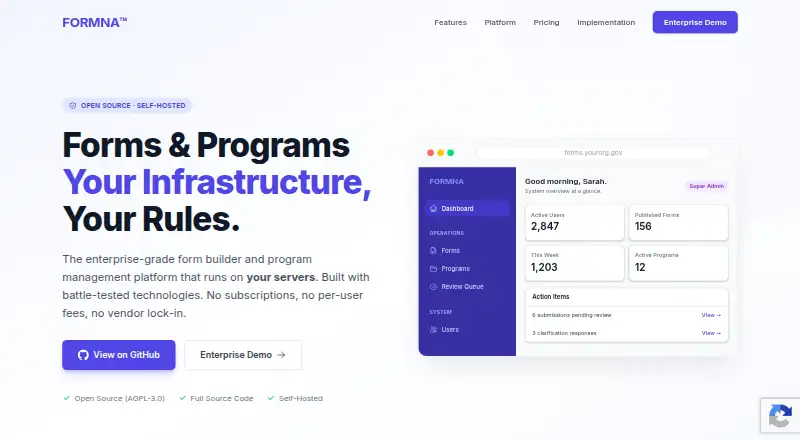
FORMNA is a self-hosted form builder and program management platform for organizing forms, submissions, review workflows, and reports. Its drag-and-drop builder offers 15 field types, conditional logic, validation, file uploads, draft auto-save, and version management. Programs can bundle forms with deadlines, submission and eligibility rules, instructions, and permissions. Multi-stage reviews support assigned reviewers, weighted scoring, clarification requests, and approve, reject, or advance decisions. Four roles have scoped permissions and tailored dashboards. Security features include TOTP multi-factor authentication, encrypted data at rest, rate limiting, and session invalidation; actions are logged, and submissions can be exported as CSV. Optional AI summaries use a configurable provider while data stays on the organization’s servers. Deployment is documented for Docker or bare metal, with PHP 8.2+, MySQL 8.0+ or MariaDB 10.6+, and Apache or Nginx required. The Open Source plan is free for qualifying organizations. Commercial plans include Enterprise Annual License at $25,000 a year and Enterprise Lifetime License at $67,500, paid once. Specified organization types and uses require commercial licensing.
Who it suits
FORMNA suits organizations managing structured applications or submissions with multi-stage review and audit requirements. Its open-source plan is for qualifying organizations; specified commercial uses require a commercial license.
What it does well
- Builder includes 15 field types and conditional logic
- Supports assigned reviewers and weighted scoring
- Logs actions and exports submissions as CSV
- Self-hosted deployment supports Docker or bare metal
What to know first
- Requires PHP 8.2+ and a supported database
- Commercial licensing is required for specified uses
- Enterprise Annual License costs $25,000 a year
- Enterprise Lifetime License costs $67,500, paid once
Limits
The free Open Source plan is restricted to qualifying organizations. Commercial licensing is required for enterprises with revenue of at least $1M, healthcare providers, financial-services firms, public or commercial government use, and SaaS deployments. Enterprise Annual License costs $25,000 a year; the one-time Enterprise Lifetime License costs 67500.00 USD.
Plans
| Plan | Billed and limits | Price |
|---|---|---|
| Open Source | Free · AGPL-3.0 · self-hosted · all features included · qualifying organizations | Free |
| Annual Maintenance | $2,500 / year · lifetime license holders only · security patches · upgrades · priority support | $2,500 a year |
| Enterprise Annual License | $25,000 / year · commercial use · priority support · implementation assistance · custom feature development · unlimited users & modifications | $25,000 a year |
| Enterprise Lifetime License | $67,500 one-time · commercial use · indefinite use · implementation assistance · priority support · custom feature development · unlimited users & modifications | $67,500, paid once |
As formna.com lists them, read 30 Sept 2026. The maker's own page has the final word.
Getting started
- Check whether your organization qualifies for the Open Source plan or needs commercial licensing.
- Prepare a server with PHP 8.2+, MySQL 8.0+ or MariaDB 10.6+, and Apache or Nginx.
- Choose a Docker or bare-metal installation.
- Set up organization roles, permissions, and programs.
- Build forms and configure review stages.
Overview
FORMNA combines form creation with program rules, review workflows and reporting in software organizations host themselves. It suits institutions that need structured application or submission processes, with role-based access and an auditable record of actions. Its breadth is compelling, but deployment and licensing make it a more considered choice than a lightweight hosted form tool.
Key features
The drag-and-drop builder covers 15 field types, conditional logic, validation, regex patterns, file uploads, draft auto-save and version management. That is a substantial toolkit for complex applications; version management and saved drafts are particularly useful when forms change or submissions take time to complete.
Programs can group forms with deadlines, instructions, submission and eligibility rules, and custom permissions. Multi-stage reviews add assigned reviewers, weighted scoring, clarification requests and approve, reject or advance decisions. Together, these features support a defined intake-to-decision process rather than just collecting responses.
Four roles—Super Admin, Admin, Reviewer and User—come with scoped permissions and tailored dashboards. Security measures include TOTP multi-factor authentication, role-specific MFA policies, encryption at rest, CSRF protection, IP-based rate limiting and cross-device session invalidation. Action logs record who did what and when, and submissions can be exported as CSV. These controls suit organizations with accountability requirements, though self-hosting also means the organization takes responsibility for operating its own installation.
Outgoing webhooks cover submission events, retries and delivery logs, with SSRF-safe URL validation; email can use SMTP or SES. Optional organization-level AI summaries use a configurable LLM provider while keeping data on the organization’s servers. The system includes English and Arabic, French, Spanish, German and Danish translations, custom language support, and both LTR and RTL layouts.
Installation is documented for Docker or bare metal and requires PHP 8.2 or later, MySQL 8.0 or later or MariaDB 10.6 or later, and Apache or Nginx. That flexibility helps organizations with suitable infrastructure, but makes FORMNA a poor fit for teams seeking a fully managed service.
Pricing
FORMNA is freemium, but its free tier is conditional: the Open Source plan costs nothing, is self-hosted, uses AGPL-3.0 and includes all features for qualifying organizations. Enterprises with revenue of at least $1M, healthcare providers, financial-services firms, public or commercial government use, and SaaS deployments require commercial licensing. Organizations should establish eligibility before treating the free plan as an option.
Annual Maintenance costs $2,500 a year and is limited to lifetime license holders; it includes security patches, upgrades and priority support. It is not an entry-level commercial subscription. The Enterprise Annual License costs $25,000 a year and adds commercial use, priority support, implementation assistance, custom feature development, and unlimited users and modifications. The Enterprise Lifetime License costs $67,500, paid once, for indefinite commercial use with implementation assistance, priority support, custom feature development, and unlimited users and modifications. The lifetime price is a larger upfront commitment; the annual license spreads the cost but recurs yearly.
Enterprise implementation is priced separately: remote setup for up to 25 forms costs $8,000—$15,000, additional form migration costs $150—$300 per form, and additional training costs $1,000—$1,500 per session. These costs matter for teams moving an established process into FORMNA, beyond the license itself.
Platforms
FORMNA is available as self-hosted software and on the web. Deployment requires PHP 8.2+, MySQL 8.0+ or MariaDB 10.6+, and Apache or Nginx. Open-source users receive community support through GitHub; commercial licensing includes priority support and maintenance.
Who it's for
FORMNA is best suited to government, enterprise, university, healthcare and financial-services organizations that need governed programs, multi-stage decisions and control over where the system runs. Its feature set can support complex intake and review, but the self-hosting requirements and commercial-use rules are significant trade-offs. Smaller qualifying organizations may find the open-source plan attractive; organizations that need a managed platform or do not qualify for free use should weigh the commercial costs and implementation work carefully.
Pros and cons
Pros
- One system for forms and decisions: Program rules, multi-stage reviews, weighted scoring and decision actions connect collection to evaluation.
- Detailed controls and traceability: Four permission-scoped roles, security measures and action logs support accountable workflows.
- Deployment and language flexibility: Docker or bare-metal installation, custom language support and RTL alongside LTR address varied organizational needs.
- Open-source access for qualifying users: The free self-hosted plan includes all features.
Cons
- Free use is restricted: Several organization types and SaaS deployments require commercial licensing.
- Commercial entry costs are substantial: The annual license is $25,000 a year, with implementation and migration potentially adding materially to the bill.
- Self-hosting calls for technical capacity: Organizations need to provide compatible infrastructure and manage the deployment.
- Maintenance has a narrow audience: The $2,500 a year plan is only for lifetime license holders.
Alternatives
For organizations comparing tools by their program and form workflows, browse Nonprofit Program Management Software and Form Automation Software.
- Alleviate ImpactOps OS is worth considering when a web-based freemium option is preferable; its Growth plan costs $150 a month and includes three programmes and 25 funding alerts per month.
- eSuivi may suit smaller teams looking for a free starting point: its Starter plan covers up to two users and one project, with basic reporting and email support; it also offers a free trial.
- Kinaki is another web-based freemium option with a free plan and free trial.
- KoNote is a free, self-hosted MIT-licensed option for organizations prepared to configure and secure their own infrastructure.
- Kindora offers a web-based free Starter plan for up to five team members, with core modules, basic exports, email support and community resources.
- Salesforce Nonprofit Cloud may be relevant to eligible nonprofits seeking Salesforce: its Power of Us Program provides 10 free Nonprofit Cloud or Sales/Service Cloud licenses.
- OpenSPP SP-MIS is a free option with self-hosted availability.
- TraxSolutions is an alternative available on Android, iOS and the web.
Verdict
FORMNA is a strong fit for organizations that need self-hosted form and program management with structured reviews, granular access controls and an audit trail. Its all-features free plan is appealing to qualifying organizations, but commercial-use restrictions, infrastructure demands and high enterprise licensing and implementation costs make eligibility and total cost central to the decision. Look elsewhere if you need a managed service or cannot justify that operational and financial commitment.
Verdict
FORMNA brings form creation, program rules, reviews, and reporting into a self-hosted platform. Organizations should check whether they qualify for the free plan or require commercial licensing.
Questions
Is FORMNA free?
Yes, the Open Source plan costs nothing and is available under AGPL-3.0 for qualifying organizations. Commercial use cases specified by the maker require a commercial license.
What does the Enterprise Annual License cost?
It costs $25,000 a year and includes commercial use, priority support, implementation assistance, custom feature development, and unlimited users and modifications.
Is there a lifetime license?
Yes. Enterprise Lifetime License costs $67,500, paid once for indefinite use, with implementation assistance, priority support, custom feature development, and unlimited users and modifications.
Can FORMNA be self-hosted?
Yes. Installation is documented for Docker and bare metal. Requirements include PHP 8.2+, MySQL 8.0+ or MariaDB 10.6+, and Apache or Nginx.
Does FORMNA support webhooks?
Yes. Outgoing webhooks support submission events, automatic retries, and delivery logs.
What support comes with the plans?
Open-source users receive community support via GitHub. Commercial licensing includes priority support and maintenance; Annual Maintenance for lifetime license holders costs $2,500 a year.
Facts from FORMNA's own pages
- Access control
- FORMNA provides four roles—Super Admin, Admin, Reviewer, and User—with scoped permissions and tailored dashboards. · formna.com, 30 Sept 2026
- AI summaries
- Optional organization-level AI summaries use a configurable LLM provider while keeping data on the organization’s servers. · formna.com, 30 Sept 2026
- Auditability
- Every action is logged with who, what, and when, and submissions can be exported in CSV format. · formna.com, 30 Sept 2026
- Deployment
- The repository documents Docker and bare-metal installation with PHP 8.2+, MySQL 8.0+ or MariaDB 10.6+, and Apache or Nginx. · github.com, 30 Sept 2026
- Form builder
- The drag-and-drop builder supports 15 field types, conditional logic, validation rules, regex patterns, file uploads, auto-save drafts, and version management. · formna.com, 30 Sept 2026
- Implementation
- Enterprise implementation pricing includes remote setup for up to 25 forms at $8,000—$15,000, additional form migration at $150—$300 per form, and additional training at $1,000—$1,500 per session. · formna.com, 30 Sept 2026
- Integrations
- Outgoing webhooks support submission events, automatic retries, delivery logs, SSRF-safe URL validation, and SMTP or SES email. · formna.com, 30 Sept 2026
- Languages
- The system includes English and Arabic plus French, Spanish, German, and Danish translations, with custom language support and full LTR and RTL support. · formna.com, 30 Sept 2026
- Program management
- Programs can bundle forms with deadlines, submission rules, instructions, eligibility rules, and custom permissions. · formna.com, 30 Sept 2026
- Purpose
- FORMNA is a self-hosted form builder and program management platform for managing forms, submissions, review workflows, and reports. · github.com, 30 Sept 2026
- Review workflows
- Multi-stage reviews support assigned reviewers, weighted scoring, configurable actions, clarification requests, and approve, reject, or advance decisions. · formna.com, 30 Sept 2026
- Security
- Security features include TOTP multi-factor authentication, per-role MFA policies, encrypted data at rest, CSRF protection, IP-based rate limiting, and cross-device session invalidation. · formna.com, 30 Sept 2026
- Support
- Open-source users receive community support via GitHub, while commercial licensing includes priority support and maintenance. · github.com, 30 Sept 2026
- Target organizations
- FORMNA is presented for government, enterprise, universities, healthcare, and financial-services organizations, with commercial licensing required for enterprises with revenue of at least $1M, healthcare providers, financial-services firms, public or commercial government use, and SaaS deployments. · formna.com, 30 Sept 2026
Where FORMNA stands on Freedom251
- Nonprofit Program Management Software#4 of 29
- Form Automation Software#11 of 26