Freedom251 › Nonprofit Program Management Software
OpenSPP SP-MIS
What OpenSPP SP-MIS is
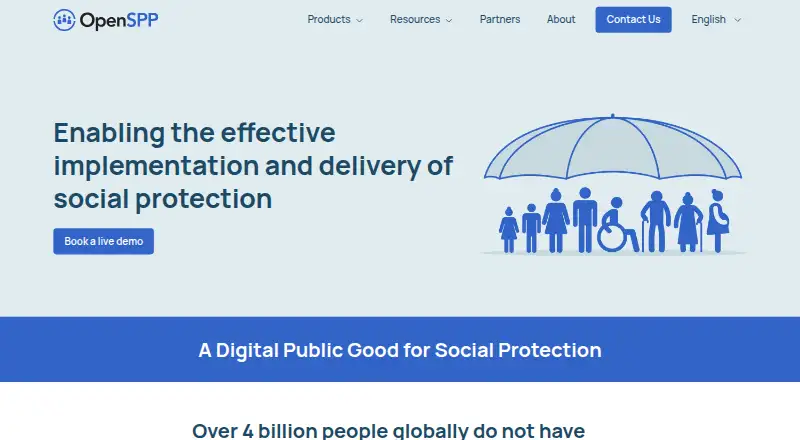
OpenSPP SP-MIS manages social protection programs from beneficiary enrollment through assistance delivery and payment. It supports routine and emergency cash or in-kind programs, including vouchers and food and non-food distributions. Enrollment workflows can use configurable approval chains, while eligibility rules use Common Expression Language and can be configured in the visual Logic Studio builder. Teams can plan payment cycles, calculate entitlements, reconcile payments, and distribute through bank transfers, mobile money, or manual delivery. Service point tools track locations and capacity, schedule distributions, record attendance, and link inventory. A grievance mechanism lets beneficiaries and staff submit and track complaints through resolution, with service-level management and escalation rules. The product also includes outcome tracking, participant portals, forms and surveys, and reporting dashboards. Integrations include REST APIs with OAuth 2.0 authentication and ODK Central imports. Its operations guidance describes measures including role-based access control and field-level encryption. OpenSPP is open-source LGPL-3.0 software with no licence fees, built and supported by its community. Docker is available for evaluation, development, and production, but the quick-start setup recommends further configuration for production.
Who it suits
It is intended for governments, social protection agencies, NGOs, program managers overseeing cash transfers, and M&E teams tracking performance. Teams planning production deployment should account for the extra configuration recommended beyond the Docker quick start.
What it does well
- Manages enrollment through payment disbursement
- Supports cash and in-kind interventions
- CEL eligibility rules have a visual builder
- Includes grievance tracking and escalation
- No licence fees
What to know first
- Docker quick-start setup recommends additional production configuration
- Debian/Ubuntu packages and a Windows installer are coming soon
Limits
The Docker quick-start is designed for evaluation and development; the guide recommends additional configuration for production. Debian/Ubuntu packages and a Windows installer are marked as coming soon.
Getting started
- Visit the OpenSPP website.
- Use the Docker installation option for evaluation or development.
- Configure additional settings before production deployment.
- Connect data through the REST APIs or ODK Central imports where needed.
Verdict
OpenSPP covers eligibility, enrollment, distribution, payments, grievances, and program reporting in one social protection management system. Its production deployment requires more configuration than the evaluation and development quick start.
Questions
Does OpenSPP have a free plan?
OpenSPP is listed as free and open source, with no licence fees.
What license does OpenSPP use?
The developer guide identifies it as LGPL-3.0 software.
Which platforms are listed for OpenSPP?
Its listed platforms are API, Linux, macOS, self-hosted, web, and Windows.
How is OpenSPP deployed?
Docker is available for evaluation, development, and production, with additional production configuration recommended. Debian/Ubuntu packages and a Windows installer are marked as coming soon.
Who supports OpenSPP?
OpenSPP is described as an open-source product built and supported by its community.
What integrations does OpenSPP offer?
It offers REST APIs with OAuth 2.0 authentication and supports ODK Central data imports.
Facts from OpenSPP SP-MIS's own pages
- Audience
- The product page identifies governments, social protection agencies, and NGOs or development partners supporting vulnerable households as intended users. · docs.openspp.org, 8 Oct 2026
- Deployment
- The operations guide covers production deployment and describes development, standard, enterprise, and cloud deployment tiers. · docs.openspp.org, 9 Oct 2026
- Deployment limit
- The Docker quick-start guide says its setup is designed for evaluation and development and recommends additional production configuration. · docs.openspp.org, 8 Oct 2026
- Distribution
- Service point features include location and capacity tracking, distribution scheduling, attendance tracking, and inventory links. · docs.openspp.org, 9 Oct 2026
- Eligibility
- SP-MIS uses Common Expression Language (CEL) for configurable, transparent eligibility rules and offers a visual expression builder called Logic Studio. · docs.openspp.org, 8 Oct 2026
- Eligibility and enrollment
- It supports CEL-based eligibility rules and enrollment workflows with configurable approval chains. · docs.openspp.org, 9 Oct 2026
- Grievances
- Its grievance redress mechanism lets beneficiaries and staff submit, track, and resolve complaints with service-level management and escalation rules. · docs.openspp.org, 8 Oct 2026
- Integrations
- Its integration capabilities include REST APIs, OAuth 2.0, ODK Central, external MIS connectors, DCI standards, bulk data operations, and webhooks. · docs.openspp.org, 9 Oct 2026
- License
- The developer guide identifies OpenSPP as LGPL-3.0 software. · docs.openspp.org, 8 Oct 2026
- Licensing
- OpenSPP says it has no licence fees and no vendor lock-in. · openspp.org, 9 Oct 2026
- Payments
- It supports payment cycles, entitlement calculations, reconciliation, and bank transfers, mobile money, or manual distribution. · docs.openspp.org, 9 Oct 2026
- Program delivery
- It supports routine and emergency cash or in-kind interventions, including vouchers and food and non-food distributions. · docs.openspp.org, 8 Oct 2026
- Purpose
- SP-MIS manages the beneficiary lifecycle from enrollment through payment disbursement for social protection programs. · docs.openspp.org, 9 Oct 2026
- Security
- Documented security features include PII encryption, pluggable key providers, consent records, upload antivirus scanning, and area-based roles. · docs.openspp.org, 9 Oct 2026
- Support
- OpenSPP provides a contact form and says it will get back to people who submit a message. · openspp.org, 9 Oct 2026
- Who it serves
- It is intended for social protection agencies, program managers overseeing cash transfers, and M&E teams tracking program performance. · docs.openspp.org, 9 Oct 2026