Freedom251 › Embedded Payments Platforms
DreamPay
What DreamPay is
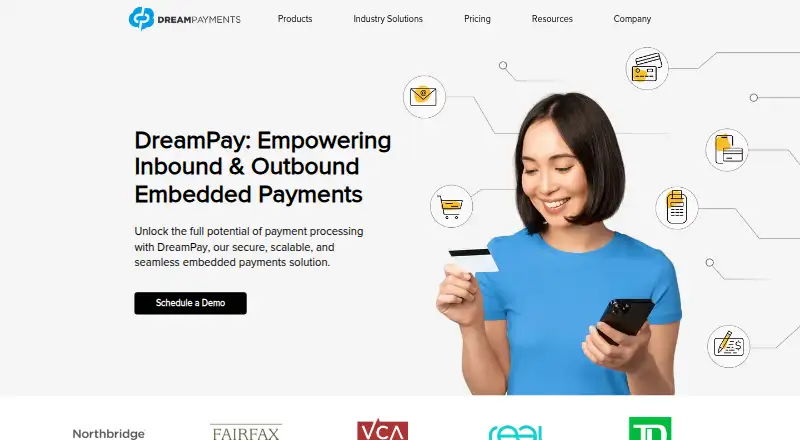
DreamPay provides embedded and private-label payment solutions for merchant acquirers, software platforms, insurance companies, and financial institutions. Its online payment tools handle one-time and recurring payments by card or pay by bank, including ACH in the US and EFT in Canada. Businesses can offer hosted payment pages, embedded checkout, and one-click payments with stored cards. Payouts can use ACH, EFT, real-time payments, virtual cards, Interac e-Transfer, or cheques. The online payments dashboard tracks transaction volume, success rates, revenue, refunds, and chargebacks. Developers can use APIs to embed inbound and outbound payments and integrate payment data, with webhook notifications for outcomes and status changes. Dream says its platform follows PCI DSS and SOC 2 standards, encrypts transactions and payouts end to end, and includes KYC and AML tools. Its security page also lists GDPR compliance. A zero-fee processing option passes transaction fees to customers using a flat or percentage-based structure. Dream also offers customizable revenue sharing, with earnings dependent on transaction volume. The company is headquartered in Toronto, Ontario, Canada. Pricing is available on request, and its listed platforms are Android, iOS, web, and API.
Who it suits
DreamPay is suited to banks, insurers, software platforms, marketplaces, merchant acquirers, and large enterprises seeking embedded or private-label payment services.
What it does well
- Supports one-time and recurring card or pay-by-bank payments.
- Offers hosted pages, embedded checkout, and one-click stored-card payments.
- Lists multiple payout methods, including real-time payments and Interac e-Transfer.
- Dashboard tracks volume, success rates, revenue, refunds, and chargebacks.
- APIs and webhooks cover payment integration and status notifications.
- Platform lists PCI DSS, SOC 2, encryption, KYC, AML, and GDPR.
What to know first
- Pricing is available on request.
- KYC and AML tools are described as basic.
- API coverage is listed as standard.
Getting started
- Visit the DreamPay website.
- Contact DreamPay to request pricing.
- Review DreamPay's listed payment and payout methods.
- Use DreamPay APIs to embed inbound or outbound payments and integrate payment data.
- Use webhooks to receive payment outcome and status notifications.
- Work with DreamPay on integration; its zero-fee payments page says it provides full integration support.
DreamPay combines embedded payment acceptance, payouts and developer APIs for organizations building payments into their own software. It is better suited to financial institutions, insurers, platforms and marketplaces than to businesses looking for a standalone checkout service. Its breadth of payment and payout methods is a strength; custom pricing makes cost comparison harder.
Overview
DreamPay supports private-label payment experiences and lets clients launch digital and mobile payment flows within their core applications. It combines inbound payments with outbound payouts and also offers point-of-sale solutions for in-person merchant payments. That range makes it relevant when payments need to be part of a larger product or service, rather than a separate tool for a single merchant.
Its online acceptance covers one-time and recurring card and pay-by-bank payments, including ACH in the US and EFT in Canada. Embedded bank transfers settle to the platform's bank account in 1–2 business days through ACH or EFT. Organizations can choose a zero-fee processing model that passes transaction fees to customers, using either a flat fee or a percentage-based fee. This may reduce the business's direct processing costs, but customers bear the fee.
Key features
Checkout and payment acceptance
Hosted payment pages, embedded checkout and one-click payments using stored card options give organizations several ways to fit payment flows into their customer experience. The in-person point-of-sale option extends acceptance beyond online transactions. This flexibility is useful for platforms serving customers across channels, though the breadth of options may be unnecessary for a business that only needs a basic checkout.
Payouts and revenue sharing
Payout methods include ACH, EFT, real-time payments, virtual cards, Interac e-Transfer and cheques. The choice of rails can suit organizations paying different types of recipients, while customizable revenue-sharing arrangements give financial institutions, platforms and marketplaces a way to earn from transaction activity. Revenue depends on transaction volume, and terms are tailored to the business model, so this is not a predictable fixed income stream.
Reporting and integration
The online payments dashboard tracks transaction volume, success rates, revenue, refunds and chargebacks. APIs support inbound and outbound payments and payment-data integration for reconciliation; webhooks report payment outcomes and status changes. These tools are pertinent for teams integrating payments into existing applications and operational workflows, rather than simply accepting payments through a separate storefront.
Security and compliance
Dream says its platform follows PCI DSS and SOC 2 standards and uses end-to-end encryption for payment transactions and payouts. Its security offering also includes KYC and AML tools and lists GDPR compliance. KYC and AML capabilities are described as basic, so organizations with more demanding compliance workflows should assess whether they meet their requirements.
Pricing
DreamPay is paid, with custom pricing. There is no published plan structure or price to compare, so organizations need to contact Dream to understand the cost for their payment model and expected transaction volume. That makes it harder to estimate expenses before starting a sales conversation, especially for teams comparing providers on price.
The zero-fee option does not make processing cost-free: it passes transaction fees to customers, under a flat-fee or percentage-based structure. Revenue-sharing terms are also customized and depend on transaction volume. Organizations should weigh both arrangements against their customer experience and business model.
Platforms
DreamPay supports Android, iOS, web and API platforms. This combination accommodates mobile and web experiences as well as direct integrations, which is useful for software providers embedding payments across their products.
Who it's for
DreamPay is aimed at banks and other financial institutions, insurers, software platforms, marketplaces and large enterprises. It is a strong candidate for organizations that need embedded or private-label acceptance alongside outbound payouts and API integration. A small business seeking a simple standalone processor, or a buyer that needs transparent prices before engaging a provider, is less likely to find it the right fit.
Pros and cons
Pros
- Broad acceptance and payout coverage: Card and bank-payment acceptance sits alongside multiple payout methods, including real-time payments, virtual cards and cheques.
- Integration tools for product teams: APIs, reconciliation data and webhook notifications support payment flows inside an organization's own software.
- Flexible commercial options: Customer-paid processing fees and tailored revenue sharing can accommodate different business models.
- Security and compliance provisions: PCI DSS, SOC 2, encryption, KYC, AML and GDPR are included in Dream's stated security and compliance offering.
Cons
- Custom pricing limits early comparison: Buyers cannot assess DreamPay's cost from a published price or plan structure.
- Zero-fee processing shifts the charge: The business may reduce its direct processing costs, but customers pay the transaction fee.
- Basic KYC and AML tools may not be enough: Organizations with more demanding compliance workflows should verify that the capabilities suit their needs.
Alternatives
For a broader comparison, see Embedded Payments Platforms.
- Checkout.com is worth considering for registered charities, which have a free payment-processing plan in countries where it operates; its other pricing is tailored.
- Stripe Connect may suit platforms that want no fees for their platform while Stripe sets and collects processing fees from connected accounts.
- NMI is another paid option for buyers comparing embedded payment providers.
- PayPal Multiparty Payments may suit organizations willing to seek platform or marketplace approval, with pricing not stated.
- Unipaas offers custom pricing tailored to business model, transaction volumes, payment rails and growth ambitions.
- WePay is an alternative to assess if its Link Standard card rates and current closed-beta availability match your requirements.
- Flute Embedded Payments uses partner pricing based on revenue share on processing fees, with terms and quote not stated.
- Stax Connect is another paid option with pricing handled through sales.
Verdict
DreamPay is a good fit for financial institutions, insurers, software platforms and marketplaces that want embedded or private-label payments, varied payout rails and APIs in one offering. Its strongest case is the combination of acceptance, payouts and integration support; its main drawback is that custom pricing leaves buyers unable to compare costs upfront. Choose it when those capabilities match a larger product or payments operation, and look elsewhere if published pricing is essential to your decision.
Verdict
Choose DreamPay if your organization needs embedded or private-label payment acceptance alongside flexible payouts and developer APIs. Its listed solutions address banks, insurers, software platforms, marketplaces, and large enterprises. Organizations that need to compare costs before contacting a provider may prefer a service with published pricing.
Questions
How much does DreamPay cost?
DreamPay is paid, with pricing available on request.
Which platforms does DreamPay support?
Its listed platforms are Android, iOS, web, and API.
What payment methods can customers use?
Online payments support one-time and recurring card or pay-by-bank payments, including ACH in the US and EFT in Canada.
What payout methods are available?
Listed methods are ACH, EFT, real-time payments, virtual cards, Interac e-Transfer, and cheques.
What security and compliance tools does DreamPay list?
Dream says it follows PCI DSS and SOC 2 standards, encrypts transactions and payouts end to end, and includes KYC and AML tools. Its security page also lists GDPR compliance.
Does DreamPay offer revenue sharing?
Yes. It offers customizable revenue-sharing opportunities for financial institutions, software platforms, and marketplaces, with earnings dependent on transaction volume.
Facts from DreamPay's own pages
- API tools
- The developer page describes APIs for embedding inbound and outbound payments, payment data integration, and webhook notifications for payment outcomes and status changes. · dreampayments.com, 9 Oct 2026
- Bank transfers
- Embedded bank transfers settle to the platform’s bank account in 1–2 business days via EFT in Canada and ACH in the US. · dreampayments.com, 9 Oct 2026
- Checkout
- The online payment options include hosted payment pages, embedded checkout, and one-click payments using stored card options. · dreampayments.com, 9 Oct 2026
- Compliance tools
- The security page describes built-in tools for KYC and AML and lists GDPR compliance. · dreampayments.com, 9 Oct 2026
- Developer tools
- The API supports payment data integration for reconciliation and webhook notifications about payment outcomes and status updates. · dreampayments.com, 9 Oct 2026
- Headquarters
- Dream Payments lists its address as 201-171 East Liberty Street, Toronto, Ontario, M6K 3P6. · dreampayments.com, 9 Oct 2026
- Inbound and outbound payments
- Its API and embedded payments platform lets clients launch digital and mobile payments within their core software applications. · dreampayments.com, 9 Oct 2026
- Intended customers
- Dream describes its solutions for banks and other financial institutions, insurers, software platforms, and marketplaces. · dreampayments.com, 9 Oct 2026
- Intended users
- Dream describes its solutions for banks, insurers, software platforms, marketplaces, and large enterprises. · dreampayments.com, 9 Oct 2026
- Online payments
- The platform supports one-time and recurring payments by credit or debit card and pay-by-bank through ACH or EFT. · dreampayments.com, 9 Oct 2026
- Payments
- Its online payments support one-time and recurring card or pay-by-bank payments, including ACH in the US and EFT in Canada. · dreampayments.com, 9 Oct 2026
- Payout methods
- Payout methods listed include ACH, EFT, real-time payments, virtual cards, Interac e-Transfer, and cheques. · dreampayments.com, 9 Oct 2026
- Point of sale
- DreamPay offers point-of-sale solutions for in-person merchant payments. · dreampayments.com, 9 Oct 2026
- Product
- DreamPay provides embedded and private-label payment solutions for merchant acquirers, software platforms, insurance companies, and financial institutions. · dreampayments.com, 9 Oct 2026
- Reporting
- The revenue-sharing platform includes a reporting dashboard with real-time visibility into transactions and revenue earned. · dreampayments.com, 9 Oct 2026
- Revenue share
- Dream offers customizable revenue-sharing opportunities for financial institutions, software platforms, and marketplaces, with earnings dependent on transaction volume. · dreampayments.com, 9 Oct 2026
- Revenue sharing
- DreamPay offers customizable revenue-sharing opportunities for financial institutions, software platforms, and marketplaces, with terms tailored to the business model. · dreampayments.com, 9 Oct 2026
- Security
- Dream says its platform follows PCI DSS and SOC 2 standards and uses end-to-end encryption for payment transactions and payouts. · dreampayments.com, 9 Oct 2026
- Security and compliance
- Dream’s security page lists PCI DSS, SOC 2, KYC, AML, GDPR, and end-to-end encryption for payment transactions and payouts. · dreampayments.com, 9 Oct 2026
- Support
- The zero-fee payments page says Dream provides full support for the integration process. · dreampayments.com, 9 Oct 2026
- Zero-fee option
- Its zero-fee processing option passes transaction fees to customers, with a flat-fee or percentage-based fee structure. · dreampayments.com, 9 Oct 2026
- Zero-fee processing
- Its zero-fee model passes processing fees to customers, and businesses can choose a flat fee or percentage-based fee. · dreampayments.com, 9 Oct 2026
Where DreamPay stands on Freedom251
- Embedded Payments Platforms#7 of 28