Freedom251 › Embedded Payments Platforms
PayPal Multiparty Payments
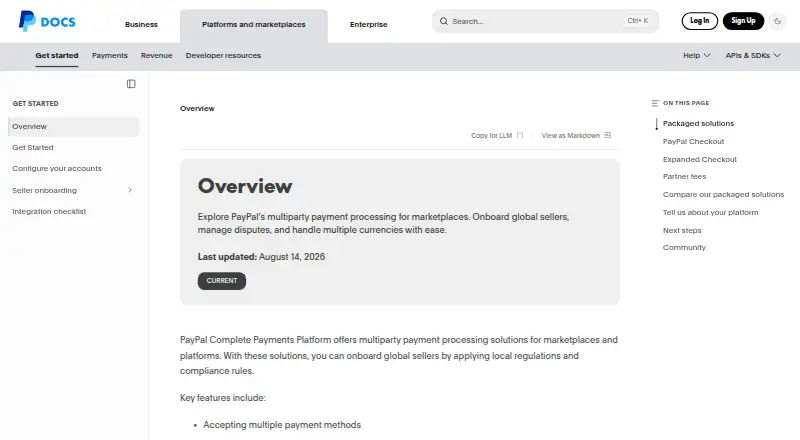
What PayPal Multiparty Payments is
PayPal Multiparty Payments is part of PayPal Complete Payments Platform, a payment service for marketplaces and other platforms. It supports onboarding sellers globally while applying local regulations and compliance rules. Its checkout options accept PayPal, Pay Later, Venmo in the US, alternative payment methods, and credit or debit cards. Expanded Checkout adds customizable card fields with business branding. The platform also supports partner fees, foreign exchange, payouts, and dispute and chargeback management. Partners can charge commissions or brokerage fees on transactions they facilitate for sellers; fees are settled to the associated bank account once daily. Integration uses the PayPal JavaScript SDK, with client-side and server-side options. The platform is limited to approved partners, though sandbox testing is available before approval. Advanced card payments require vetting and underwriting. A multi-merchant order can contain up to 10 purchase units, and API responses have a 20-second timeout limit. Pricing is on request.
Who it suits
It suits marketplaces, ecommerce and shopping carts, sharing and gig economy platforms, technology partners, payment service providers, and crowdfunding services that need multiparty payment processing. Partner approval is required for live platform use.
What it does well
- Onboards global sellers under local compliance rules
- Accepts multiple payment methods, including Venmo in the US
- Supports partner fees, foreign exchange, and payouts
- Offers client-side and server-side SDK integration
What to know first
- Live use is limited to approved partners
- Advanced card payments require vetting and underwriting
- Multi-merchant orders are limited to 10 purchase units
- Platform fees are unsupported for first-party integrations
Limits
A multi-merchant order can contain at most 10 purchase units, with a 20-second API response timeout. Advanced card payments require vetting and underwriting, and platform fees are not supported for first-party integrations.
Plans
| Plan | Billed and limits | Price |
|---|---|---|
| PayPal Complete Payments Platform | Pricing is not stated; platform or marketplace approval required | On request |
As developer.paypal.com lists them, read 3 Oct 2026. The maker's own page has the final word.
Getting started
- Visit the PayPal developer platform overview.
- Apply to become an approved partner; a PayPal representative evaluates business needs and contacts applicants about approval and going live.
- Use sandbox testing before approval.
- Choose PayPal Checkout or Expanded Checkout for the packaged checkout solution.
- Integrate checkout with the PayPal JavaScript SDK on the client side or server side.
- Complete vetting and underwriting if using advanced credit and debit card payments.
PayPal Multiparty Payments is a payment platform for marketplaces and other businesses routing transactions among sellers. It suits operators seeking global seller onboarding and PayPal checkout options, provided they can qualify as an approved partner. The breadth is useful, but approval and order constraints make it a poor fit for teams that need unrestricted, self-serve live access.
Overview
The platform combines payment acceptance with seller onboarding and transaction management. Operators can onboard sellers globally under local compliance rules, split payments, charge commissions or brokerage fees, handle foreign exchange, and make payouts. Managed account management and advanced KYC/AML tools suit businesses that want payment-provider support for seller operations.
Production access is conditional: only approved partners can use the platform live. Sandbox testing is possible before approval, but unapproved live API calls return HTTP 401. A PayPal representative evaluates an applicant’s business needs and contacts them about approval and going live. That process is a significant trade-off for businesses that need to launch without an external approval step.
Key features
Checkout and integration
PayPal Checkout accepts PayPal, Pay Later, Venmo in the US, alternative payment methods, and credit or debit cards. Expanded Checkout adds branded, customizable card fields and customizable fraud protection tools; the checkout guide identifies Simility for fraud customization. This gives merchants a choice between packaged payment options and a more tailored card experience.
Multiparty checkout uses the PayPal JavaScript SDK and supports client-side and server-side integration. Advanced card payments require vetting and underwriting, so access to those card capabilities is not automatic. Seller protection also differs by transaction: it applies to PayPal and basic card transactions for standard payments, but only to PayPal transactions for advanced card payments. Sellers handle disputes through the PayPal Account Resolution Center.
Splits, payouts, and operating limits
Partners can charge transaction commissions or brokerage fees, with partner fees consolidated and settled to the associated bank account once daily. The platform supports foreign exchange for global currencies and payouts, but payout capabilities are basic. A multi-merchant order can contain no more than 10 purchase units, and API responses have a 20-second timeout limit; platforms with larger order structures or slower processing needs should account for those ceilings.
Platform fees are not supported for first-party integrations. PayPal must also enable a partner to use the platform-fee refund feature. These restrictions matter for operators whose revenue model depends on charging a fee directly through their own integration or refunding such fees.
PayPal’s developer security guidance requires HTTPS for API and SDK requests, and HTTPS is enforced on all endpoints. Help resources include FAQs, account help, and technical support.
Pricing
PayPal Complete Payments Platform: custom pricing. The platform is paid, but no fixed price is published. Marketplace or platform approval is required, so businesses should account for both commercial discussions and partner eligibility before committing to an integration.
The plan combines global payment acceptance, broad API and SDK coverage, split payments, advanced KYC/AML tools, managed account management, and basic payout capabilities. It is most relevant to an approved marketplace or platform that needs seller onboarding and payment routing in one offering; there is no cheaper tier described for a smaller operation to step into.
Platforms
The platform supports Android, iOS, web, and API. The JavaScript SDK and client-side or server-side integration provide the checkout integration path for platform teams.
Who it's for
Packaged solutions target marketplaces, ecommerce businesses and shopping carts, sharing and gig-economy platforms, technology partners, payment service providers, and crowdfunding. It is strongest for operators handling payments across multiple sellers who can work within partner approval and the stated order limits. It is less suitable for businesses that require first-party platform fees, immediate production access, or more than 10 purchase units in a multi-merchant order.
Pros and cons
- Pro: Global seller onboarding with local compliance rules, advanced KYC/AML tools, and managed account management can support marketplaces with cross-border seller operations.
- Pro: Checkout covers PayPal, Pay Later, US Venmo, alternative methods, and cards, with branded card fields and customizable fraud tools in Expanded Checkout.
- Pro: Partners can charge transaction commissions or brokerage fees, with consolidated daily settlement to an associated bank account.
- Con: Live use requires partner approval; sandbox testing does not remove the HTTP 401 response for unapproved live API calls.
- Con: First-party integrations cannot use platform fees, and use of the platform-fee refund feature requires PayPal enablement.
- Con: Advanced card payments require vetting and underwriting, while seller protection for those transactions covers PayPal transactions only.
- Con: Multi-merchant orders are capped at 10 purchase units and API response timeouts at 20 seconds.
Alternatives
Embedded Payments Platforms and Marketplace Payment Platforms are useful starting points for comparing providers by category.
Consider Checkout.com if a free option matters: it offers free payment processing for registered charities in countries where it operates, alongside tailored pricing. Stripe Connect may suit platforms that prefer Stripe to set and collect processing fees from connected accounts; its listed option has no platform fees for the platform. NMI is another paid option for readers comparing payment platforms across a wider range of operating systems.
Unipaas offers custom pricing tailored to business model, transaction volumes, payment rails, and growth ambitions, making it an option for businesses seeking a personalised quote. WePay lists card-present and card-not-present rates and a $0 chargeback fee, but its Link Standard plan is currently closed beta. DreamPay is another paid alternative. Flute Embedded Payments bases partner pricing on revenue share from processing fees and says pricing scales with transaction volume. Stax Connect is a paid option with pricing available through sales.
Verdict
PayPal Multiparty Payments is a strong candidate for an approved marketplace or platform that needs global seller onboarding, split payments, partner fees, and familiar PayPal checkout methods in one integration. Its principal drawback is the combination of partner approval, first-party platform-fee exclusion, and strict order limits. Choose it when those terms fit the business model; look elsewhere if production access must be self-serve or first-party platform fees are essential.
Verdict
PayPal Multiparty Payments combines seller onboarding, payment acceptance, partner fees, and payouts for marketplace-style businesses. Check partner eligibility, the order limits, and the first-party platform-fee restriction before planning an integration.
Questions
How much does PayPal Multiparty Payments cost?
Pricing is on request.
Can a business use the platform before partner approval?
Sandbox testing is available before approval. Unapproved live API calls return HTTP 401.
Which checkout payment methods are supported?
The checkout solutions support PayPal, Pay Later, Venmo in the US, alternative payment methods, and credit or debit cards.
How does integration work?
Multiparty checkout uses the PayPal JavaScript SDK and supports client-side and server-side integration.
What is the order limit for multiple sellers?
A multi-merchant payment order can contain a maximum of 10 purchase units.
Who handles seller disputes?
Sellers handle disputes through the PayPal Account Resolution Center.
Facts from PayPal Multiparty Payments's own pages
- Advanced card eligibility
- Advanced credit and debit card payments require vetting and underwriting. · developer.paypal.com, 2 Oct 2026
- Checkout methods
- PayPal Checkout supports PayPal, Pay Later, Venmo in the US, alternative payment methods, and credit or debit cards. · developer.paypal.com, 2 Oct 2026
- Currencies and payouts
- The platform supports handling foreign exchange for global currencies and making payouts. · developer.paypal.com, 3 Oct 2026
- Disputes
- Sellers handle disputes through the PayPal Account Resolution Center. · developer.paypal.com, 3 Oct 2026
- Eligibility
- The platform is available only to approved partners, though sandbox testing is available before approval. · developer.paypal.com, 3 Oct 2026
- Expanded Checkout
- Expanded Checkout adds customizable credit and debit card fields with business branding. · developer.paypal.com, 3 Oct 2026
- Fraud tools
- Expanded Checkout includes customizable fraud protection tools, and the checkout guide identifies Simility for customizable fraud tools. · developer.paypal.com, 2 Oct 2026
- Integration
- The multiparty checkout integration uses the PayPal JavaScript SDK and supports client-side and server-side integration. · developer.paypal.com, 2 Oct 2026
- Integration limitation
- Platform fees are not supported for first-party integrations, and PayPal must enable a partner to use the platform-fee refund feature. · developer.paypal.com, 2 Oct 2026
- Integrations
- Multiparty checkout uses the PayPal JavaScript SDK and supports client-side and server-side integration. · developer.paypal.com, 3 Oct 2026
- Multi-seller limit
- A multi-merchant payment order can contain a maximum of 10 purchase units, with a 20-second API response timeout limit. · developer.paypal.com, 2 Oct 2026
- Notable limit
- Platform fees are not supported for first-party integrations. · developer.paypal.com, 3 Oct 2026
- Packaged checkouts
- The multiparty packaged solutions include PayPal Checkout and Expanded Checkout. · developer.paypal.com, 2 Oct 2026
- Partner approval
- PayPal Complete Payments Platform is available only to approved partners; unapproved live API calls return HTTP 401, while sandbox testing is available before approval. · developer.paypal.com, 2 Oct 2026
- Partner fees
- Partners can charge commissions or brokerage fees on transactions they facilitate for sellers. · developer.paypal.com, 3 Oct 2026
- Partner fee settlement
- Partner fees are consolidated and settled to the associated bank account once daily. · developer.paypal.com, 3 Oct 2026
- Payment capabilities
- Listed features include multiple payment methods, partner fees, foreign exchange, payouts, and dispute and chargeback management. · developer.paypal.com, 2 Oct 2026
- Payments
- The platform supports PayPal, Pay Later, Venmo in the US, alternative payment methods, and credit or debit cards through its checkout solutions. · developer.paypal.com, 3 Oct 2026
- Purpose
- PayPal Complete Payments Platform provides multiparty payment processing for marketplaces and platforms, including global seller onboarding. · developer.paypal.com, 3 Oct 2026
- Security
- PayPal's developer security guidance requires HTTPS for API and SDK requests and says HTTPS is enforced on all endpoints. · developer.paypal.com, 3 Oct 2026
- Seller onboarding
- The platform supports onboarding global sellers while applying local regulations and compliance rules. · developer.paypal.com, 2 Oct 2026
- Seller protection
- The checkout comparison says seller protection applies to PayPal and basic card transactions for standard payments, and to PayPal transactions for advanced card payments. · developer.paypal.com, 2 Oct 2026
- Support
- The developer site lists FAQs, account help, and technical support among its help resources. · developer.paypal.com, 3 Oct 2026
- Support and go-live
- A PayPal representative evaluates the platform's business needs and contacts the applicant about approval and going live. · developer.paypal.com, 2 Oct 2026
Where PayPal Multiparty Payments stands on Freedom251
- Embedded Payments Platforms#11 of 28
- Marketplace Payment Platforms#16 of 28