Freedom251 › Embedded Payments Platforms

dLocal
What dLocal is
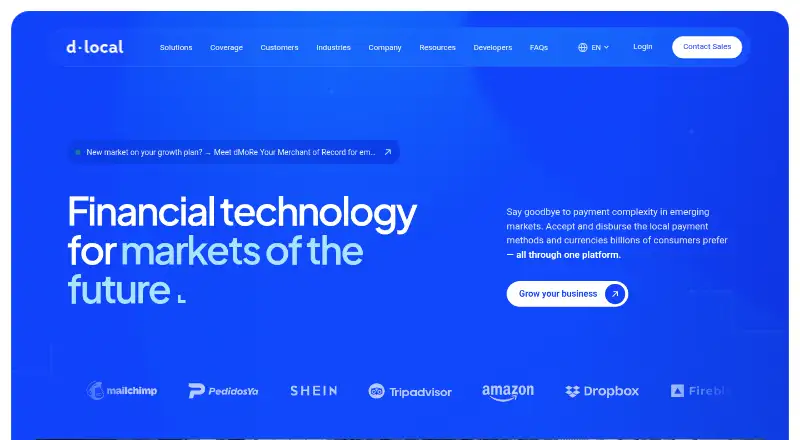
dLocal provides payment services for businesses that accept payments, send payouts, and settle funds across emerging markets. Its Payins service operates in more than 60 markets across Latin America, Africa and the Middle East, and Asia. The company says one integration opens access to over 1,000 local payment methods, including cards, bank transfers, cash, digital wallets, mobile money, real-time payments, and buy now pay later. Payins includes local acquiring, dynamic FX conversion, and payment approval optimization. Payouts can be requested individually or in batches through an API, file, or SFTP. dLocal for Platforms supports user onboarding, payments, payouts, and fund splitting. Its REST API uses JSON and includes a sandbox; requests require signature authentication. A full API integration requires PCI DSS compliance. Listed integration options include Shopify, Google Pay, and Tiendanube, which is available only in Argentina. The company says it was born in Uruguay and launched Pay-In and Pay-out solutions in 2016. It is headquartered in Montevideo and incorporated in the Cayman Islands. Pricing is custom and available from sales.
Who it suits
dLocal suits businesses operating across emerging markets, including ecommerce, travel, marketplaces, SaaS, fintech, gaming, remittances, and payroll platforms. It is available through web and API integrations.
What it does well
- Access to over 1,000 local payment methods
- Supports individual and batch payout requests
- Offers recurring billing and payment links
- REST API uses JSON and has a sandbox
- Supports multi-currency payments
What to know first
- Pricing is custom and available on request
- Full API integration requires PCI DSS compliance
- Tiendanube integration is available only in Argentina
Limits
Pricing is custom per merchant and available on request. Full API integrations require PCI DSS compliance; merchants using dLocal generally rely on its PCI Level 1 status while completing the relevant self-assessment questionnaire.
Plans
| Plan | Billed and limits | Price |
|---|---|---|
| Custom commercial proposal | Tailored to the customer’s business needs, solutions, markets, and operational requirements. · Pricing is custom per merchant; contact sales for a quote | On request |
As dlocal.com lists them, read 8 Oct 2026. The maker's own page has the final word.
Getting started
- Visit the dLocal website.
- Contact sales to discuss a custom commercial proposal.
- Choose a web or API integration route.
- Review the API documentation and use the sandbox if developing an integration.
- Select an integration option such as Shopify, Google Pay, or Tiendanube where available.
Verdict
dLocal covers collections, payouts, and fund splitting across a broad set of emerging markets and payment methods. Businesses considering a full API integration should account for its PCI DSS requirement and request a tailored commercial proposal.
Questions
How much does dLocal cost?
dLocal uses paid pricing, with a custom commercial proposal available on request. Contact sales for a quote.
What payment methods does dLocal support?
Listed methods include credit and debit cards, local bank transfers, cash payments, digital wallets, mobile money, real-time payments, and buy now pay later.
Which platforms does dLocal support?
dLocal is available through web and API platforms.
Can dLocal handle recurring billing and multiple currencies?
Yes. Recurring billing and multi-currency support are listed.
Which integrations are listed?
The documentation lists Shopify, Google Pay, and Tiendanube. Tiendanube is available only in Argentina.
What businesses does dLocal serve?
Its listed business types include retail and ecommerce, travel and tourism, marketplaces and platforms, SaaS and subscriptions, fintech, gaming, crypto, remittances, and payroll platforms.
Facts from dLocal's own pages
- API
- The dLocal API follows REST principles and uses JSON for requests and responses; a sandbox is available for testing. · docs.dlocal.com, 8 Oct 2026
- Company origin
- dLocal says it was born in Uruguay and launched Pay-In and Pay-out solutions in 2016. · dlocal.com, 8 Oct 2026
- Founded
- 2016 · dlocal.com, 28 Sept 2026
- Headquarters
- The company identifies its operational headquarters as Montevideo, Uruguay; its principal executive offices are in Grand Cayman, Cayman Islands. · investor.dlocal.com, 8 Oct 2026
- Integrations
- The documentation lists Shopify, Google Pay, and Tiendanube integration options; Tiendanube is available only in Argentina. · docs.dlocal.com, 8 Oct 2026
- Market coverage
- dLocal Payins operates across more than 60 emerging markets in Latin America, Africa and the Middle East, and Asia. · dlocal.com, 8 Oct 2026
- Payins features
- Payins supports local acquiring, local payment methods, dynamic FX conversion, and payment approval optimization. · dlocal.com, 8 Oct 2026
- Payment methods
- dLocal says one integration provides access to over 1,000 local payment methods across more than 60 emerging markets. · dlocal.com, 8 Oct 2026
- Payouts
- Payout requests can be sent individually or in batches through an integration by API, file, or SFTP. · dlocal.com, 8 Oct 2026
- PCI requirement
- A full API integration requires PCI DSS compliance because payment processing occurs directly on the merchant’s website or app. · docs.dlocal.com, 8 Oct 2026
- Platform payments
- dLocal for Platforms lets marketplaces and platforms onboard users, accept payments, send payouts, and split funds between users. · dlocal.com, 8 Oct 2026
- Security
- API requests require a signature for authentication, and dLocal’s PCI guidance says merchants using dLocal generally rely on its PCI Level 1 status while completing the relevant self-assessment questionnaire. · docs.dlocal.com, 8 Oct 2026
- Support
- Existing merchants are directed to support options in the merchant dashboard and their account manager; prospects can contact sales. · dlocal.com, 8 Oct 2026
- What it does
- dLocal provides payment solutions for businesses to accept payments, send payouts, and settle funds across emerging markets. · docs.dlocal.com, 8 Oct 2026
- Who it serves
- dLocal lists retail and ecommerce, travel and tourism, marketplaces and platforms, SaaS and subscriptions, fintech, gaming, crypto, remittances, and payroll platforms among the businesses it supports. · dlocal.com, 8 Oct 2026
Where dLocal stands on Freedom251
- Embedded Payments Platforms#6 of 28
- Marketplace Payment Platforms#11 of 28
- Cross-Border Payment Platforms#17 of 32
- Payment Software#17 of 29
- Payment Processing Software#42 of 71