Freedom251 › Case Management Software

DFIRe
by DFIRe
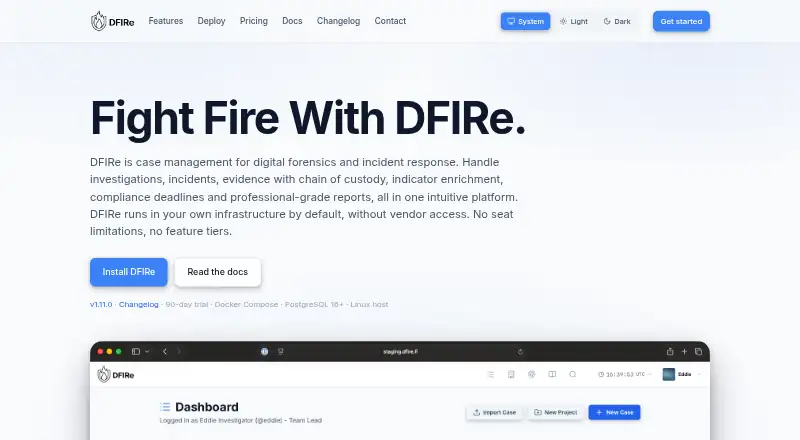
What DFIRe is
DFIRe is self-hosted case management software for digital forensics and incident response. Teams can configure case types, severities, and assignments, then escalate work from triage to incident response while retaining its history. Evidence can be organized hierarchically with configurable attributes, verifiable custody records, receipts, and transfer records. The product includes playbooks for fifteen common case types, which users can customize or replace, as well as timers and reminders for breach notifications, statutory reporting, and other deadlines such as SLAs. Its IOC registry supports STIX 2.1 types, enrichment from named threat intelligence providers, and sharing through MISP and TAXII. Documented integrations include Slack, bidirectional Jira synchronization, webhooks, and SIEM or log forwarding. Reports support structured sections, QA, evidence inventories, and optional LLM drafting through a provider selected by the user. Security controls include OIDC sign-on, role-based access, encrypted attachments, and an immutable audit trail. Deployment is supported through Docker Compose on Linux, including air-gapped use. The annual licence is €9,900 a year and starts with a 90-day trial.
Who it suits
DFIRe suits digital forensics and incident response teams that need configurable case handling, evidence custody, and deadline tracking in a self-hosted environment. It also fits organizations requiring air-gapped deployment, provided they can manage the infrastructure and backups.
What it does well
- Escalates cases while preserving history
- Records evidence custody and transfers
- Includes customizable playbooks for fifteen case types
- Supports MISP and TAXII sharing
- Air-gapped deployment and offline licensing are supported
What to know first
- Customers secure infrastructure, storage, and backups
- Supported deployment is Docker Compose on Linux
- Annual licence covers one production deployment
- Database case data is stored in plaintext
Limits
The annual licence covers unlimited users and cases in a single production deployment. The documented supported deployment is Docker Compose on a Linux host; other container platforms are not supported deployment models.
Plans
| Plan | Billed and limits | Price |
|---|---|---|
| Annual licence | annual; VAT 0% · unlimited users and cases · one production installation · offline conversion · 90-day trial | €9,900 a year |
| Non-commercial | case by case · individual, student, educational, charity and community non-commercial use · all features | Free |
| Small teams | custom · same deployment model and features · unlimited cases | On request |
As dfire.fi lists them, read 15 Oct 2026. The maker's own page has the final word.
Getting started
- Visit the DFIRe website.
- Prepare a Linux host with Docker Engine 24.0 or later and Compose 2.24.4 or later.
- Use PostgreSQL 16 or later for production.
- Choose the case-by-case non-commercial option if eligible, or review the annual licence.
- Start the annual licence’s 90-day trial, or arrange offline licensing for an air-gapped network.
Overview
DFIRe is a self-hosted case-management system for digital forensics and incident response. It is best suited to teams that need structured investigations and accountable evidence handling within infrastructure they operate. Its specialized workflow and offline option are appealing, but the annual licence and the work of securing and maintaining the deployment rule it out for teams seeking a managed service.
Key features
Teams can tailor case types, severity levels, assignments, and escalation, carrying a case from triage into incident response without losing its history. Fifteen default playbooks provide a useful starting framework, and teams can edit or replace them. That flexibility suits organizations with established procedures, though it also means they must decide how those procedures should work.
Evidence is organized hierarchically, with configurable attributes, verifiable custody records, printable receipts, and transfer records. That makes DFIRe more purpose-built for investigations where evidence handling must be documented than a general case tracker. Compliance timers and reminders can cover breach notifications, statutory reporting, and SLAs, helping teams keep deadlines attached to case work.
The IOC registry supports STIX 2.1 types, enrichment from named threat-intelligence providers, and sharing through MISP and TAXII. Slack collaboration, bidirectional Jira synchronization, webhooks, and SIEM or log-forwarding integrations connect investigations to surrounding operations. Reports have structured sections, a QA workflow, and generated evidence inventories; optional LLM drafting uses a provider chosen by the customer, giving teams a drafting aid without binding them to one provider.
Documented security controls include OIDC single sign-on, two-tier role-based access control, AES-256-GCM encryption for attachments, and an immutable, fail-closed audit trail. Those controls do not remove the operator's security burden: customers must secure the database, file storage, network, server infrastructure, and backups, and case data remains plaintext in the database for performance and full-text search.
Pricing
The Non-commercial plan has custom pricing and is granted case by case to individuals, students, educational organizations, charities, and community users. It includes all features, making it the relevant route for qualifying non-commercial use, but access is not automatic.
The Annual licence costs €9,900 a year, billed 9,900 EUR / year, with VAT 0%, added per EU rules. It includes unlimited users and cases for a single production deployment, can be converted to an offline licence, and starts with a 90-day trial. The unlimited case and user allowance avoids per-seat or case caps, but the single-deployment term matters to organizations that need separate production instances.
Small teams pricing is custom for small organisations, with the same deployment model and features and unlimited cases. It may suit a smaller organization that needs the full deployment model, but no published price allows a direct cost comparison. The free plan and trial offer an entry point, while the 90-day trial gives teams a defined evaluation period before a paid annual commitment.
Platforms
DFIRe supports API, Linux, self-hosted, and web use. The tested and supported deployment model is Docker Compose on a Linux host; other container platforms are not supported. Production requires Docker Engine 24.0 or later, Compose 2.24.4 or later, and PostgreSQL 16 or later. Air-gapped deployment and offline licensing make it viable for networks without internet access, provided the organization can operate the required infrastructure.
Who it's for
DFIRe fits digital forensics and incident-response teams that need customizable case processes, traceable evidence custody, reporting, and integrations in a self-managed environment. Its offline capability is useful for isolated networks. Teams without Linux and database operations capacity, or those wanting a vendor-managed environment, should look elsewhere.
Pros and cons
- Pros: Unlimited users and cases on the annual licence avoid scaling charges tied to case volume or team size.
- Pros: Evidence custody records, receipts, transfers, and an immutable audit trail support accountable investigation workflows.
- Pros: Air-gapped deployment and offline licensing serve teams working without internet access.
- Cons: One production deployment per annual licence can constrain organizations that need multiple live environments.
- Cons: Customers must secure and back up the entire stack, while case data is stored plaintext in the database.
- Cons: Docker Compose on Linux is the supported deployment model, limiting teams standardized on other container platforms.
Alternatives
DFIR-IRIS is worth considering when a no-licence-fee, self-hosted option matters more than DFIRe's particular evidence and case-workflow controls; it is free and open-source, with API, Linux, macOS, web, and Windows platforms.
Forensicator is a free, open-source cross-platform incident response toolkit for teams looking for a toolkit rather than DFIRe's case-management focus. GRR Rapid Response is another free, self-hosted option, released under Apache License 2.0.
LimaCharlie may suit teams wanting a free Community tier for up to two endpoints, with EDR free and CNAPP at $150/organization. ORNA offers a self-managed free plan for teams seeking a free platform option.
SIFT Workstation is a free, open-source choice for teams looking for a forensic workstation, with an OVA download and Ubuntu 22.04 installation options. TraceLock CRM is a free, open-source self-hosted CRM with no per-seat pricing, a different fit for teams prioritizing CRM use.
Binalyze AIR is an alternative with a free trial for teams comparing paid incident-response software.
Browse Incident Response Software, Incident Management Software, or Case Management Software for more options in adjacent categories.
Verdict
Choose DFIRe if your forensics or incident-response team needs adaptable case workflows, documented evidence custody, and offline self-hosting, and can take responsibility for operating the stack. Its unlimited users and cases strengthen the proposition for one production deployment, but teams that need managed hosting, multiple licensed deployments, or a lower-cost entry point should look elsewhere.
Verdict
DFIRe brings case workflows, evidence records, integrations, and reporting together for self-hosted response teams. The annual licence is €9,900 a year for one production deployment, and customers retain responsibility for securing their environment.
Questions
How much does the annual licence cost?
The annual licence is 9,900 EUR per year. VAT is 0%, with VAT added according to EU rules.
Is there a free option?
A non-commercial licence is granted case by case for individual, student, educational, charity, and community use; all features are included.
Does DFIRe offer a trial?
The annual licence starts with a 90-day trial.
Where does DFIRe run?
It supports Docker Compose on a Linux host. The documented production deployment requires PostgreSQL 16 or later.
Can DFIRe run without internet access?
Yes. DFIRe supports air-gapped deployments and offline licensing.
What integrations are documented?
They include Slack collaboration, bidirectional Jira synchronization, webhooks, and integrations for SIEM or log forwarding. The IOC registry supports sharing through MISP and TAXII.
Facts from DFIRe's own pages
- API
- DFIRe provides a REST API with per-user API keys, service accounts, interactive ReDoc documentation and a downloadable OpenAPI 3 schema. · dfire.fi, 15 Oct 2026
- Audit logging
- The audit trail is append-only and fail-closed, so an operation does not complete when its audit record cannot be written. · dfire.fi, 15 Oct 2026
- Case workflow
- Cases combine actions, notes, files, evidence, indicators and reports, with investigations escalatable into incidents. · dfire.fi, 15 Oct 2026
- Case workflows
- The product supports custom case types, severities, assignments, and escalation from triage to incident response without losing history. · dfire.fi, 7 Oct 2026
- Changelog news
- Version 1.12.1, released October 8, 2026, added a redesigned website, documentation search and clarified license-server data reporting. · dfire.fi, 15 Oct 2026
- Compliance
- Users can define compliance timers and reminders for breach notifications, statutory reporting, and other deadlines such as SLAs. · dfire.fi, 7 Oct 2026
- Compliance timers
- Cases can track deadlines for GDPR, NIS2, DORA, HIPAA, SEC and custom rules with reminders. · dfire.fi, 15 Oct 2026
- Custody hashing
- Each custody entry uses SHA-256 chaining, and failed verification stops further transfers for that item. · dfire.fi, 15 Oct 2026
- Database requirement
- Production deployments require PostgreSQL 16 or later managed by the customer or its provider. · dfire.fi, 15 Oct 2026
- Deployment
- Installation uses a release-pinned Docker Compose bundle and supports manual or air-gapped deployment. · dfire.fi, 15 Oct 2026
- Enrichment providers
- Official examples include VirusTotal, AbuseIPDB, Shodan, GreyNoise, MISP, urlscan and Spur.us, using customer API keys. · dfire.fi, 15 Oct 2026
- Evidence custody
- Evidence records include ownership, storage, custodians, runbooks, encrypted files and a verifiable chain of custody. · dfire.fi, 15 Oct 2026
- Free plan
- Yes · dfire.fi, 19 Sept 2026
- Headquarters
- Vantaa, Finland · dfire.fi, 28 Sept 2026
- Indicators
- The indicator registry supports STIX 2.1 types, enrichment, cross-case correlation and sharing through TAXII 2.1 or MISP-compatible feeds. · dfire.fi, 15 Oct 2026
- Infrastructure responsibility
- Customers are responsible for securing their database, file storage, network, server infrastructure, and backups; case data is stored in plaintext in the database for performance and full-text search. · dfire.fi, 7 Oct 2026
- Integrations
- Native integrations include Slack case workflows, two-way Jira Cloud synchronization, outgoing webhooks and SIEM/SOAR forwarding. · dfire.fi, 15 Oct 2026
- Licence limits
- The annual licence covers unlimited users and cases but applies to a single production deployment. · dfire.fi, 7 Oct 2026
- Licence ownership
- DFIRe software is proprietary and owned by Finnish limited-liability company DFIRe Oy; only third-party dependencies are open source. · dfire.fi, 15 Oct 2026
- Limit: incoming webhooks
- Incoming webhooks were deprecated, so systems creating cases must use API keys with the REST API or import endpoint. · medium.com, 15 Oct 2026
- Limit: infrastructure responsibility
- Customers remain responsible for securing PostgreSQL, storage, networks, servers, backups and regulatory compliance. · dfire.fi, 15 Oct 2026
- Limit: support SLA
- The EULA states that technical support is best effort and provides no service-level agreement or guaranteed response time. · dfire.fi, 15 Oct 2026
- Limit: template updates
- The independent review notes that edits to global playbooks do not automatically change existing case snapshots, requiring manual edits or a playbook swap. · medium.com, 15 Oct 2026
- LLM providers
- AI integration supports OpenAI, Anthropic, Google Gemini, Gemini Enterprise Agent Platform, Azure OpenAI and GitHub Models. · dfire.fi, 15 Oct 2026
Where DFIRe stands on Freedom251
- Case Management Software#3 of 177
- Incident Response Software#3 of 21
- Incident Management Software#5 of 29