Freedom251 › Case Management Software

DFIR-IRIS
by DFIR-IRIS
What DFIR-IRIS is
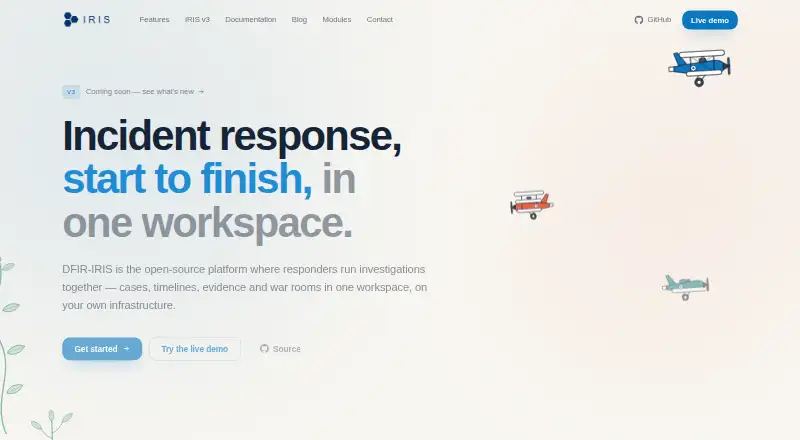
DFIR-IRIS is a free, open-source incident response platform for teams conducting investigations in a shared workspace. Each case can hold assets, indicators of compromise, tasks, evidence and notes under one record with an audit trail. Teams can collect and triage alerts from SIEM, EDR, MISP, IntelOwl or REST endpoints, then promote them into cases. Evidence can be verified with SHA-256, MD5 or SHA-1; access restrictions and logs cover downloads, views and changes. War rooms provide real-time chat, threads, room-based teams and slash commands that record decisions and case actions. Configurable Jinja templates can create PDF or DOCX executive summaries, technical reports or court-ready documents. The project lists IrisVT, IrisMISP, IrisCheck and IrisWebHooks modules, plus a REST API and 162 hook binding points. Permissions include deny-all, read-only and full-access case controls. Docker and Docker Compose are recommended. Linux and macOS are officially supported; Windows may need Dockerfile changes for file storage paths. Documentation identifies v3.0.0-beta.1 as the current v3 release and says beta versions are not production-ready. The project advises keeping IRIS in a restricted environment rather than exposing it to the Internet.
Who it suits
It suits incident response teams that need shared case management, alert triage and evidence tracking in a self-hosted workspace. Teams should be prepared to deploy it in a restricted environment.
What it does well
- Free and open-source with self-hosted deployment.
- Cases include an audit trail.
- Evidence verification supports three hash algorithms.
- Reports can be generated as PDF or DOCX.
What to know first
- Current v3 release is beta and not production-ready.
- Windows may need Dockerfile changes for file storage.
- Project advises against Internet exposure.
- Linux and macOS are the officially supported systems.
Limits
The free and open-source plan costs nothing and has no licence fee for self-hosted deployment. Documentation says the current v3 release, v3.0.0-beta.1, is beta and not production-ready; Windows may require Dockerfile changes for file storage paths.
Plans
| Plan | Billed and limits | Price |
|---|---|---|
| Free and open-source | No licence fee · self-hosted deployment | Free |
| Open-source self-hosted | No licence fee stated · Deploy on your own infrastructure · Docker deployment · Hosted demo available | Free |
As dfir-iris.org lists them, read 5 Oct 2026. The maker's own page has the final word.
Getting started
- Visit https://www.dfir-iris.org/ and review the project documentation.
- Prepare a self-hosted environment on Linux or macOS.
- Use Docker and Docker Compose, which the documentation recommends.
- Configure access in a restricted environment and set case permissions.
- Contact [email protected] for getting-started help, support and implementation, or training.
DFIR-IRIS is a self-hosted platform for managing digital forensics and incident response investigations. It is best suited to security teams that need shared case records, evidence controls and reporting under their own operational control. Its breadth is compelling, but the current v3 beta and restricted-environment requirement make deployment a considered choice.
Overview
DFIR-IRIS grew from an idea within Airbus CyberSecurity’s commercial CSIRT in France in 2019 and became open source in December 2021 with Airbus CyberSecurity’s agreement and support. It gives investigations a common workspace rather than scattering case materials across separate processes. That is a strong fit for teams coordinating complex response work, provided they can manage a self-hosted system and its security.
Key features
Cases, alerts and evidence
Each case can hold assets, indicators of compromise, tasks, evidence and notes, with an audit trail. Alerts from SIEM and EDR tools, MISP, IntelOwl or REST endpoints can be collected, triaged and promoted to cases. This connects alert handling to subsequent investigation work without treating each alert as an isolated item.
Evidence supports SHA-256, MD5 and SHA-1 verification, access restrictions, and logged downloads, views and changes. Those controls are useful when teams need to account for access and document handling; they do not remove the need to operate IRIS in an appropriately restricted environment.
Collaboration and reporting
War rooms combine real-time chat and threaded discussion with per-room teams and slash commands that record decisions and case actions. Configurable Jinja templates can generate PDF or DOCX executive summaries, technical reports or court-ready documents. The combination helps carry discussion and decisions into a case record and its outputs.
Integrations and permissions
Named modules include IrisVT, IrisMISP, IrisCheck and IrisWebHooks. IRIS also provides a REST API and 162 hook binding points, offering teams several routes to connect it with their workflows. Role-based permissions and case-level controls include deny-all, read-only and full-access levels, allowing access to be scoped beyond a single broad permission.
Pricing
Free and open-source: free. The plan has no licence fee and uses self-hosted deployment. That makes the software accessible without a licence charge, but organizations must take responsibility for running the platform themselves. The project lists getting-started help, support and implementation, and training; contact [email protected] for details.
Platforms
DFIR-IRIS supports API, Linux, macOS, self-hosted, web and Windows. Its documentation recommends Docker and Docker Compose; Linux and macOS are officially supported, while Windows may require Dockerfile changes for file-storage paths. Teams planning a Windows deployment should account for that extra adjustment.
The documentation identifies v3.0.0-beta.1 as the current v3 release and cautions that beta versions are not production-ready. It also advises keeping IRIS within a restricted environment and not exposing it to the Internet. Those are material constraints: this is not a default choice for teams seeking a production-ready, publicly reachable hosted service.
Who it's for
DFIR-IRIS suits digital forensics and incident response teams that want to coordinate alerts, investigations, evidence and reporting in a shared case workspace, and have the capability to deploy and secure it. It is a weaker fit for organizations that need a production-ready release now, cannot self-host, or need Internet-facing access.
Pros and cons
Pros
- Case records unite assets, indicators, tasks, evidence and notes with an audit trail, supporting continuity across an investigation.
- Evidence verification and logged access actions provide concrete accountability controls for sensitive case materials.
- War rooms, configurable reports, named modules and API hooks connect collaboration and workflow integration to casework.
- No licence fee lowers the software cost for teams able to operate a self-hosted deployment.
Cons
- The current v3 release is beta and explicitly not production-ready, which limits its suitability for operational adoption.
- Deployment requires self-hosting; Windows may need file-storage path changes in the Dockerfile.
- The project advises against Internet exposure, ruling it out for deployments that require a publicly accessible service.
Alternatives
For a free plan with capped staffing and document allowances, Socianote offers up to 3 staff, 50 people, 1 programme and 200 documents; it is a different option for teams whose work fits those limits and its Android, iOS or web platforms.
Pega Investigative Case Management is a paid web, iOS and Android alternative. IntegrityLog is another paid option, available on web, iOS and Android.
Marble Case Manager has a free, open-source self-hosted plan with a real-time decision engine and community support, making it an alternative for case management needs centered on that offer.
UiPath Maestro Case Management offers a free trial and is self-hosted; consider it if a trial-based alternative is preferable. ServiceNow HR Service Delivery includes HR Knowledge Search and Virtual Agent capabilities, making it a different choice for HR service delivery rather than incident response.
Collaborate uses custom pricing based on organization size, user count and modules, with no per-seat licensing fees; it may suit organizations looking for that pricing structure. Primero offers a free, open-source self-managed tier, with documentation and community support, for teams seeking that kind of deployment.
For broader comparisons, see Case Management Software, Incident Response Software and Incident Management Software.
Verdict
Choose DFIR-IRIS if your response team needs a no-licence-fee, self-hosted workspace that ties alert triage to auditable casework, evidence handling and reporting. Look elsewhere if production readiness or Internet exposure is essential: the v3 release is beta, and the project advises against exposing the system to the Internet.
Verdict
DFIR-IRIS brings case records, evidence controls, collaboration and reporting into a self-hosted incident response platform. Its beta release status and restricted-environment guidance are important deployment considerations.
Questions
How much does DFIR-IRIS cost?
The Free and open-source plan is free, with no licence fee for self-hosted deployment.
Is DFIR-IRIS open source?
Yes. DFIR-IRIS is open source and offers a free plan.
Which platforms does DFIR-IRIS support?
Its listed platforms are API, Linux, macOS, self-hosted, web and Windows. Linux and macOS are officially supported; Windows may need Dockerfile changes for file storage paths.
Who makes DFIR-IRIS?
The maker is DFIR-IRIS. The project says its idea originated within Airbus Cybersecurity’s commercial CSIRT in France in 2019 and that it was released as open source in December 2021 with Airbus CyberSecurity’s agreement and support.
What integrations does DFIR-IRIS offer?
The project names IrisVT, IrisMISP, IrisCheck and IrisWebHooks modules. It also describes a REST API and 162 hook binding points.
Is the current v3 release production-ready?
The documentation identifies v3.0.0-beta.1 as the current v3 release and says beta versions are not production-ready.
Facts from DFIR-IRIS's own pages
- Access control
- IRIS provides RBAC permissions plus case-level ACLs for users, groups and customers, with deny-all defaults from v2.4.0. · docs.dfir-iris.org, 15 Oct 2026
- Alert ingestion
- The platform accepts alerts from SIEM, EDR, MISP, IntelOwl and arbitrary REST endpoints. · dfir-iris.org, 15 Oct 2026
- Alert triage
- Related alerts can be clustered, deduplicated, merged, split and promoted into cases. · dfir-iris.org, 15 Oct 2026
- API authentication
- Each user receives an API key used as a Bearer token; renewing a key revokes the previous token. · docs.dfir-iris.org, 15 Oct 2026
- API versioning
- Documentation maps IRIS releases through v2.4.x to corresponding API versions and identifies a separate develop API. · docs.dfir-iris.org, 15 Oct 2026
- Case management
- Cases contain assets, IOCs, tasks, evidence and notes with severity, ownership, status and audit history. · dfir-iris.org, 15 Oct 2026
- Collaboration
- War rooms provide real-time chat, threads, per-room teams and slash commands that record decisions and case actions. · dfir-iris.org, 5 Oct 2026
- Community funding
- OpenCollective reports total raised of $13,201.06 USD, total disbursed of $44.71 USD and an estimated annual budget of $4,870 USD at the time viewed. · opencollective.com, 15 Oct 2026
- Company origin
- The project began inside Airbus CyberSecurity's commercial CSIRT in France in 2019 and was released publicly in December 2021 with Airbus support. · blog.dfir-iris.org, 15 Oct 2026
- Deployment
- The documentation recommends Docker and Docker Compose; it says Linux and macOS are officially supported and Windows may need Dockerfile changes for file storage paths. · docs.dfir-iris.org, 5 Oct 2026
- Deployment components
- The v3 stack uses backend, worker, frontend, PostgreSQL, RabbitMQ and nginx services. · docs.dfir-iris.org, 15 Oct 2026
- Documentation
- The documentation covers operations, modules, reports, upgrades, API reference, Python client and development topics. · docs.dfir-iris.org, 15 Oct 2026
- Evidence
- Evidence can be verified with SHA-256, MD5 or SHA-1, with access restrictions and logged downloads, views and changes. · dfir-iris.org, 5 Oct 2026
- Evidence handling
- Evidence is hashed, tagged, access-controlled and logged, with SHA-256, MD5 and SHA-1 verification options. · dfir-iris.org, 15 Oct 2026
- Extensibility
- Python modules can attach logic to 162 hook points such as case creation, IOC addition and evidence upload. · dfir-iris.org, 15 Oct 2026
- Founded
- 2019 · dfir-iris.org, 23 Sept 2026
- Free plan
- Yes · dfir-iris.org, 19 Sept 2026
- Independent limit: scope
- Darkroast Protocol positions IRIS as an investigative case record rather than a SOAR or automated playbook engine. · darkroastprotocol.com, 15 Oct 2026
- Independent praise: deployment
- Darkroast Protocol describes Docker Compose deployment as suitable for on-premises or private-cloud regulated environments. · darkroastprotocol.com, 15 Oct 2026
- Independent praise: MISP
- Darkroast Protocol reports that the MISP integration supports bidirectional IOC exchange between IRIS cases and MISP events. · darkroastprotocol.com, 15 Oct 2026
- Independent praise: workflow fit
- Darkroast Protocol praises IRIS for modeling cases, assets, IOCs, timelines, evidence, notes and tasks around real DFIR work. · darkroastprotocol.com, 15 Oct 2026
- Integrations
- First-party modules include IrisVT for VirusTotal, IrisMISP for MISP, IrisCheck for validations and IrisWebHooks for URL destinations. · dfir-iris.org, 15 Oct 2026
- Integration: Sumo Logic
- Sumo Logic's integration exposes actions for creating and updating cases, adding assets, IOCs, notes and timeline events, and escalating alerts. · sumologic.com, 15 Oct 2026
- Licence
- The project is open source under the LGPL-3.0 licence. · dfir-iris.org, 15 Oct 2026
Where DFIR-IRIS stands on Freedom251
- Case Management Software#1 of 177
- Incident Management Software#1 of 29
- Incident Response Software#1 of 21