Freedom251 › Incident Response Software
GRR Rapid Response
What GRR Rapid Response is
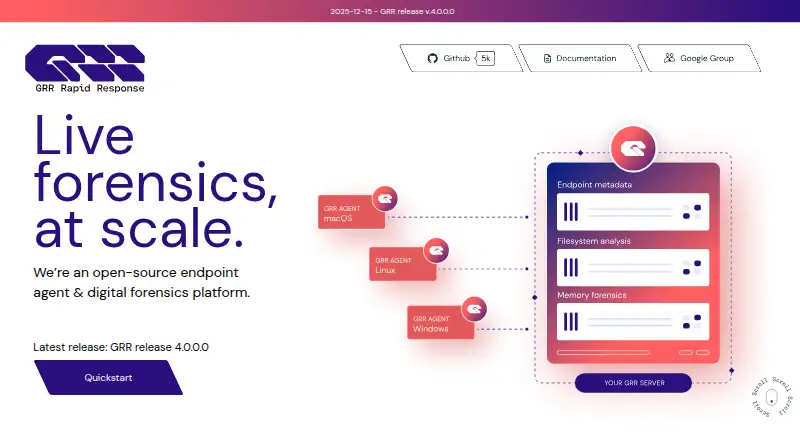
GRR Rapid Response is an open-source framework for remote live forensics and incident investigation. It uses client agents installed on target machines and server infrastructure with a web interface and API. Analysts can search for and download files, inspect the Windows registry, access raw filesystems, and collect forensic artifacts. GRR also supports live remote memory analysis using YARA. Fleet hunts can be scheduled across groups of machines, including systems that are offline when a hunt is scheduled. Listed integrations and interfaces include Colab, Splunk, BigQuery, Elasticsearch, Timesketch, Turbinia, Python API clients, and an HTTPS REST API with OpenAPI definitions. The project is self-hosted and available under the Apache License 2.0 for free. The maker says client-server communication is encrypted against eavesdropping and impersonation, and approval controls can gate sensitive actions. GRR clients normally run as root and can read system data, so server access should be treated as root-level access to client machines. The core team does not provide a helpdesk or paid setup assistance.
Who it suits
GRR suits incident response teams that need remote forensic collection or fleet-wide investigations and can operate a self-hosted system. The maker notes that large enterprise deployments may require users to fix minor bugs, improve documentation, and engage with the project team.
What it does well
- Supports remote file, registry, and forensic artifact collection.
- Runs live remote memory analysis using YARA.
- Fleet hunts can include machines offline at scheduling time.
- Offers approval controls for sensitive actions.
- Open source under Apache License 2.0.
What to know first
- Clients normally run as root and can read system data.
- Server access carries root-equivalent access to client machines.
- Core team does not offer a helpdesk.
- No paid setup assistance is offered.
Limits
The listed plan is self-hosted. No free-plan usage quota or feature limit is listed.
Plans
| Plan | Billed and limits | Price |
|---|---|---|
| Open-source GRR Rapid Response | Apache License 2.0 · self-hosted | Free |
As grr-response.com lists them, read 4 Oct 2026. The maker's own page has the final word.
Getting started
- Open the GRR website.
- Choose the self-hosted Apache License 2.0 plan, listed as free.
- Install client agents on target systems.
- Set up server infrastructure to provide the web interface and API.
- Use the web interface or API to investigate systems and schedule hunts.
GRR Rapid Response is an open-source framework for remote incident investigation and live forensics, built around agents on target machines and self-hosted server infrastructure. It suits security teams that can operate their own response platform and manage privileged client access. Its fleet hunts and broad forensic collection are compelling; the trade-off is that deployment and ongoing support rest with the team using it.
Overview
GRR combines client agents with a server that provides a web interface and API. That architecture gives analysts remote access to investigations across managed systems without requiring each hunt to happen while every machine is online. Because the client normally runs as root and can read system data, server administration is a high-trust responsibility, not a routine hosting task.
Key features
- Remote forensic collection: Clients can search and download files, inspect Windows registry data, access raw filesystems, and collect forensic artifacts. This breadth makes GRR useful for investigations that need evidence from endpoints, but also makes privileged access controls central to safe use.
- Live memory analysis: YARA-based remote memory analysis extends collection beyond files on disk, useful when an investigation needs to examine live system memory.
- Fleet hunts: Analysts can schedule hunts across fleets, including machines offline at scheduling time. That helps teams coordinate broad investigations without limiting the hunt to currently connected endpoints.
- Integrations and APIs: GRR names Colab, Splunk, BigQuery, Elasticsearch, Timesketch, Turbinia, Python API clients, and an HTTPS REST API with OpenAPI definitions. These options suit teams that want to connect response work to analysis and data systems they already use.
- Security controls: Client-server communication is encrypted and designed to resist eavesdropping and impersonation. Approval-based access controls cover sensitive actions such as starting client flows and downloading collected files. These protections help govern access, but do not remove the risk of granting server access equivalent to root on clients.
Pricing
Open-source GRR Rapid Response: free under the Apache License 2.0, with self-hosted deployment. It is a fit for teams able to provide their own infrastructure and operational work; the free license does not come with a helpdesk or paid setup assistance.
The Apache 2.0 license and free plan avoid a license fee, while self-hosting and the support model put more responsibility on the adopting organization. GRR’s FAQ cautions that large enterprise deployments may need users to fix minor bugs, improve documentation, and engage actively with the project team.
Platforms
GRR lists API, Linux, macOS, self-hosted, web, and Windows support. The combination of a web interface and API with self-hosted infrastructure makes it relevant to organizations that want control over deployment, rather than a managed service.
Who it's for
GRR is best suited to incident-response and security teams that need remote forensic collection or coordinated fleet hunts, and have the technical capacity to run the server and maintain a privileged system. It is a weaker fit for organizations that need vendor-led onboarding, a helpdesk, or consulting, or cannot treat server access as equivalent to root access across clients.
Pros and cons
- Pro: File, registry, raw filesystem, artifact, and live-memory capabilities give investigators several remote collection paths from one framework.
- Pro: Fleet hunts can include machines offline when scheduled, which supports investigations across larger endpoint groups.
- Pro: Open-source licensing, self-hosting, APIs, and named integrations give technically capable teams flexibility in how they operate and connect GRR.
- Con: Client agents normally run as root, so access to the server carries unusually high consequences for client systems.
- Con: The core team does not provide a helpdesk, paid setup assistance, feeds, or consulting, leaving deployment and support work to users.
Alternatives
Incident Response Software is the broader category to explore when comparing incident-response tools. Consider DFIR-IRIS for another free, self-hosted option with API, web, Linux, macOS, and Windows platforms. Forensicator is another free cross-platform incident-response toolkit; its Enterprise plan may suit readers evaluating an enterprise tier.
LimaCharlie may fit teams seeking a freemium option with a free tier capped at two endpoints and a free trial. DFIRe offers a case-by-case non-commercial plan for individual, student, educational, charity, and community use. ORNA has a self-managed free plan as well as a managed option with custom pricing.
SIFT Workstation is a free, open-source Linux workstation option for teams looking for a workstation rather than GRR’s remote-response framework. TraceLock CRM is a free, open-source self-hosted CRM, not a like-for-like response framework. Binalyze AIR is a paid alternative with a free trial for teams considering a paid option.
Verdict
Choose GRR if your response team needs remote forensic collection and fleet-wide hunts, and can run a self-hosted platform while tightly governing root-equivalent access. Its breadth and free Apache-licensed model are strong reasons to adopt it. Look elsewhere if you need vendor help with setup or ongoing support, or cannot accept the responsibility that comes with privileged agents.
Verdict
GRR provides remote forensic tools and fleet hunts as a self-hosted, open-source framework. Its client privileges make server access a high-trust responsibility, and support does not include a helpdesk or paid setup assistance.
Questions
How much does GRR Rapid Response cost?
The open-source self-hosted plan is listed as free.
Is GRR open source?
Yes. It is released under the Apache License 2.0.
Which platforms does GRR support?
Listed platforms are API, Linux, macOS, self-hosted, web, and Windows.
What integrations are listed?
Colab, Splunk, BigQuery, Elasticsearch, Timesketch, Turbinia, Python API clients, and an HTTPS REST API with OpenAPI definitions.
Does the core team provide support services?
The FAQ says the core team does not offer a helpdesk, paid setup assistance, feeds, or consulting services.
What access controls does GRR provide?
Approval-based controls can gate sensitive actions such as starting client flows and downloading collected files.
Facts from GRR Rapid Response's own pages
- Access controls
- GRR supports approval-based access controls for sensitive actions such as starting client flows and downloading collected files. · grr-doc.readthedocs.io, 4 Oct 2026
- Agent privileges
- The client normally runs as root and can read system data, so the documentation says access to the GRR server should be treated as equivalent to root access on client machines. · grr-doc.readthedocs.io, 4 Oct 2026
- Architecture
- It consists of client agents installed on target systems and server infrastructure that provides a web interface and API. · grr-doc.readthedocs.io, 4 Oct 2026
- Fleet hunts
- Analysts can schedule hunts across fleets, including machines that are offline when a hunt is scheduled. · grr-response.com, 4 Oct 2026
- Forensic collection
- The client supports file and Windows registry search and download, raw filesystem access, and collection of forensic artifacts. · grr-doc.readthedocs.io, 4 Oct 2026
- Integrations
- The maker lists Colab, Splunk, BigQuery, Elasticsearch, Timesketch, Turbinia, Python API clients, and an HTTPS REST API with OpenAPI definitions. · grr-response.com, 4 Oct 2026
- Intended users
- The FAQ says large enterprise deployments may require users to fix minor bugs, improve documentation, and actively engage with the project team. · grr-doc.readthedocs.io, 4 Oct 2026
- License
- GRR is open source under the Apache License 2.0. · grr-doc.readthedocs.io, 4 Oct 2026
- Memory analysis
- GRR supports live remote memory analysis using YARA. · grr-doc.readthedocs.io, 4 Oct 2026
- Platforms
- The maker says agents run on Debian, Ubuntu, and CentOS-based Linux distributions, macOS, and Windows. · grr-response.com, 4 Oct 2026
- Purpose
- GRR is an incident response framework focused on remote live forensics and remote investigation. · grr-doc.readthedocs.io, 4 Oct 2026
- Security
- The maker says client-server communication is encrypted and secure against eavesdropping and impersonation. · grr-doc.readthedocs.io, 4 Oct 2026
- Support
- The FAQ says the core team does not offer a helpdesk, paid setup assistance, feeds, or consulting services. · grr-doc.readthedocs.io, 4 Oct 2026
Where GRR Rapid Response stands on Freedom251
- Incident Response Software#5 of 21