Freedom251 › Data Archiving Software
Datadobi Open Archive
What Datadobi Open Archive is
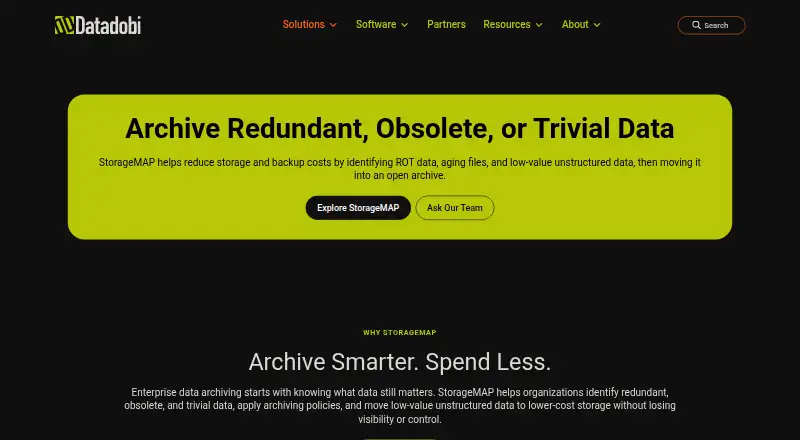
Datadobi Open Archive uses StorageMAP to identify redundant, outdated, aging, and otherwise low-value unstructured data, then helps teams move it to lower-cost or secure storage, or cloud services. It works with file and object data, including format transformations, across heterogeneous on-premises, cloud, and hybrid environments. Datadobi describes it as designed for billion-file and multi-petabyte settings. Teams can set and monitor archiving policies that adapt as business needs change, and use dashboards, reports, and exports to track archived data, policy enforcement, and potential savings. Logging and chain-of-custody records support auditability of data movement. Supported sources include SMB/CIFS and NFS file servers, S3 object servers, SMB/NFS/S3 cloud storage, and NAS systems. Retention policies, legal hold, and immutable archiving are available. The product runs on Linux, as a self-hosted deployment, and on the web. It is paid, with pricing on request. The annual subscription includes analytics, dashboards, automation, and core actions; migration and replication need separate add-on licenses.
Who it suits
Datadobi positions StorageMAP for large enterprises managing substantial unstructured data across hybrid-cloud environments. It may suit teams that need policy-based archiving and audit trails across varied storage systems.
What it does well
- Supports file and object data, including format transformations.
- Retention policies, legal hold, and immutable archiving are available.
- Tracks data movement with logging and chain-of-custody.
- Provides dashboards, reports, and exportable detail.
What to know first
- Pricing is available on request.
- Migration and replication require separate add-on licenses.
Limits
The annual subscription includes analytics, dashboards, automation, and core actions. Migration and replication require separate add-on licenses.
Plans
| Plan | Billed and limits | Price |
|---|---|---|
| StorageMAP | Annual subscription; exact cost discussed during a discovery conversation. · Analytics, dashboards, automation, move, delete, report, copy, tagging; migration and replication licenses sold separately | On request |
As datadobi.com lists them, read 10 Oct 2026. The maker's own page has the final word.
Getting started
- Visit the Datadobi Open Archive website.
- Choose a Linux, self-hosted, or web environment.
- Contact Datadobi to discuss pricing and the annual StorageMAP subscription.
- Confirm whether migration or replication add-on licenses are needed.
Datadobi Open Archive is an enterprise archiving platform built around StorageMAP, which finds low-value unstructured data and moves it to more suitable storage. It is best suited to organizations managing enormous, mixed file and object estates across on-premises and cloud environments. The main appeal is policy-driven control with detailed reporting and audit trails; the main qualification is that migration and replication are licensed separately from the annual subscription.
Overview
StorageMAP identifies redundant, obsolete, trivial, and aging files, then helps place them in an open archive on lower-cost, secure, or cloud storage. It handles both file and object data and can transform data between formats during management and movement. Datadobi positions it for billion-file and multi-petabyte environments, so its value appears when ordinary file-by-file housekeeping no longer scales.
The platform is vendor-neutral and intended to span heterogeneous file, object, on-premises, cloud, and hybrid storage. That breadth makes it a practical fit for enterprises consolidating archives across different vendors rather than committing to one storage ecosystem. Retention policies, legal holds, and immutable archives support governance requirements, while logged data-mobility actions and chain-of-custody records give auditors a traceable account of what moved and why.
Key features
Policy automation and control
Teams can implement and monitor archiving policies that change as business and data requirements evolve. This is more useful than a one-time cleanup: administrators can keep enforcing lifecycle rules as volumes and priorities shift. Retention, legal hold, and immutability controls are particularly relevant where deletion and preservation decisions must be defensible.
Reporting at enterprise scale
Dashboards, reports, and exportable detail show archived data, policy enforcement, and potential savings. These outputs help storage and compliance teams quantify results and find the next set of candidates, rather than relying on opaque background jobs.
Broad source coverage
Supported sources include SMB/CIFS and NFS file servers, S3 object servers, SMB/NFS/S3 cloud storage, and NAS systems. That mix suits hybrid estates, although buyers should verify that every source in their environment fits these categories before committing.
Support
Datadobi says its technical support engineers help customers address data challenges and reports an average customer satisfaction rating of 98%. That is a meaningful consideration for deployments where archive policy and mobility operations are business-critical.
Pricing
StorageMAP uses an annual subscription with custom pricing discussed during a discovery conversation. The subscription includes analytics, dashboards, automation, and core actions such as move, delete, report, copy, and tagging. Migration and replication require separate add-on licenses, so the headline subscription is not the complete cost for projects that need either capability.
This model fits large organizations that can budget for an enterprise deployment and want a tailored scope. It is a poor match for buyers seeking a published monthly price, a self-serve free tier, or a small archive with predictable low costs.
Platforms
Datadobi Open Archive runs on Linux and is available as self-hosted and web software. A self-hosted deployment can align with controlled infrastructure and data-residency requirements, while the web interface supports administration across a distributed storage estate.
Who it's for
It is designed for large enterprises managing significant unstructured-data volumes across hybrid-cloud environments. Storage, infrastructure, and compliance teams that need policy enforcement, format-aware movement, and auditable custody are the strongest candidates. Smaller organizations, single-platform estates, or teams without a need for billion-file scale may find the enterprise subscription and separate mobility licenses disproportionate.
Pros and cons
- Pro: Billion-file and multi-petabyte positioning makes it appropriate for very large estates.
- Pro: Vendor-neutral support across file, object, on-premises, cloud, and hybrid storage reduces lock-in during archive consolidation.
- Pro: Retention, legal hold, immutable archive, logging, and chain-of-custody features strengthen governance and audit readiness.
- Pro: Dashboards and exportable reporting connect policy enforcement with savings analysis.
- Con: Migration and replication are separate licenses, which can materially expand project cost and procurement complexity.
- Con: Pricing is custom and requires a discovery conversation, making comparison harder for smaller buyers.
Alternatives
Choose Fedora Repository when a free, Apache 2.0-licensed repository with no file-type or format restrictions is the priority.
ESSArch Digital Archive is a free open-source option; service and support are handled through a maintenance contract.
Pick RODA for a free open-source project maintained by KEEP SOLUTIONS, with commercial plugins, integrations, and professional support available.
Archivematica offers free open-source software, with hosted service starting at $11,440 a year.
HuskHoard is a free-forever AGPL v3 open-source core for Linux.
Preservica suits smaller starts with a free tier for one user and 1GB, plus a 310.00 USD-per-month Starter Plus plan billed annually.
Infobelt Enterprise Information Archiving is a paid, premises-installed alternative with a low fixed monthly cost.
Komprise Intelligent Data Management is another paid option with a free trial and subscription capacity set in the customer quote.
For a broader shortlist, see Data Archiving Software.
Verdict
Datadobi Open Archive is a strong choice for large enterprises that need scalable, vendor-neutral unstructured-data archiving with adaptable policies, governance controls, and evidence-rich reporting. Choose it for the operational visibility and auditability around complex hybrid estates; look elsewhere if you need transparent pricing, a free plan, or migration and replication included in one license.
Verdict
Datadobi Open Archive brings policy automation, reporting, and auditability to large-scale unstructured-data archiving. Check that your storage sources are supported and account for separate migration or replication licenses.
Questions
How is Datadobi Open Archive priced?
It is a paid product with pricing available on request. StorageMAP is billed as an annual subscription.
What does the StorageMAP subscription include?
It includes analytics, dashboards, automation, and core actions such as move, delete, report, copy, and tagging.
Do migration and replication come with the subscription?
No. Migration and replication licenses are sold separately.
Which storage sources are supported?
Supported sources include SMB/CIFS and NFS file servers, S3 object servers, SMB/NFS/S3 cloud storage, and NAS systems.
Which environments can use it?
The listed platforms are Linux, self-hosted, and web.
Does it support retention controls and auditability?
Yes. It supports retention policies, legal hold, and immutable archiving, and tracks data mobility with logging and chain-of-custody.
Facts from Datadobi Open Archive's own pages
- Archiving purpose
- StorageMAP identifies redundant, obsolete, and trivial data, aging files, and other low-value unstructured data, then helps move it into an open archive. · datadobi.com, 10 Oct 2026
- Auditability
- The platform tracks data mobility actions with logging and chain-of-custody to support auditability. · datadobi.com, 10 Oct 2026
- Company
- Datadobi says it is headquartered in Leuven, Belgium, and was founded in 2010. · datadobi.com, 10 Oct 2026
- Founded
- 2010 · datadobi.com, 28 Sept 2026
- Headquarters
- Leuven, Belgium · datadobi.com, 28 Sept 2026
- Interoperability
- StorageMAP is described as vendor-neutral and built to work across heterogeneous file, object, on-premises, cloud, and hybrid storage environments. · datadobi.com, 10 Oct 2026
- Policy automation
- StorageMAP helps teams implement and monitor archiving policies that can adapt as data and business needs change. · datadobi.com, 10 Oct 2026
- Pricing limits
- The annual subscription includes analytics, dashboards, automation, and core actions; migration and replication require separate add-on licenses. · datadobi.com, 10 Oct 2026
- Reporting
- The product provides dashboards, reporting, and exportable detail for tracking archived data, policy enforcement, and savings opportunities. · datadobi.com, 10 Oct 2026
- Scale
- Datadobi describes StorageMAP as designed for billion-file and multi-petabyte environments. · datadobi.com, 10 Oct 2026
- Storage targets
- The open archive page describes archiving data to lower-cost storage, secure storage, or cloud services. · datadobi.com, 10 Oct 2026
- Support
- Datadobi says its technical support engineers help customers address data challenges and reports an average customer satisfaction rating of 98%. · datadobi.com, 10 Oct 2026
- Supported data
- StorageMAP analyzes, manages, and moves file and object data, including transformations between formats. · datadobi.com, 10 Oct 2026
- Who it serves
- Datadobi says StorageMAP is built for large enterprises managing significant volumes of unstructured data across hybrid-cloud environments. · datadobi.com, 10 Oct 2026
Where Datadobi Open Archive stands on Freedom251
- Data Archiving Software#12 of 30