Freedom251 › Data Archiving Software

Datacyclic
What Datacyclic is
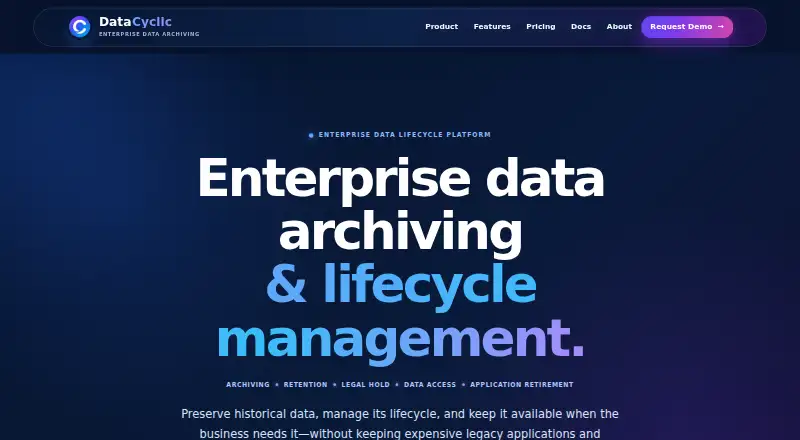
Datacyclic helps enterprises archive historical data, govern its lifecycle and retain access after applications or databases are retired. It stores archives in portable formats such as Parquet within customer-controlled storage. Governance features include retention policies, legal holds, access controls, audit history and policy-driven purge. Users can browse archive datasets and restore individual records, date ranges, tables or complete datasets. Relational connectivity is listed through JDBC or drivers for Oracle, SQL Server, PostgreSQL and MySQL. Archive targets include S3, Azure Blob, Google Cloud Storage, on-premises object stores, HDFS-compatible systems and secondary relational stores. APIs and service interfaces support archive-status lookups, legal-hold triggers and restore requests. Deployment can be customer-cloud, on-premises or hybrid, using customer-managed infrastructure and storage. Enterprise single sign-on and role-based administration controls are listed. Datacyclic names banking, insurance, healthcare, pharmaceuticals, SaaS, retail, manufacturing and enterprise IT among its target sectors. Pricing is on request after a free, time-boxed proof of concept.
Who it suits
Datacyclic targets enterprises in regulated and data-intensive sectors that need governed archives after system retirement. It suits organizations wanting customer-managed deployment and storage choices.
What it does well
- Portable archive formats in customer storage
- Retention policies and legal holds
- Search and restore selected data
- Customer-cloud, on-premises or hybrid deployment
- Supports major relational databases
What to know first
- No published starting price
- Commercial terms follow a proof of concept
- Self-hosted platform
- Pricing tailored to agreed scope
Limits
The free proof of concept is time-boxed. Paid plans generally begin after proof-of-concept acceptance, and commercial pricing is customized rather than published as a starting price.
Plans
| Plan | Billed and limits | Price |
|---|---|---|
| Custom enterprise pricing | Pricing is tailored to data under management, compliance posture, performance needs, and agreed scope; contact the maker for commercial options. · Free, time-boxed POC before commercial commitment · Paid plans generally begin after POC acceptance | On request |
| Custom enterprise engagement | Data/application scale · archive requirements · usage · deployment model · platform capabilities · support/services | On request |
As datacyclic.com lists them, read 9 Oct 2026. The maker's own page has the final word.
Getting started
- Open the Datacyclic website
- Discuss archive strategy, retention, and deployment needs
- Start a free, time-boxed proof of concept
- Connect databases through JDBC or listed drivers
- Select customer-managed archive storage
- Configure retention, legal holds, access, and restore workflows
Verdict
Datacyclic focuses on preserving and governing historical data with flexible deployment and restore options. Buyers must request pricing and complete the maker’s proof-of-concept path before commercial commitment.
Questions
What is Datacyclic used for?
It archives historical data, governs its lifecycle, and preserves access after applications or databases are retired.
Where can archives be stored?
Targets include S3, Azure Blob, Google Cloud Storage, on-premises object stores, HDFS-compatible systems, and secondary relational stores.
Which databases can it connect to?
The maker lists JDBC or driver connectivity for Oracle, SQL Server, PostgreSQL, and MySQL.
Can users restore part of an archive?
Yes. Users can restore records, date ranges, tables, or complete datasets.
Is there a free trial?
Datacyclic offers a free, time-boxed proof of concept before commercial commitment.
How is pricing handled?
Pricing is on request and tailored to data under management, compliance posture, performance needs, and agreed scope.
Facts from Datacyclic's own pages
- Access and restore
- Users can browse archive datasets and restore specific records, date ranges, tables, or complete datasets. · datacyclic.com, 9 Oct 2026
- Access control
- SSO and role-based permissions are provided for administrators, developers and end users. · datacyclic.com, 15 Oct 2026
- API capability
- The integrations page says APIs or service interfaces can expose archive status, initiate legal holds and request restores. · datacyclic.com, 15 Oct 2026
- Application retirement
- The product is intended to let organizations decommission expensive legacy applications while retaining governed historical access. · datacyclic.com, 15 Oct 2026
- Archive extraction
- The platform extracts eligible historical records from databases, applications and file-based sources. · datacyclic.com, 15 Oct 2026
- Archive formats
- The integration guidance emphasizes open Parquet, JSON and CSV formats and standard interfaces. · datacyclic.com, 15 Oct 2026
- Archive targets
- Targets include AWS S3 and Glacier, Azure Blob, Google Cloud Storage, on-premises storage, HDFS-compatible stores and secondary SQL databases. · datacyclic.com, 15 Oct 2026
- Audit history
- The product records archive, retention, legal-hold, restore and purge activity for auditability. · datacyclic.com, 15 Oct 2026
- Browsing
- Users can search archived datasets, inspect metadata and schemas, and retrieve authorized information without restarting the legacy application. · datacyclic.com, 15 Oct 2026
- Company maturity
- A LinkedIn post says the company was still in formal registration and early development while shaping its roadmap through industry feedback. · linkedin.com, 15 Oct 2026
- Database sources
- Documented relational sources include Oracle, SQL Server, PostgreSQL and MySQL through JDBC or drivers. · datacyclic.com, 15 Oct 2026
- Deployment
- The maker describes customer-cloud, on-premises and hybrid deployment using customer-controlled infrastructure and storage. · datacyclic.com, 15 Oct 2026
- Documentation depth
- The public documentation is an architectural and capability guide covering lifecycle stages, sources, targets and deployment models. · datacyclic.com, 15 Oct 2026
- File and export sources
- CSV, JSON, XML and Parquet exports, file shares, object-storage folders, SaaS exports and event or log batches can feed archives. · datacyclic.com, 15 Oct 2026
- Founded
- The official About page gives 2025 as the founding year. · datacyclic.com, 15 Oct 2026
- Governance
- It supports retention policies, legal holds, access controls, audit history, and policy-driven purge. · datacyclic.com, 9 Oct 2026
- Industry listing
- LinkedIn classifies DataCyclic under IT System Data Services. · linkedin.com, 15 Oct 2026
- Integration approach
- Datacyclic can ingest through existing ETL staging areas or connect directly with JDBC and bulk unload methods. · datacyclic.com, 15 Oct 2026
- Integrations
- The maker lists relational database connectivity through JDBC or drivers, including Oracle, SQL Server, PostgreSQL, and MySQL. · datacyclic.com, 9 Oct 2026
- Integrity claim
- A LinkedIn post says its Business Object Archiving approach preserves referential integrity rather than producing flat exports. · linkedin.com, 15 Oct 2026
- Intended customers
- The maker names banking and financial services, insurance, healthcare, pharmaceuticals, SaaS, retail, manufacturing, and enterprise IT among its target sectors. · datacyclic.com, 9 Oct 2026
- Interfaces
- The maker describes APIs and service interfaces for archive-status lookup, legal-hold triggers, and restore requests. · datacyclic.com, 9 Oct 2026
- Legal hold
- Legal holds prevent governed records from being purged during litigation, investigations or regulatory obligations. · datacyclic.com, 15 Oct 2026
- Legal name
- The maker identifies itself as Datacyclic Private Limited with CIN U58200KA2026PTC214350. · datacyclic.com, 15 Oct 2026
Where Datacyclic stands on Freedom251
- Data Archiving Software#8 of 30