Freedom251 › Data Archiving Software
HuskHoard
What HuskHoard is
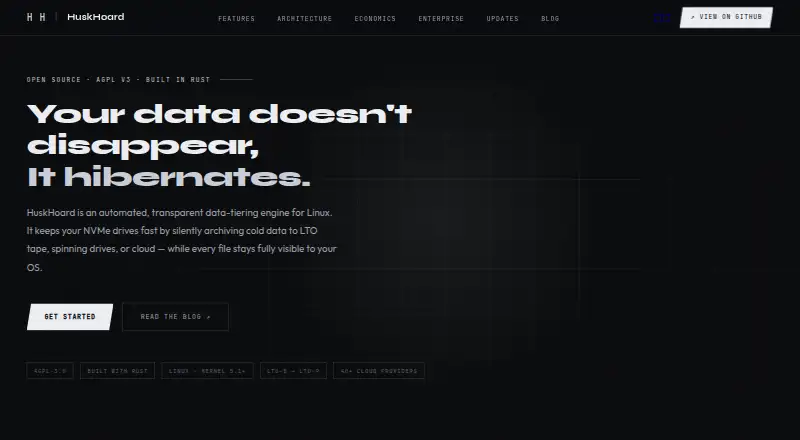
HuskHoard is a free Linux data-tiering engine that archives cold data to LTO tape, spinning drives or cloud storage while keeping files visible to the operating system. Its policy engine can identify cold data by age, file extension or directory policy. Linux fanotify intercepts requests for stubbed files so they can be recalled in real time. StreamGate serves video from LTO tape or S3 through a local HTTP bridge with range requests; the site names Plex, Jellyfin and VLC as compatible players. The architecture tracks file versions and supports point-in-time rollback of individual files. A scheduled BLAKE3 scrubber verifies offline storage, while payloads use Zstd streams verified by BLAKE3 and can be extracted with dd and zstd. HuskHoard ships as a single CLI binary and runs in user space without kernel modules or root daemons. It lists SCSI support for LTO-5 through LTO-9 and rclone cloud replication to 40+ providers. The open-source core is free forever under AGPL v3. It requires Linux kernel 5.1 or later, and installation instructions are shown for Ubuntu 24.04 LTS. A web dashboard, Prometheus integration, advanced replication policies and dedicated support with SLAs are listed as coming soon.
Who it suits
HuskHoard suits Linux users managing cold data across disk, tape and cloud storage. Its StreamGate feature is described for media and entertainment pipelines that serve video from LTO or S3.
What it does well
- Stubbed files can be recalled when requested.
- Supports LTO-5 through LTO-9 and 40+ cloud providers.
- Individual files have version history and rollback.
- Runs in user space without kernel modules or root daemons.
What to know first
- Requires Linux kernel 5.1 or later.
- Dashboard and Prometheus integration are coming soon.
- Advanced replication policies and SLA support are coming soon.
Plans
| Plan | Billed and limits | Price |
|---|---|---|
| Open-source core | Free forever · AGPL v3 | Free |
As huskhoard.com lists them, read 4 Oct 2026. The maker's own page has the final word.
Getting started
- Use a Linux system with kernel 5.1 or later.
- Follow the site's installation instructions for Ubuntu 24.04 LTS, if applicable.
- Install and run the single CLI binary in user space.
- Configure tiering policies based on age, file extension or directory policy.
- Connect supported storage, including NVMe, HDD, LTO-5 to LTO-9 tape or S3-compatible cloud storage.
HuskHoard is a Linux data-tiering tool that moves cold files to tape, disks or cloud while keeping them visible to the operating system. It best suits Linux operators managing large archives, especially media teams that need to stream older video. Its strengths are flexible storage targets and file-level recovery; its enterprise management features are still forthcoming.
Overview
HuskHoard keeps archived files accessible as stubs and recalls them when applications request them. That approach can make lower-cost or offline storage useful without forcing users to navigate a separate archive interface. It is also a focused Linux CLI, not a cross-platform archive-management service.
Data can be tiered according to age, file extension or directory policy. Version history and individual-file point-in-time rollback add a useful recovery layer, while scheduled BLAKE3 checks help identify bit rot in offline storage. These controls suit administrators who want to automate cold-data handling, though they do not replace the web dashboard, monitoring integration or support SLAs that are still coming.
Key features
Transparent recall and streaming
Linux fanotify intercepts access to stubbed files and recalls them in real time, preserving their visibility to the OS. StreamGate can serve video from LTO tape or S3 through a local HTTP bridge with Range requests, with Plex, Jellyfin and VLC named as compatible players. That makes it particularly relevant to media pipelines where older footage still needs to be browsed or played without first restoring an entire archive.
Open formats and storage choices
HuskHoard supports NVMe drives, HDD, LTO-5 through LTO-9 tape and S3-compatible cloud storage; it also lists cloud replication through rclone to more than 40 providers. Payloads are standard Zstd streams verified by BLAKE3, and the maker says they can be extracted with dd and zstd. That offers a straightforward path to reading archived payloads outside the application, while the broad storage mix gives teams room to combine local and remote targets.
Deployment and limits
The single CLI binary runs in user space without kernel modules or root daemons, which keeps deployment simpler than a kernel-level storage stack. HuskHoard requires Linux kernel 5.1 or later, and its installation instructions cover Ubuntu 24.04 LTS. Teams that need a web dashboard, Prometheus integration, advanced replication policies or dedicated support with SLAs will have to wait for those features or look elsewhere.
Pricing
Open-source core: free (Free forever · AGPL v3). The free plan includes retention policies, legal hold, immutable archive, and search and restore. It is a substantial starting point for Linux users who can operate a CLI and want to manage cold data without a subscription. There is no free trial because the core is free forever; no paid HuskHoard plan is given.
Platforms
HuskHoard runs on Linux, with kernel 5.1 or later required. Its user-space deployment avoids kernel modules and root daemons, but organizations standardizing on Windows or macOS cannot use it as their archive engine.
Who it's for
HuskHoard is a strong fit for Linux administrators, storage teams and media or entertainment pipelines that need automated tiering, recall from tape or cloud, and file-level rollback. It is less suited to buyers who require a browser-based administration console, Prometheus monitoring or dedicated SLA-backed support today.
Pros and cons
- Pros: Automatic recall keeps stubbed files visible to Linux applications, reducing friction around cold storage.
- Pros: LTO, HDD, NVMe and S3-compatible targets, plus rclone replication, offer multiple archive paths.
- Pros: Zstd payloads and BLAKE3 verification support portability and scheduled integrity checks.
- Cons: Linux-only operation and a CLI binary rule out teams that need a cross-platform or web-managed product.
- Cons: Dashboard, Prometheus integration, advanced replication policies and SLA support are not yet available.
Alternatives
For a broader comparison, browse Data Archiving Software.
- Preservica is worth considering if a freemium service with API, self-hosted and web platforms fits better: its free Starter plan allows one user and 1GB, with files and folders up to 50GB; Starter Plus is $310 a month, billed annually, excluding sales tax.
- Archon Data Store is a paid alternative identified as a product of Platform 3 Solutions.
- Infobelt Enterprise Information Archiving may suit organizations seeking on-premises deployment with a low, fixed monthly cost; it supports Linux as well as API, self-hosted and web platforms.
- Komprise Intelligent Data Management is a paid option with a free trial and subscription capacity documented in the customer quote.
- Archive360 is a paid, web-based option for buyers prepared to request a demo or contact sales for pricing.
- Arkivum offers a custom package tailored to each customer's requirements.
- Docbyte Vault is a paid alternative for buyers willing to contact Docbyte about pricing.
- Fedora Repository is another free option, available for web, Windows, macOS and Linux.
Verdict
Choose HuskHoard if your priority is a free Linux CLI for tiering cold data across disks, tape and cloud while retaining transparent recall and file-level rollback. Its portable payload format and integrity checks strengthen the case for long-lived archives. Look elsewhere if a web dashboard, monitoring integration or dedicated support is a requirement rather than a future possibility.
Verdict
HuskHoard offers tiering, recalls and integrity checks in a free Linux CLI core. Its listed enterprise features remain forthcoming, so confirm that its current command-line deployment suits your needs.
Questions
Is HuskHoard free?
Yes. Its Open-source core plan costs nothing and is free forever under AGPL v3.
Which operating systems does HuskHoard support?
HuskHoard is for Linux and requires kernel 5.1 or later. The site shows installation instructions for Ubuntu 24.04 LTS.
What storage sources does it support?
The listed sources are NVMe drives, HDD, LTO-5 to LTO-9 tape and S3-compatible cloud storage.
Can archived files be recovered?
Yes. Linux fanotify intercepts requests for stubbed files for real-time recall. HuskHoard also tracks file versions and supports point-in-time rollback of individual files.
Can it serve video from tape or S3?
StreamGate can serve video through a local HTTP bridge with HTTP Range requests. The site names Plex, Jellyfin and VLC as compatible players.
Is HuskHoard open source?
The Open-source core plan is licensed under AGPL v3.
Facts from HuskHoard's own pages
- Deployment
- HuskHoard ships as a single CLI binary and operates in user space without kernel modules or root daemons. · huskhoard.com, 4 Oct 2026
- Enterprise features
- A web dashboard, Prometheus integration, advanced replication policies, and dedicated support with SLAs are listed as coming soon. · huskhoard.com, 4 Oct 2026
- Hardware and cloud
- The site lists native SCSI support for LTO-5 through LTO-9 and cloud replication via rclone to 40+ providers. · huskhoard.com, 4 Oct 2026
- Integrity checks
- A BLAKE3 bit-rot scrubber cryptographically verifies offline storage on a schedule the user sets. · huskhoard.com, 4 Oct 2026
- Intended users
- The site describes StreamGate as built for media and entertainment pipelines and presents HuskHoard for managing cold data on Linux. · huskhoard.com, 4 Oct 2026
- Purpose
- HuskHoard is an automated data-tiering engine for Linux that archives cold data to LTO tape, spinning drives, or cloud while keeping files visible to the OS. · huskhoard.com, 4 Oct 2026
- Requirements
- The site specifies Linux kernel 5.1 or later and shows installation instructions for Ubuntu 24.04 LTS. · huskhoard.com, 4 Oct 2026
- Storage formats
- Payloads use standard Zstd streams verified by BLAKE3, and the site says they can be extracted with dd and zstd. · huskhoard.com, 4 Oct 2026
- Streaming
- StreamGate can serve video from LTO tape or S3 over a local HTTP bridge with HTTP Range requests; the page names Plex, Jellyfin, and VLC as compatible players. · huskhoard.com, 4 Oct 2026
- Tiering policies
- The background policy engine identifies cold data by age, file extension, or directory policy. · huskhoard.com, 4 Oct 2026
- Transparent recalls
- It uses Linux fanotify to intercept requests for stubbed files and recall them in real time. · huskhoard.com, 4 Oct 2026
- Version recovery
- The architecture description says HuskHoard tracks file version history and supports point-in-time rollback of individual files. · huskhoard.com, 4 Oct 2026
Where HuskHoard stands on Freedom251
- Data Archiving Software#6 of 30