Freedom251 › Data Archiving Software

ESSArch Digital Archive
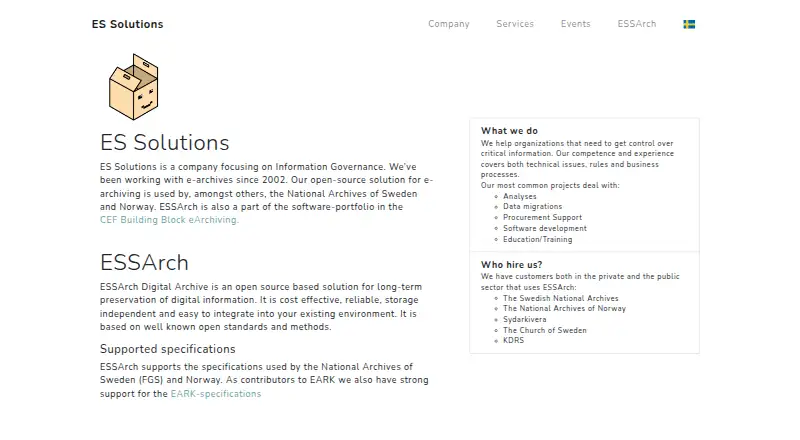
What ESSArch Digital Archive is
ESSArch Digital Archive is an open-source digital archiving system for organizations that need to search for and restore archived material. It is deployed on premises and supports web, Linux, and Windows platforms. The listed data sources include SIP packages, ERMS, business systems, disks, tape, virtual filesystems, and AWS S3. These options cover packaged submissions, organizational systems, storage media, virtual filesystems, and cloud storage. Search and restore are listed capabilities, so users can locate archived material and retrieve it. ESSArch is free, and its pricing note identifies it as open source. The project was founded in 2002 and is headquartered in Saltsjö-Boo, Sweden. Its listed scope centers on archiving information from several kinds of sources, then searching for and restoring that material from an on-premises deployment. Organizations choosing it can use the listed web, Linux, or Windows platforms in connection with the archive. The combination of varied supported sources and search and restore makes ESSArch relevant where those archive tasks are central.
Who it suits
ESSArch suits organizations that need an on-premises digital archive with search and restore capabilities. It is relevant to teams handling material from sources such as SIP packages, business systems, disks, tape, virtual filesystems, or AWS S3.
What it does well
- Free and identified as open source.
- Can be deployed on premises.
- Supports web, Linux, and Windows platforms.
- Lists search and restore capabilities.
- Accepts data from several listed source types.
What to know first
- Deployment is on premises.
- The listed platforms are limited to web, Linux, and Windows.
Plans
| Plan | Billed and limits | Price |
|---|---|---|
| ESSArch Digital Archive | Open-source solution; service and support are regulated by maintenance contract | Free |
As essarch.org lists them, read 11 Oct 2026. The maker's own page has the final word.
Getting started
- Visit the ESSArch website.
- Choose the listed web, Linux, or Windows platform.
- Set up an on-premises deployment.
ESSArch Digital Archive is an open-source system for preserving digital records over the long term. It is best suited to organizations that need formal archival workflows and can deploy and operate server software. Its breadth—from ingest to migration—makes it a serious archival platform, though ongoing service and support are covered by a maintenance contract.
Overview
ESSArch follows the OAIS archival model, with components for pre-ingest, ingest, preservation, access, data management, administration, and management. Components can be used individually or combined, giving organizations a way to fit the system into an existing environment rather than take on every part at once. The maker describes it as storage independent and designed to integrate with existing infrastructure.
It supports specifications used by the National Archives of Sweden and Norway, along with EARK specifications. Its customers include public- and private-sector organizations, including both national archives, a strong fit for institutions with established preservation responsibilities.
Key features
- Producer and ingest workflows: Users can prepare and collect content, create and submit submission information packages (SIPs), and manage ingest reception and approval. This supports a controlled path from producer submission into the archive rather than simple file storage.
- Access and dissemination: Workflows include access to storage units and dissemination of archived content, connecting preservation operations to later use.
- Preservation maintenance: Configurable validation profiles include checksum and directory-structure validators. Staff can also schedule or manually run format-conversion jobs on selected archived content, useful for planned preservation work.
- Archival description: Description management covers accession, location, classification, and preservation planning, with ICA standards support including ISAAR-CPF, ISAD-G, and ISDF.
- Storage migration: Workflows move information packages between storage targets, which is relevant for organizations that need to change storage arrangements without treating migration as an ad hoc file-copy task.
- Integration and access control: A REST API covers archival descriptions, events, information packages, search, storage, profiles, notifications, and orders. Documented authentication options include token, basic, and session methods; the access-control documentation covers users, groups, roles, permissions, and single sign-on configuration.
Pricing
ESSArch Digital Archive — free. The open-source solution has a free plan and no free trial. That makes it a cost-free software option for organizations able to run it themselves; it does not mean service and support are included. Service and support for ESSArch Core are regulated through a maintenance contract with ES Solutions AB.
Platforms
ESSArch supports API, Linux, self-hosted, web, and Windows environments. The documented server operating systems are Ubuntu 22.04, Debian 11, RHEL 9, OpenSUSE/SLES 15.3, and Windows Server 2019, all x86_64. Deployment documentation covers Docker and Python installation, plus an automatic installer for Ubuntu, Debian, RHEL, OpenSUSE, and SLES. Operators should account for the documented prerequisites: Redis 5.0 or later, RabbitMQ 3.8 or later, and Elasticsearch 7.*. This is a substantial technical footprint, so it is a better match for organizations with server administration capacity than for teams seeking a turnkey hosted service.
Who it's for
ESSArch is aimed at organizations preserving information from SIP packages, ERMS, business systems, disk, tape, virtual filesystems, and AWS S3. Public institutions and private organizations with archival processes, staff able to manage the deployment, and a need for structured preservation and access workflows are its natural audience. It is less suitable for buyers who want bundled support without a maintenance agreement or cannot operate the required server environment.
Pros and cons
- Pro: A broad OAIS-based workflow spans ingest, description, preservation, access, and storage migration, rather than stopping at retention.
- Pro: Modular components, storage independence, and a REST API give organizations several routes to fit ESSArch into existing systems.
- Pro: The software is free and open source, with documented Linux and Windows Server deployment options.
- Con: The listed dependencies and server operating-system requirements make deployment and upkeep a meaningful operational commitment.
- Con: Service and support are governed by a maintenance contract, so the free software price should not be mistaken for included vendor support.
Alternatives
Data Archiving Software is the broader category directory for comparing archive tools.
- Fedora Repository is another free, open-source option, with support for API, Linux, macOS, self-hosted, web, and Windows; choose it if macOS support or its Apache 2.0 licensing terms are a priority.
- RODA is also free and supports API, Linux, macOS, self-hosted, web, and Windows. Its open-source project is maintained by KEEP SOLUTIONS; consider it when that platform range or project stewardship better fits.
- Archivematica offers free software to download, install, and use, as well as a hosting plan at $11,440 a year. It is worth considering if a hosting option matters more than ESSArch's documented storage-migration and description workflows.
- HuskHoard has a free AGPL v3 open-source core and Linux support; consider it if Linux is the platform you need.
- Preservica has a free Starter plan with 1 user and 1GB, files and folders up to 50GB, and a Starter Plus plan at $310 a month billed annually, excluding sales tax. Choose it if those plan terms and a trial are more appropriate than a free self-hosted open-source system.
- Datadobi Open Archive is a paid Linux, self-hosted, web option with annual subscription pricing discussed during a discovery conversation; consider it if that paid model suits your organization.
- Infobelt Enterprise Information Archiving is a paid, on-premises option with a low, fixed monthly cost; choose it if that pricing approach fits better.
- Komprise Intelligent Data Management is a paid, subscription-capacity product with a free trial; consider it if a trial is important to your selection process.
Verdict
Choose ESSArch if your organization needs a free, open-source archival system with structured ingest, preservation, search, and restore across its supported data sources, and has the capacity to deploy and maintain it. Its modular OAIS workflows and integration options are compelling for institutional archives; look elsewhere if you need a simpler hosted service or support included without a maintenance contract.
Verdict
Choose ESSArch if you need a free, open-source on-premises archive with search and restore across the listed data sources. Its fit is strongest for organizations working with those sources; readers seeking a listed platform outside web, Linux, or Windows should look elsewhere.
Questions
How much does ESSArch Digital Archive cost?
Its pricing model is free, and the pricing note identifies it as open source.
Which platforms does ESSArch support?
The listed platforms are web, Linux, and Windows.
Can ESSArch search for and restore archived material?
Yes. Search and restore are listed capabilities.
Where can ESSArch be deployed?
Its listed deployment model is on premises.
What data sources are supported?
The listed sources are SIP packages, ERMS, business systems, disk, tape, virtual filesystems, and AWS S3.
Where is ESSArch based, and when was it founded?
It was founded in 2002 and is headquartered in Saltsjö-Boo, Sweden.
Facts from ESSArch Digital Archive's own pages
- Access control
- The documentation covers users, groups, roles, permissions, and single sign-on configuration. · docs.essarch.org, 11 Oct 2026
- Archival description
- Its archival description management supports accession, location, classification, preservation planning, and ICA standards including ISAAR-CPF, ISAD-G, and ISDF. · docs.essarch.org, 11 Oct 2026
- Archival model
- ESSArch is an OAIS-compliant archival solution with components for pre-ingest, ingest, preservation, access, data management, administration, and management. · docs.essarch.org, 11 Oct 2026
- Archive maintenance
- The user guide lists appraisal, format conversion, archival description management, and storage migration functions. · docs.essarch.org, 11 Oct 2026
- Authentication
- The documented API supports token, basic, and session authentication. · docs.essarch.org, 11 Oct 2026
- Dependencies
- The documented prerequisites include Redis 5.0 or later, RabbitMQ 3.8 or later, and Elasticsearch 7.*. · docs.essarch.org, 11 Oct 2026
- Deployment
- The documentation describes Docker and Python installation, and an automatic installer for Ubuntu, Debian, RHEL, OpenSUSE, and SLES. · docs.essarch.org, 11 Oct 2026
- Format conversion
- Users can create scheduled or manual format-conversion jobs for selected archived content. · docs.essarch.org, 11 Oct 2026
- Founded
- 2002 · essarch.org, 28 Sept 2026
- Headquarters
- Saltsjö-Boo, Sweden · essarch.org, 28 Sept 2026
- Ingest and access
- The user guide includes ingest reception and approval, storage unit access, and dissemination workflows. · docs.essarch.org, 11 Oct 2026
- Integration
- ESSArch provides a REST API excerpt documenting relevant API areas for integration with other systems. · docs.essarch.org, 11 Oct 2026
- Integration API
- The REST API documents integration endpoints for archival descriptions, events, information packages, search, storage, profiles, notifications, and orders. · docs.essarch.org, 11 Oct 2026
- Modular use
- Each ESSArch software component can be used individually or integrated with other components. · docs.essarch.org, 11 Oct 2026
- Platform support
- The documented supported server operating systems include Ubuntu 22.04, Debian 11, RHEL 9, OpenSUSE/SLES 15.3, and Windows Server 2019, all x86_64. · docs.essarch.org, 11 Oct 2026
- Preservation tools
- Users can configure validation profiles with checksum and directory-structure validators. · docs.essarch.org, 11 Oct 2026
- Producer workflow
- The user guide documents preparing information packages, collecting content, creating submission information packages (SIPs), and submitting SIPs. · docs.essarch.org, 11 Oct 2026
- Purpose
- ESSArch Digital Archive is an open source based solution for long-term preservation of digital information. · essarch.org, 11 Oct 2026
- Standards
- ESSArch supports the specifications used by the National Archives of Sweden and Norway and has support for EARK specifications. · essarch.org, 11 Oct 2026
- Storage
- The maker describes ESSArch as storage independent and easy to integrate into an existing environment. · essarch.org, 11 Oct 2026
- Storage migration
- ESSArch provides workflows for migrating information packages from one storage target to another. · docs.essarch.org, 11 Oct 2026
- Support
- The GitHub project says service and support for ESSArch Core are regulated in a maintenance contract with ES Solutions AB. · github.com, 11 Oct 2026
- Supported platforms
- The prerequisites page lists Ubuntu 22.04, Debian 11, RHEL 9, OpenSUSE/SLES 15.3, and Windows Server 2019 as supported operating systems. · docs.essarch.org, 11 Oct 2026
- Users
- The maker says its customers include public- and private-sector organizations, including the National Archives of Sweden and Norway. · essarch.org, 11 Oct 2026
Where ESSArch Digital Archive stands on Freedom251
- Data Archiving Software#2 of 30