Freedom251 › Version Control Software
Darcs
What Darcs is
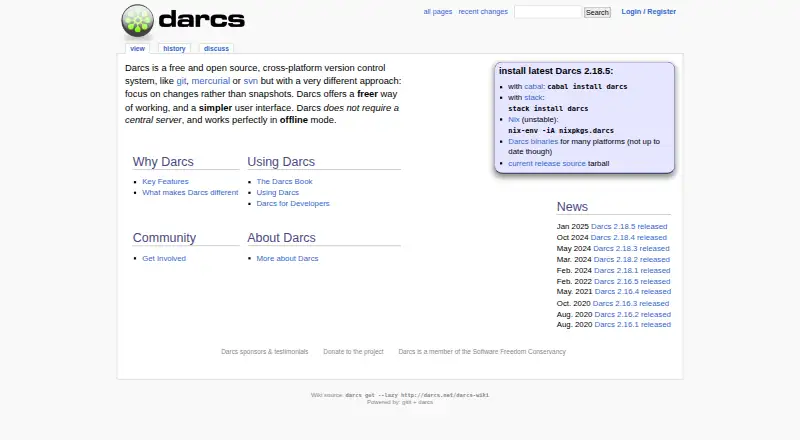
Darcs is a free, open-source version control system for Windows, macOS, Linux, and self-hosted use. It focuses on patches, or individual changes, rather than snapshots. Each working directory is its own repository, so contributors can record changes offline and push them to a remote repository later. Interactive commands let users choose changes for a patch, pull individual changes, and modify or discard a patch before sending it. Darcs treats each repository as a branch, with collaboration handled through pushing and pulling. Contributors can also use the darcs send command to email proposed patches for maintainers to accept or reject without giving them commit privileges. The project names hub.darcs.net and darcsweb as hosting options. Darcs is written in Haskell, with installation routes including Cabal, Stack, Nix, platform binaries, and a source tarball. The volunteer-run project belongs to the Software Freedom Conservancy. Documented limitations include no local branches, no Git-style staging index, no versioning of file permissions, and performance problems in many areas.
Who it suits
Darcs may suit contributors who want to work offline, share changes as patches, or propose updates by email without commit privileges. Its patch-based workflow is relevant to teams that need selective changes or parallel development.
What it does well
- Repositories support recording changes offline.
- Interactive commands let users select changes for patches.
- Email proposals do not require contributors to have commit privileges.
- Available for Windows, macOS, and Linux.
- Free and open source.
What to know first
- Does not support local branches.
- Does not use a Git-style staging index.
- Does not version file permissions.
- FAQ notes performance problems in many areas.
Limits
Darcs does not support local branches, does not version file permissions, and has no listed large-file handling. Its FAQ reports that performance remains poor in some areas, though it is improving.
Plans
| Plan | Billed and limits | Price |
|---|---|---|
| Darcs | Free and open-source version control system | Free |
As darcs.net lists them, read 8 Oct 2026. The maker's own page has the final word.
Getting started
- Visit the Darcs website.
- Choose an installation route: Cabal, Stack, Nix, a platform binary, or a source tarball.
- Create or use a working directory as a repository.
- Record changes locally, then push them to a remote repository when ready.
Overview
Darcs is a free, open-source version control system for developers who prefer to exchange discrete patches over a snapshot-based workflow. It is most appealing to contributors who need to work offline and submit selected changes by email, but it is a less natural fit for teams that rely on local branches or file-permission history.
Key features
Every working directory is an independent repository, letting developers record changes without a network connection and push them to another repository later. Darcs models branches through pushes and pulls between repositories rather than local branch creation. That supports independent and parallel work, but it adds friction for teams whose everyday workflow depends on local branches.
Interactive commands let contributors select which changes to include in a patch, pull individual changes from another repository, and edit a patch before sending it. They can also discard a patch and start again. This fine-grained control suits cherry-picking and carefully scoped contributions; the trade-off is that Darcs has no Git-style staging index, so it will not suit users who expect that workflow.
With darcs send, contributors can email proposed patches to maintainers for acceptance or rejection without commit privileges. That can lower the barrier for occasional contributors. Repository hosting and sharing are separate concerns: Darcs points to hub.darcs.net and darcsweb as options.
Darcs is written in Haskell. Installation options include Cabal, Stack, Nix, platform binaries, and a source tarball. The download page warns that some listed binaries may lag the current stable release; checksums are provided for the Windows and Intel Mac binaries.
Pricing
Darcs costs free under its free and open-source plan. There is no free trial because the software is free. It is a straightforward choice for individuals or teams seeking version control without a software charge, though users should account separately for their hosting arrangements.
Platforms
Darcs supports Windows, macOS, and Linux, and can be deployed as self-hosted software. Download options also include OpenBSD and FreeBSD. Large-file handling, sparse checkout, and nested repositories are not supported, which may rule it out for repositories that depend on those capabilities.
Who it's for
Darcs best serves developers whose work is organized around offline editing, patch exchange, parallel development, and selective changes. Email proposals without commit privileges are particularly useful where maintainers want to review contributions from occasional collaborators. It is a weaker choice for workflows requiring local branches, a staging index, file-permission versioning, or consistently strong performance: the project FAQ says performance remains poor in many areas, though it is improving, and warns against using Darcs to version many files in /etc because it does not track file permissions.
The project is volunteer-run and belongs to the Software Freedom Conservancy. Its community resources include mailing lists, IRC, a bug tracker, Reddit, Stack Overflow, and a Trello board. The official pages do not describe a security certification or compliance program.
Pros and cons
- Pro: Independent repositories support offline work, with later pushes to a remote repository.
- Pro: Interactive patch selection and editing let contributors control exactly which changes they propose.
- Pro: Email-based patch proposals allow maintainers to accept or reject work without giving contributors commit privileges.
- Con: No local branches or Git-style staging index means familiar branch-and-stage workflows do not translate directly.
- Con: Darcs does not version file permissions, and the project warns against using it for many files in /etc.
- Con: Performance remains poor in some areas, and large-file handling, sparse checkout, and nested repositories are absent.
Alternatives
Choose another version control option if Darcs's patch-centered model or missing capabilities do not fit your workflow.
- Diversion is a freemium alternative with a free plan and trial; its Education plan is free for eligible academic institutions for up to 10 users.
- Unity Version Control is a freemium alternative with a free trial and a free tier that includes unlimited cloud seats and 25 GB of storage, with usage beyond included limits billed pay-as-you-go.
- Accessibility Test Framework for Android is a free alternative whose code is hosted in Google's public GitHub organization.
- Fossil is a free, open-source, self-hosted alternative.
- GitUI is a free, open-source terminal Git client.
- Magit is a free Emacs package installed through Emacs' package manager or its development repository.
- Apache Subversion is free, open-source version control software with source code provided by the project and binary packages maintained by third parties.
- BitKeeper is free version control software released under the Apache 2.0 License.
Verdict
Choose Darcs if you want free, cross-platform version control centered on offline work and selective patch exchange, especially when email proposals help bring in contributors without repository privileges. Look elsewhere if your team needs local branches, file-permission history, support for large files, sparse checkout or nested repositories, or if the project's reported performance shortcomings are unacceptable.
Verdict
Darcs centers collaboration on patches, with offline work, interactive selection, and email-based proposals. Its lack of local branches and file-permission versioning, along with reported performance problems, may matter for some workflows.
Questions
How much does Darcs cost?
Darcs is free and open source. Its listed plan is free.
Is there a free plan or trial?
Darcs is free to use. No free trial is offered.
Which platforms does Darcs support?
The listed desktop platforms are Windows, macOS, and Linux. The project also lists self-hosted use, and its download page names OpenBSD and FreeBSD binaries.
Can contributors submit changes by email?
Yes. The `darcs send` command lets contributors email proposed patches for maintainers to accept or reject without commit privileges.
Is Darcs open source, and who runs it?
Darcs is free and open source. The project describes itself as volunteer-run and a member of the Software Freedom Conservancy.
What are Darcs' version control limitations?
Darcs does not support local branches or a Git-style staging index, and it does not version file permissions. Large-file handling is listed as none.
Facts from Darcs's own pages
- Branching and merging
- Darcs treats every repository as a branch, with branching handled by pushing and pulling between repositories. · darcs.net, 8 Oct 2026
- Collaboration
- Users can send proposed patches by email for maintainers to accept or reject, without needing commit privileges. · darcs.net, 8 Oct 2026
- Community support
- The project lists mailing lists, an IRC channel, a bug tracker, Reddit, Stack Overflow, and a Trello board as community resources. · darcs.net, 8 Oct 2026
- Distributed and offline
- Each working directory is a repository, so users can record changes offline and push them to a remote repository later. · darcs.net, 8 Oct 2026
- Downloads
- The download page lists Windows, Intel Mac OS X, GNU/Linux, OpenBSD, and FreeBSD, while noting that the listed binaries may be older than the current stable release. · darcs.net, 8 Oct 2026
- Email collaboration
- The darcs send command lets contributors send patches by email for maintainers to accept or reject without requiring commit privileges. · darcs.net, 8 Oct 2026
- File permission limitation
- The FAQ says Darcs does not version file permissions and warns that this makes it unsafe for versioning many files in /etc. · darcs.net, 8 Oct 2026
- Hosting
- The features page names hub.darcs.net and darcsweb as options for hosting and sharing repositories. · darcs.net, 8 Oct 2026
- Installation
- The front page lists installation through Cabal, Stack, Nix, platform binaries, and a source tarball. · darcs.net, 8 Oct 2026
- Intended users
- The features page describes workflows for offline work, patch-based collaboration, parallel development, and cherry-picking changes. · darcs.net, 8 Oct 2026
- Interactive changes
- Users can interactively choose which changes to include in a patch, and push and pull operations offer similar interaction. · darcs.net, 8 Oct 2026
- Languages and tooling
- Darcs is written in Haskell, and the homepage lists installation through cabal, Stack, and Nix. · darcs.net, 8 Oct 2026
- Local branches
- The comparison page says Darcs does not yet support local branches. · darcs.net, 8 Oct 2026
- Offline work
- Darcs repositories work independently, so users can record changes offline and push them to a public repository later. · darcs.net, 8 Oct 2026
- Patch editing
- Users can modify patches before sending them to a remote repository or discard them and start over. · darcs.net, 8 Oct 2026
- Performance limitation
- The FAQ says Darcs performance is still bad in many areas, though it is improving. · darcs.net, 8 Oct 2026
- Platforms
- The download page lists binaries for Windows and Intel Mac OS X, with Linux and BSD distribution packages or source-build instructions also described. · darcs.net, 8 Oct 2026
- Product
- Darcs is a free and open source, cross-platform version control system that focuses on changes rather than snapshots. · darcs.net, 8 Oct 2026
- Project organization
- Darcs describes itself as a volunteer-run project and a member of the US tax-exempt Software Freedom Conservancy. · darcs.net, 8 Oct 2026
- Security
- The download page provides checksums alongside the listed Windows and Intel Mac binaries. · darcs.net, 8 Oct 2026
- Security and compliance
- The official pages opened describe Darcs as free and open source and note project membership in the Software Freedom Conservancy; they do not state a security certification or compliance program. · darcs.net, 8 Oct 2026
- Selective changes
- Interactive commands let users choose which changes to include in a patch, and users can pull individual changes from another repository. · darcs.net, 8 Oct 2026
- Support
- The FAQ directs unanswered questions to the darcs-users mailing list or the #darcs IRC channel. · darcs.net, 8 Oct 2026
- Version control limitation
- The comparison page says Darcs does not yet support local branches and does not use a Git-style staging index. · darcs.net, 8 Oct 2026
Where Darcs stands on Freedom251
- Version Control Software#7 of 62