Freedom251 › Git Hosting Services

Codeberg
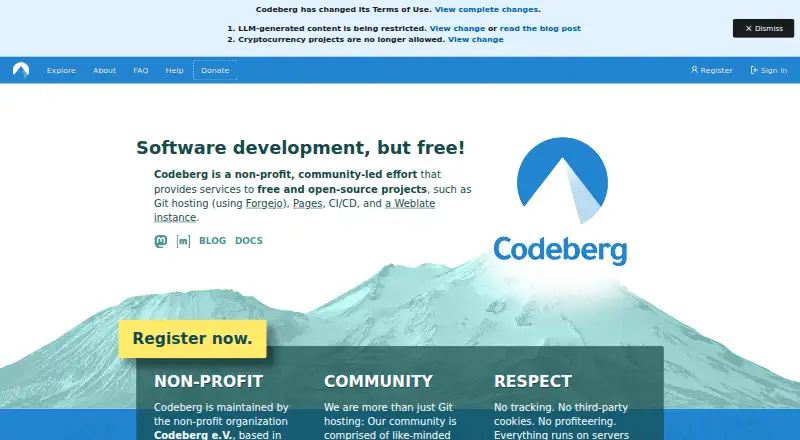
What Codeberg is
Codeberg is a free, community-driven software development platform operated by the non-profit Codeberg e.V. and centered on the Forgejo software forge. Repositories support Git source code, issue tracking, and wikis. Codeberg Pages publishes static websites at a codeberg.page address or custom domain, and CI/CD options include a Woodpecker instance and Forgejo Actions. Weblate is available for software localization, with integration documentation for Keycloak, LiberaPay, Matrix, and Read the Docs. Users can enable two-factor authentication; Codeberg recommends SSH keys for passwordless repository access and publishes host fingerprints for server verification. The service is intended for free/libre software projects and may reject uses that do not contribute to that purpose or abuse its infrastructure. The free plan includes 750 MiB of Git storage, 1.5 GiB for packages, LFS, and attachments, 100 MiB of private or personal content, and 100 repositories. The default repository limit is 100 for users and organizations; increases can be requested through a public repository. Codeberg recommends self-hosting Forgejo as an alternative deployment option.
Who it suits
Codeberg suits people and organizations building free/libre software who need hosted Git repositories and related project tools. Those needing a different deployment option can self-host Forgejo.
What it does well
- Repositories include Git, issue tracking, and wikis.
- Pages supports custom domains.
- Woodpecker and Forgejo Actions provide CI/CD.
- Two-factor authentication is supported.
- Membership is not required to use Codeberg.org.
What to know first
- Use is intended for free/libre software projects.
- Default limit is 100 repositories.
- Moderation and infrastructure administrators can access private profiles and repositories.
Limits
The free plan includes 750 MiB of Git storage, 1.5 GiB for packages, LFS, and attachments, 100 MiB of private or personal content, and 100 repositories. Users and organizations have a default limit of 100 repositories, with increases requestable through Codeberg’s public requests repository.
Plans
| Plan | Billed and limits | Price |
|---|---|---|
| Free/libre software projects | No payment required · 750 MiB Git storage · 1.5 GiB packages/LFS/attachments · 100 MiB private or personal content · 100 repositories | Free |
As codeberg.org lists them, read 2 Oct 2026. The maker's own page has the final word.
Getting started
- Visit https://codeberg.org/.
- Use Codeberg.org without joining Codeberg e.V.; membership is not required.
- Create or access a repository for Git source code, issues, and a wiki.
- Enable two-factor authentication and consider SSH keys for passwordless repository access.
- Use Codeberg Pages for static-site hosting, or the Woodpecker CI instance and Forgejo Actions for CI/CD.
- Self-host Forgejo if you want to run the software yourself.
Codeberg is a Forgejo-based code-hosting and collaboration service best suited to free/libre software projects. It brings repositories, issue tracking, wikis, static pages and CI/CD together, with defined storage caps and an eligibility policy that make it a more focused choice than a general-purpose host.
Overview
Codeberg is operated by Codeberg e.V., a Berlin-based non-profit association with a community-driven model. You do not need to be a member to use Codeberg.org. Its Forgejo foundation also gives developers who want to run their own forge a clear alternative: self-host Forgejo instead.
The intended-use policy matters: Codeberg is for projects that contribute to free/libre software, and it may reject projects that do not meet that purpose or that abuse its infrastructure. Its moderation team and infrastructure administrators can access private profiles and repositories under its Privacy Policy, so it is not the right place for sensitive private material if that access is a concern.
Key features
Repositories combine Git source code with issue tracking and wikis, keeping core project coordination alongside code. Codeberg Pages can publish static websites at a codeberg.page address or on a custom domain, making it useful for project sites and documentation without serving as a general-purpose hosting platform.
CI/CD is available through a Woodpecker CI instance at ci.codeberg.org and Forgejo Actions. Weblate is offered as an additional service for software localization. Official integration documentation covers Keycloak, LiberaPay, Matrix and Read the Docs, a useful set for projects that already depend on those services.
For account and repository access, Codeberg supports two-factor authentication and recommends SSH keys for passwordless access. It also publishes SSH host fingerprints, letting users verify they are connecting to Codeberg servers. For bugs or unanswered questions, its documentation points users to the Codeberg Community Tracker.
Pricing
Codeberg's “Free/libre software projects” plan costs nothing, with no payment required. It includes 750 MiB of Git storage, 1.5 GiB for packages, LFS and attachments, and 100 MiB for private or personal content. The allowance supports modest project needs, but the separate, relatively small private or personal-content cap is a constraint for teams keeping substantial non-public material.
The plan also includes 100 repositories by default for users and organizations. Increases can be requested through Codeberg's public requests repository. The free plan's eligibility is as important as its price: it is intended for free/libre software projects, not unrestricted commercial or personal use.
Platforms
Codeberg supports web use and is categorized for Linux, macOS, Windows and self-hosted environments. Self-hosting means running Forgejo, the software behind Codeberg, rather than installing Codeberg.org itself.
Who it's for
Codeberg is a strong fit for free/libre software maintainers who want source hosting, issue tracking, wikis, static project pages and CI/CD in one place, and who can work within its storage and repository limits. It is a weaker fit for projects outside its eligibility purpose, users who need larger private-content allowances, or anyone unwilling to accept administrator access to private profiles and repositories under the Privacy Policy.
Pros and cons
- Pro: Git repositories, issues and wikis sit alongside Pages and two CI/CD options, reducing the need to separate basic project work across services.
- Pro: The non-profit, community-driven operating model and the option to self-host Forgejo suit projects that value community governance or deployment control.
- Con: Free use is purpose-bound to free/libre software, so it is not a universal home for every kind of code project.
- Con: The plan caps Git storage at 750 MiB and private or personal content at 100 MiB; those limits can become restrictive as projects grow.
- Con: Moderation and infrastructure administrators can access private profiles and repositories under the Privacy Policy, which may rule it out for sensitive work.
Alternatives
For a game-development-focused version-control option, start with the game version control software directory.
- Bitbucket Pipelines is worth considering when a team needs a free tier for up to five users, unlimited public and private repositories, 1 GB of LFS storage and 50 build minutes per month; its free tier is not described as purpose-limited to free/libre projects.
- Fossil suits developers who prefer a self-hosted, BSD-licensed free and open-source option.
- GitKraken Desktop is an alternative for OSS development centered on local repositories and public remotes; its free Community plan is limited to public repositories.
- SmartGit may suit personal, non-commercial use where a full feature set without enterprise integrations is enough and free registration is acceptable.
- Unity Version Control is an alternative with a free tier that includes unlimited cloud seats and 25 GB of storage, with usage beyond included limits charged pay-as-you-go.
- Anchorpoint offers a single-user, non-commercial Personal plan with GitHub Git, local Git, a file browser and Python API.
- Apache Subversion is a free, open-source version-control option whose project provides source code.
- Git Large File Storage is a free, open-source Git extension for storing file contents on a remote server.
Verdict
Choose Codeberg if you maintain free/libre software and want a non-profit Forgejo-based home that combines repositories with project collaboration, pages and CI/CD at no charge. Look elsewhere if your project falls outside its intended-use policy, your storage needs exceed its caps, or administrator access to private repositories is incompatible with your privacy requirements.
Verdict
Codeberg combines repository hosting with pages, CI/CD, localization, and project collaboration features at no listed charge. Its free/libre software eligibility and stated storage and repository limits are important considerations.
Questions
Does Codeberg cost anything?
The free plan costs nothing and requires no payment.
What does the free plan include?
It includes 750 MiB of Git storage, 1.5 GiB for packages, LFS, and attachments, 100 MiB of private or personal content, and 100 repositories.
What platforms does Codeberg support?
The listed platforms are Linux, macOS, self-hosted, web, and Windows.
Is Codeberg open source?
Codeberg is a software development platform centered on the Forgejo-based software forge. It is intended for free/libre software projects; Forgejo can also be self-hosted.
Who operates Codeberg?
Codeberg is operated by Codeberg e.V., a registered non-profit association based in Berlin, Germany. Membership is not required to use Codeberg.org.
Which integrations are documented?
Official integration documentation covers Keycloak, LiberaPay, Matrix, and Read the Docs.
Facts from Codeberg's own pages
- Continuous integration
- Codeberg provides a Woodpecker CI instance at ci.codeberg.org and Forgejo Actions for CI/CD. · docs.codeberg.org, 2 Oct 2026
- Eligibility
- Codeberg is intended for free/libre software projects and may reject use that does not contribute to free/libre software or abuses infrastructure. · docs.codeberg.org, 2 Oct 2026
- Founded
- 2019 · codeberg.org, 28 Sept 2026
- Headquarters
- Berlin, Germany · codeberg.org, 28 Sept 2026
- Integrations
- Official integration documentation covers Keycloak, LiberaPay, Matrix, and Read the Docs. · docs.codeberg.org, 2 Oct 2026
- Localization
- Codeberg provides Weblate as an additional service for software localization. · docs.codeberg.org, 2 Oct 2026
- Operating model
- Codeberg e.V. is a registered non-profit association based in Berlin, Germany, and membership is not required to use Codeberg.org. · docs.codeberg.org, 2 Oct 2026
- Privacy access
- Codeberg's moderation team and infrastructure administrators can access private profiles and repositories under its Privacy Policy. · docs.codeberg.org, 2 Oct 2026
- Purpose
- Codeberg is a democratic, community-driven, non-profit software development platform operated by Codeberg e.V. and centered on a Forgejo-based software forge. · docs.codeberg.org, 2 Oct 2026
- Repository limits
- Users and organizations have a default repository limit of 100, with increases requestable through Codeberg's public requests repository. · docs.codeberg.org, 2 Oct 2026
- Repository workflow
- Repositories support Git source code, issue tracking, and wikis. · docs.codeberg.org, 2 Oct 2026
- Security authentication
- Codeberg supports two-factor authentication and recommends SSH keys for safer passwordless repository access. · docs.codeberg.org, 2 Oct 2026
- Self-hosting
- Codeberg recommends self-hosting Forgejo, the software that powers Codeberg, as an alternative deployment option. · docs.codeberg.org, 2 Oct 2026
- SSH verification
- Codeberg publishes SSH host fingerprints so users can verify they are connected to Codeberg servers. · docs.codeberg.org, 2 Oct 2026
- Static hosting
- Codeberg Pages publishes static websites at a codeberg.page address or a custom domain. · docs.codeberg.org, 2 Oct 2026
- Support
- The documentation recommends opening issues in the Codeberg Community Tracker for bugs or unanswered questions. · docs.codeberg.org, 2 Oct 2026
Where Codeberg stands on Freedom251
- Git Hosting Services#5 of 35
- Game Version Control Software#7 of 28