Freedom251 › Church Event Management Software

ChurchCMS
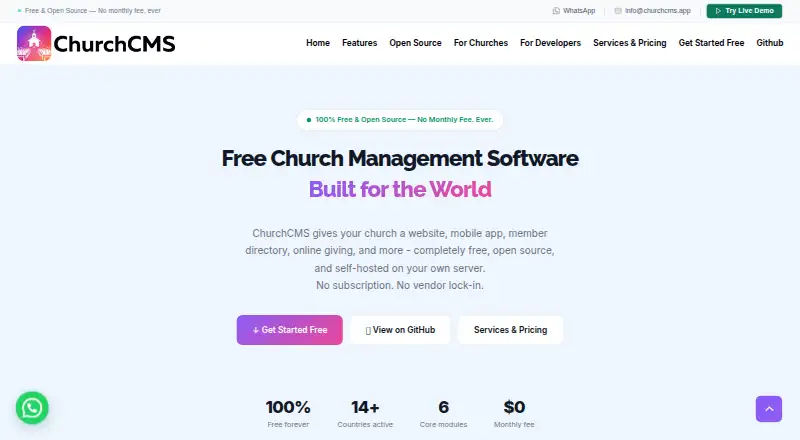
What ChurchCMS is
ChurchCMS is church management software for organizing members, attendance, online giving, events, congregation communications, and a church website. Its CRM brings searchable member profiles together with family relationships, giving and attendance history, messaging, and printable QR membership cards. Giving tools handle one-time and recurring donations, donor records, statements, and fundraising campaigns, with connections to Stripe, M-Pesa, Flutterwave, and Paystack. The product also includes a branded Android app for sermons, events, giving, member messaging, prayer requests, and a church calendar.
Churches can use the MIT-licensed software without a license fee and run it on their own server, or choose managed hosting. The free self-hosted plan includes all six core modules and the Android app with no usage limits. Managed Hosting costs $29 per month and includes AWS hosting, daily backups, upgrades, a custom domain and SSL, and email support. A $99 one-time option covers installation, configuration, data migration, and admin training; annual managed hosting is $290 per year. ChurchCMS offers a REST API for core modules and describes payment gateway and third-party integrations through that API. It is designed for small and medium churches, with no minimum congregation size.
Who it suits
ChurchCMS suits small and medium churches that need member records, attendance, giving, events, and communications in one system. It can also fit churches that want to self-host MIT-licensed software, use a branded Android app, or have installation and hosting handled for them.
What it does well
- Free self-hosted plan includes all six core modules and Android app.
- No usage limits or per-member charges.
- MIT license allows use, modification, and sharing without a license fee.
- Giving supports recurring donations and four named payment providers.
- Managed hosting includes daily backups, SSL, and email support.
What to know first
- Self-hosted churches are responsible for hosting the software on their server.
- Managed Hosting costs $29 per month.
- Payment providers set transaction fees.
Limits
The free self-hosted plan has no usage limits and includes all six core modules and the Android app. Payment gateway transaction fees are set by the providers.
Plans
| Plan | Billed and limits | Price |
|---|---|---|
| Self-Hosted | $0 / forever · full source code · all modules/features · Android app · unlimited usage · community support | Free |
| Self-Host It Yourself | $0 / forever · All 6 core modules · Android app · No usage limits | Free |
| Managed Hosting | $29 / month · AWS hosting · Daily backups · Upgrades · Custom domain and SSL · Email support | $29 a month |
| Managed Hosting Monthly | $29/mo + $99 one-time setup · AWS hosting · daily backups · upgrades · custom domain and SSL · email support | $29 a month |
| Managed Hosting Annual | $290 per year · 2 months free · no setup fee · AWS hosting · daily backups · upgrades · custom domain and SSL · priority email support | $290 a year |
| Managed Hosting (annual) | $290/yr (2 months free) · AWS hosting · Daily backups · Upgrades · Custom domain and SSL · Email support | $290 a year |
| Custom Website Template | $399 one-time fee · HTML5 and TailwindCSS design · ChurchCMS integration · responsive layout · SEO markup · 30 days support | $399, paid once |
| We Install It For You | $99 / one time · Installation · Configuration · Data migration · Admin training | $99, paid once |
The first 8 of 10 plans, as churchcms.app lists them, read 15 Oct 2026. The maker's own page has the final word. Every plan
Getting started
- Open https://churchcms.app/.
- Choose the free self-hosted plan, Managed Hosting, or the one-time installation service.
- For self-hosting, download the MIT-licensed software and run it on your server.
- For managed hosting, use the included AWS hosting, custom domain, and SSL.
- Use the Android app for sermons, events, giving, messaging, prayer requests, and the church calendar.
ChurchCMS is church management software that combines member records, giving, events, communications and a church website. It is aimed at small and medium churches, especially those that want an unlimited self-hosted option or managed hosting with onboarding. Its main trade-off is practical: self-hosting costs nothing for the software, while handing hosting and upkeep to the provider costs extra.
Overview
The MIT license allows churches to download, use, modify and share ChurchCMS without a software license fee. Its six core modules and Android app are included in the free self-hosted plan, with no usage limits, per-member charges or feature paywalls. Payment providers set their own transaction fees, however, so online donations can still incur costs.
Self-hosting keeps church data on the church’s own server, giving the church control but also making it responsible for hosting. The maker says data transmission is encrypted via SSL and passwords are hashed using bcrypt. Managed hosting includes daily automated backups, SSL, and uptime and security monitoring, which reduces the operational burden but comes with a recurring fee.
Key features
Member records and church operations
The searchable CRM links member profiles to family relationships, giving and attendance history, messaging and printable QR membership cards. Group management, child check-in, event registration, SMS messaging and volunteer scheduling extend the system beyond a directory into routine congregation administration. That breadth is useful to churches seeking one system for several workflows, though the facts do not establish how those workflows compare with specialist products.
Giving and communications
Online giving supports one-time and recurring donations, donor history, giving statements and fundraising campaigns. Stripe, M-Pesa, Flutterwave and Paystack are supported; transaction fees are set by those payment providers, not ChurchCMS. The included branded Android app adds sermons, events, giving, member messaging, prayer requests and a church calendar, giving congregants a mobile channel for common church activities.
API and integrations
A REST API covers core modules, and the developer page describes connections to payment gateways and third-party tools through that API. This gives churches room to connect other services, but it may be more useful to organizations with the capacity to configure integrations than to those seeking a fully managed setup.
Pricing
Self-Host It Yourself is free forever: it includes all six core modules and the Android app, with no usage limits. It is the strongest fit for churches able to host and maintain the software themselves. The software has no per-member fee, but payment gateway charges still apply.
Managed Hosting costs $29 / month and includes AWS hosting, daily backups, upgrades, a custom domain and SSL, and email support. This suits churches that want the provider to handle hosting and updates. Managed Hosting (annual) costs $290/yr (2 months free) and includes the same package; it lowers the equivalent monthly cost compared with paying $29 each month, in exchange for an annual commitment.
We Install It For You costs $99 / one time for installation, configuration, data migration and admin training. It fits churches that want help setting up a self-hosted instance rather than an ongoing managed-hosting arrangement. There is no free trial, so churches should choose their hosting route before committing to paid services.
Platforms
ChurchCMS supports Android, web, API access and self-hosting. The Android app is included, while the API offers a route for integrations. No iOS platform is offered, so churches whose congregants need a dedicated iPhone app should compare alternatives.
Who it's for
ChurchCMS is designed for small and medium churches, with no minimum congregation size. It makes particular sense for churches that want member, giving and event tools together without per-member pricing, and can either manage their own server or budget for managed hosting. Churches that do not want to host software themselves and cannot justify the $29 monthly plan should look elsewhere.
Pros and cons
- Pros: The free self-hosted plan includes all six core modules and the Android app without usage limits, making congregation growth less likely to trigger software charges.
- Pros: Member records, giving, events, child check-in and volunteer scheduling cover a broad range of church operations in one product.
- Pros: Managed hosting includes backups, upgrades, SSL and email support; the one-time installation service adds migration and admin training for churches that need a setup hand.
- Cons: The free plan requires self-hosting, which leaves the church responsible for its own hosting arrangement.
- Cons: Managed hosting starts at $29 / month, and donation providers may charge transaction fees, so the free license does not eliminate every cost.
- Cons: The listed mobile platform is Android, not iOS, which limits its fit for churches seeking a dedicated app on both major mobile platforms.
Alternatives
Choose ChurchPlan if its free Essentials plan is a better match: it includes unlimited members, online giving with automated tax receipts, a personalized church mobile app, and donation links and QR codes, and it supports Android, iOS, API and web.
MyUCD is a free Android, iOS and web alternative available through Universal Church Directories’ directory program. Consider it if that program is the route you want to use.
Planning Center is worth comparing if you want a free plan for specific functions: Calendar covers one room and People includes an unlimited database and reporting. It also offers a free trial and Android, iOS, API and web platforms.
Consider Churchease for its free Starter plan, which includes people management, family grouping, group management, announcements, a message center and a church dashboard; it also supports Android, iOS and web and offers a free trial.
HolyJot is a free Android, iOS and web option for individuals and churches, with unlimited journal entries, FaithAI conversations and community features and no subscriptions, tiers or upsells. Choose it if those uses matter more than ChurchCMS’s management toolkit.
Church Membership Directory may suit a church focused on a directory: its free plan covers up to 50 members and includes secure member storage, printable directories, multiple admin accounts, email support and phone support.
Directify is a directory-building alternative with a free plan for one directory and 10 listings, plus templates, a theme editor, a subdomain and SSL. It may be the better fit when publishing a directory is the main need.
MosesTab Worship Planning is another free web option, with unlimited members, one admin, one group and ministry, five events, three forms and 500 MB of storage. Compare it if worship planning and those specific free-plan limits fit your needs better.
For broader comparisons, browse Church Directory Software, Church Management Software, Small Group Management Software, Church Volunteer Management Software and Church Event Management Software.
Verdict
ChurchCMS is a strong choice for small and medium churches that want broad management tools without per-member software charges and can either host the system themselves or pay for managed service. The free, unlimited self-hosted plan is its clearest advantage; the main reason to look elsewhere is that self-hosting is not right for every church, while managed hosting costs $29 / month and the mobile app is Android-only.
Verdict
Choose ChurchCMS if your church wants broad management tools with a free, unlimited self-hosted plan or needs managed hosting and onboarding. Look elsewhere if your church does not want to host software itself and the $29 monthly managed plan does not suit its budget.
Questions
Is ChurchCMS free?
Yes. Its self-hosted plan costs $0 forever and includes all six core modules and the Android app with no usage limits. Managed Hosting is $29 per month.
Is ChurchCMS open source?
Yes. It is released under the MIT license, which allows it to be downloaded, used, modified, and shared without a license fee.
Which platforms does ChurchCMS support?
Its listed platforms are Android, API, self-hosted, and web.
What payment services does ChurchCMS support?
Online giving lists Stripe, M-Pesa, Flutterwave, and Paystack. Transaction fees are set by the payment providers.
What does Managed Hosting include?
The $29 monthly plan includes AWS hosting, daily backups, upgrades, a custom domain and SSL, and email support.
Who is ChurchCMS designed for?
The maker says it is designed for small and medium churches and has no minimum congregation size.
Facts from ChurchCMS's own pages
- Android requirements
- The Android documentation lists Android 6.0 or newer, 100 MB free storage, network access and church login credentials. · docs.churchcms.app, 15 Oct 2026
- API
- The Laravel backend exposes a REST API covering members, giving, attendance, events, sermons and notifications. · churchcms.app, 15 Oct 2026
- API and integrations
- The product exposes a REST API for core modules, and its developer page describes integrations with payment gateways and third-party tools through the API. · churchcms.app, 7 Oct 2026
- Attendance
- Attendance supports QR-coded photo ID cards, instant scanning, absence alerts, reports, child check-in and manual overrides. · churchcms.app, 15 Oct 2026
- Communications
- Communication features include push, SMS and in-app messages, targeted announcements, birthday and anniversary greetings and daily scripture. · churchcms.app, 15 Oct 2026
- Company founded
- LinkedIn lists GegoSoft as privately held, founded in 2017, headquartered in Madurai and employing 11–50 people. · linkedin.com, 15 Oct 2026
- Company profile
- Crunchbase describes GegoSoft Technologies as a private Madurai company with an 11–50 employee range and no disclosed funding information. · crunchbase.com, 15 Oct 2026
- Data and security
- The maker says self-hosted church data lives on the church's server and describes data transmission as encrypted via SSL and passwords as hashed using bcrypt. · churchcms.app, 7 Oct 2026
- Data portability
- Users can export member data and managed-hosting data, then move to another host or self-host without an exit fee. · churchcms.app, 15 Oct 2026
- Documentation
- Documentation covers Laravel web/API setup, browser and CLI installers, Android installation, requirements, troubleshooting and module guides. · docs.churchcms.app, 15 Oct 2026
- Events
- Event management includes a shared calendar, registration, reminders, ministry groups, bulletins and Sunday-school registers. · churchcms.app, 15 Oct 2026
- Extensibility
- The developer offering describes Laravel plugins, event hooks, Vue admin extensions, custom API routes, webhooks and OAuth2 integrations. · churchcms.app, 15 Oct 2026
- G2 company listing
- G2 lists GegoSoft Technologies as established in 2017, headquartered in Madurai and having zero company reviews. · g2.com, 15 Oct 2026
- Giving
- The giving module supports one-time and recurring donations, donor histories, statements, campaigns and multiple funds. · churchcms.app, 15 Oct 2026
- Google Play listing
- Google Play lists ChurchCMS by GegoSoft Technologies with 100+ downloads, a February 2026 update, no displayed star rating and declarations of no data collection or third-party sharing. · play.google.com, 15 Oct 2026
- Headquarters
- Madurai, Tamil Nadu, India · churchcms.app, 23 Sept 2026
- Intended users
- ChurchCMS says it was designed for small and medium churches and has no minimum congregation size. · churchcms.app, 7 Oct 2026
- Legal incorporation
- IndiaFilings records GEGOSOFT TECHNOLOGIES (OPC) PRIVATE LIMITED as incorporated on 14 January 2021 in Tamil Nadu. · indiafilings.com, 15 Oct 2026
- Licence
- ChurchCMS and its Android app are presented as MIT-licensed code that can be modified, forked, commercially deployed and white-labelled. · churchcms.app, 15 Oct 2026
- License
- The software is released under the MIT open-source license and can be downloaded, used, modified, and shared without a license fee. · churchcms.app, 7 Oct 2026
- Limit: Independent review coverage
- Capterra, GetApp and Software Advice show no user reviews, so independent recurring praise or complaint themes are not established. · capterra.com, 15 Oct 2026
- Limit: iOS availability
- The GitHub organization roadmap lists an iOS app as a future enhancement, while current official mobile documentation covers Android. · github.com, 15 Oct 2026
- Limits and fees
- The maker states there are no per-member charges or feature paywalls, while payment gateway transaction fees are set by the payment providers. · churchcms.app, 7 Oct 2026
- Limit: Testing maturity
- The public Laravel repository says application-level tests are not yet comprehensive. · github.com, 15 Oct 2026
Where ChurchCMS stands on Freedom251
- Church Event Management Software#1 of 46
- Church Directory Software#1 of 40
- Small Group Management Software#1 of 39
- Church Management Software#1 of 38
- Church Volunteer Management Software#1 of 30
- Nonprofit Membership Management Software#1 of 30