Freedom251 › Candidate Screening Software
CandiSift
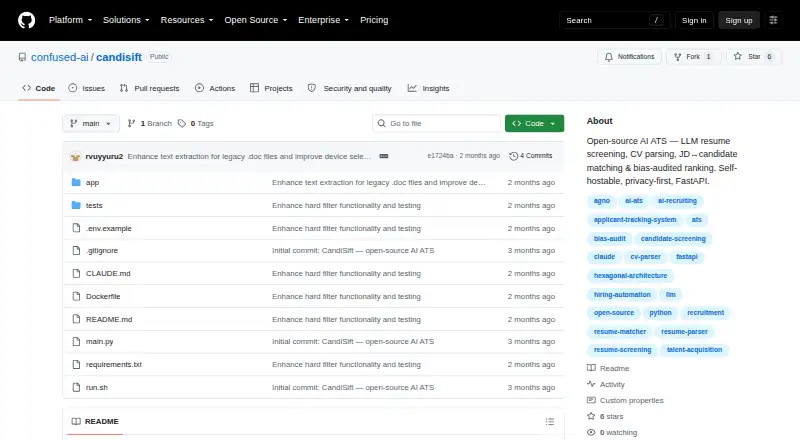
What CandiSift is
CandiSift is an open-source applicant tracking system for screening resumes and reviewing candidate matches. Recruiters can create roles, upload PDF, DOCX, or plain-text resumes—including multiple files—and review ranked results before accepting or rejecting candidates. Its flow removes personally identifying information, applies hard filters, ranks candidates, then routes those who remain to persona agents and human review. Ranking uses token-cosine scoring, with technical and risk persona agents and synthesis supporting review. Users can see an estimated processing cost before confirming a staged batch; deterministic filters run before the paid LLM stage. CandiSift connects to Anthropic Claude through Agno persona agents, or uses an offline stub LLM without an API key. It can run in Docker, stores state in SQLite by default, and can be configured for Postgres. The project describes authentication, security controls, an append-only audit log, and an API endpoint for bias audits. It has no shipped accuracy benchmark; OCR, embeddings/FAISS, and skillNER are documented swaps, not default capabilities.
Who it suits
CandiSift suits recruiters who want to screen uploaded resumes, review ranked candidates, and make accept-or-reject decisions. It is also relevant to teams that can self-host and configure an LLM connection or use the offline stub.
What it does well
- Supports PDF, DOCX, and plain-text resumes
- Removes personal identifiers before model processing
- Shows estimated processing cost before batch confirmation
- Keeps an append-only audit log
- Offers Docker deployment and SQLite or Postgres storage
What to know first
- No shipped accuracy benchmark
- OCR, embeddings/FAISS, and skillNER are not default capabilities
- LLM processing can incur per-token costs
Limits
The open-source self-hosted plan has no software fee stated, but LLM processing can incur per-token costs. The project has no shipped accuracy benchmark, and OCR, embeddings/FAISS, and skillNER are documented swaps rather than default capabilities.
Plans
| Plan | Billed and limits | Price |
|---|---|---|
| Open-source self-hosted | No software fee stated; LLM processing can incur per-token costs | Free |
As github.com lists them, read 4 Oct 2026. The maker's own page has the final word.
Getting started
- Visit the CandiSift GitHub repository
- Run the app in Docker or use its web interface and API
- Create a recruiter role
- Upload resumes in PDF, DOCX, or plain-text format
- Configure an Anthropic Claude API key for persona-agent processing, or use the offline stub LLM
CandiSift is an open-source applicant tracking system for teams screening resumes with an AI-assisted workflow. It is best suited to recruiters prepared to self-host and configure the system; its structured review and audit trail are useful, but its rankings come without a shipped accuracy benchmark.
Overview
CandiSift takes resumes through parsing and PII removal, applies hard filters, ranks candidates, and sends those who remain to persona agents and recruiter review. Recruiters can inspect ranked results and accept or reject candidates rather than relying on an unattended screening decision. That makes the system a stronger fit for teams that want a defined review process than for those seeking validated automated selection.
It accepts PDF, DOCX, and plain-text resumes, including multi-file uploads. Ranking uses token-cosine similarity, with technical and risk persona agents and synthesis supporting the review. Claude integration runs through Agno persona agents; an offline stub LLM can be used without an API key, though that does not establish ranking quality.
Key features
- Filters before model processing: Deterministic hard filters run before the paid LLM stage. This can reduce unnecessary model processing, while keeping initial screening rules distinct from later AI analysis.
- Staged batch cost estimates: Users can see an estimated processing cost before confirming a batch. That offers a useful checkpoint for teams managing variable per-token charges, though the estimate does not remove those charges.
- Recruiter decisions and audit: An append-only log records scores, rationales, decisions, and versions. Along with ranked results and accept-or-reject controls, this supports review of how a candidate moved through the workflow.
- Privacy and bias controls: CandiSift says it removes personally identifiable information before model processing and provides a bias-audit endpoint covering pass-through and recommendation mix. These controls are relevant to teams scrutinizing screening decisions, but they do not substitute for an accuracy benchmark.
- Security measures: The project describes HTTP Basic authentication, security headers, rate limiting, request-body limits, upload validation, and prompt-injection defenses. These are practical safeguards for an application handling candidate documents; self-hosting teams still need to manage deployment and configuration.
- Deployment and storage: It can run in Docker, stores state in SQLite by default, and supports a configurable Postgres database URL. The project has no shipped accuracy benchmark, and OCR, embeddings/FAISS, and skillNER are documented swaps rather than default capabilities, so teams needing those functions must account for their absence.
Pricing
Open-source self-hosted: free. There is no software fee, but LLM processing can incur per-token costs. This plan suits teams able to host and configure the application and manage model usage. It is not a hosted subscription with those operational responsibilities bundled in.
The cost estimate before confirming staged batches and the hard-filter-first workflow give users some control over paid LLM processing. Teams that need OCR, embeddings/FAISS, or skillNER by default should look elsewhere or plan for those capabilities separately.
Platforms
CandiSift supports API, self-hosted, and web access. Docker deployment and SQLite by default, with Postgres configurable, give teams a choice of deployment and storage setup. This is a practical fit for organizations comfortable operating their own software, rather than those looking for a managed recruiting service.
Who it's for
The intended workflow is for recruiters creating roles, uploading resumes, reviewing ranked candidates, and accepting or rejecting them. It suits teams that value control over screening stages, cost checkpoints, and an audit record, and can take responsibility for self-hosting. It is a weaker fit for teams that require established ranking-accuracy evidence or expect OCR and other documented swaps to be ready to use by default.
Pros and cons
- Pro: Hard filters precede the paid LLM stage, helping limit unnecessary model processing.
- Pro: Recruiter decisions and an append-only log make screening outcomes and their recorded rationales reviewable.
- Pro: PII removal and a bias-audit endpoint provide specific privacy and screening-review mechanisms.
- Con: There is no shipped accuracy benchmark, so teams cannot use a published measure of ranking performance to judge its suitability.
- Con: OCR, embeddings/FAISS, and skillNER are not included default capabilities, limiting out-of-the-box coverage for teams that need them.
- Con: LLM processing can add per-token costs, and the self-hosted setup puts deployment responsibility on the team.
Alternatives
For a broader comparison, browse AI Recruiting Assistants or Candidate Screening Software.
- Metaview is a better candidate for teams seeking sourcing profiles and concurrent searches, with Pro at $100 a month billed monthly per user and 200 profiles sourced per month.
- Sprad suits teams wanting a free ATS foundation: ATS Core is free, billed €0 forever, with career-site, pipeline, team, analytics, and MCP/AI connection features.
- Avery is worth considering for European profile discovery, offering ranked matches and market views; its free plan excludes outreach and contact details.
- HireMIQ may suit teams looking for a broader AI recruiting toolkit, with a free plan that includes eight AI modules, Boolean search, candidate scoring, outreach templates, and assessments.
- Pin is an alternative for contact lookup and email sequences, though its free plan is capped at five lookup credits per week, one job position, and one AI agent.
- Hirin is another recruiting platform to compare.
- Talview may fit organizations seeking unit-based tailored pricing, with a typical minimum commitment of approximately 150 to 200 candidates.
- HireXAI is another paid web-based alternative.
Verdict
CandiSift is a sensible choice for recruiters who can self-host and want a controllable screening workflow with cost checkpoints, human decisions, and an audit trail. Its main reason to choose it is that combination of configurable processing and review; its main reason to look elsewhere is the absence of a shipped accuracy benchmark, especially if ranking quality must be demonstrated before adoption.
Verdict
CandiSift combines resume parsing, filtering, ranking, and recruiter review in an open-source system. Teams should account for the missing accuracy benchmark and the fact that some documented capabilities are not included by default.
Questions
Is CandiSift free?
It is open source, and no software fee is stated. LLM processing can incur per-token costs.
Which resume formats does it accept?
It supports PDF, DOCX, and plain-text files, including multi-file uploads.
Does it require an Anthropic API key?
CandiSift integrates with Anthropic Claude through Agno persona agents. Without an API key, it can use an offline stub LLM.
Can CandiSift be self-hosted?
Yes. It can run in Docker, stores state in SQLite by default, and supports configuring a Postgres database URL.
Does it include OCR and embeddings?
OCR, embeddings/FAISS, and skillNER are documented swaps rather than included default capabilities.
Does CandiSift have an accuracy benchmark?
The project says it has no shipped accuracy benchmark.
Facts from CandiSift's own pages
- Bias audit
- The API includes a bias-audit endpoint covering pass-through and recommendation mix. · github.com, 4 Oct 2026
- Cost controls
- Users can see an estimated processing cost before confirming a staged batch, and deterministic hard filters run before the paid LLM stage. · github.com, 4 Oct 2026
- Deployment and storage
- The app can run in Docker, stores state in SQLite by default, and supports configuring a Postgres database URL. · github.com, 4 Oct 2026
- File formats
- Resume ingestion supports PDF, DOCX, and plain-text files, including multi-file uploads. · github.com, 4 Oct 2026
- Intended users
- The README describes a recruiter workflow for creating roles, screening uploaded resumes, reviewing ranked results, and accepting or rejecting candidates. · github.com, 4 Oct 2026
- LLM integration
- CandiSift integrates with Anthropic Claude through Agno persona agents; without an API key, it can use an offline stub LLM. · github.com, 4 Oct 2026
- Notable limits
- The project says it has no shipped accuracy benchmark and that OCR, embeddings/FAISS, and skillNER are documented swaps rather than included default capabilities. · github.com, 4 Oct 2026
- Privacy and audit
- CandiSift says it strips PII before a model sees candidate data and keeps an append-only audit log of scores, rationales, decisions, and versions. · github.com, 4 Oct 2026
- Product
- CandiSift is an open-source applicant tracking system for AI resume screening, CV parsing, job description and candidate matching, and bias-audited ranking. · github.com, 4 Oct 2026
- Ranking and review
- The product provides token-cosine ranking, technical and risk persona agents, synthesis, and a recruiter interface with ranked results and accept or reject decisions. · github.com, 4 Oct 2026
- Screening flow
- Its workflow parses resumes, strips personally identifiable information, applies hard filters, ranks candidates, and sends survivors to persona agents and human review. · github.com, 4 Oct 2026
- Security
- The repository describes HTTP Basic authentication, security headers, rate limiting, request body limits, upload validation, and prompt-injection defenses. · github.com, 4 Oct 2026
Where CandiSift stands on Freedom251
- Candidate Screening Software#1 of 36
- AI Recruiting Assistants#1 of 30