Freedom251 › Account Management

Backstory Account Strategy & Execution
Visit Backstory Account Strategy & Execution Alternatives Pricing
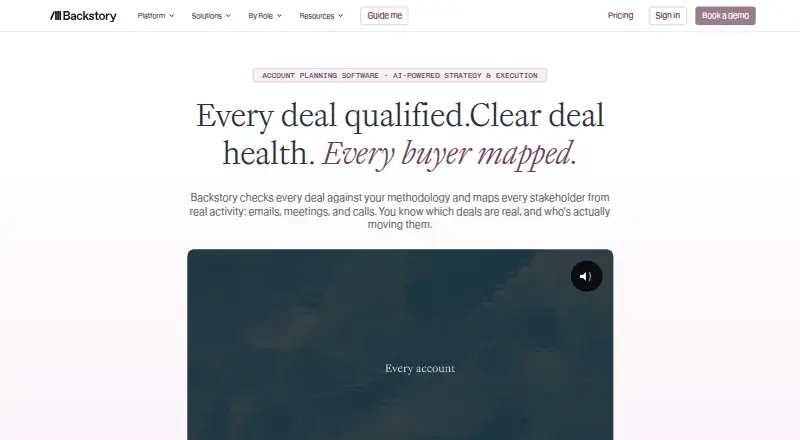
What Backstory Account Strategy & Execution is
Backstory Account Strategy & Execution creates account plans from public company information and internal CRM, email, meeting, and call history. It identifies existing sales, competitor presence, expansion opportunities, and coverage gaps across a company's accounts. Stakeholder maps organize engaged contacts by title, seniority, and department, alongside predicted buying power, inferred win rate, and engagement level. Plans can carry presale context into postsale, including why a customer bought, who championed the decision, and which stakeholders are engaged. The solution is available through web, API, and extension platforms. Integrations include native Salesforce support and API connections for Oracle and Microsoft CRM products, plus a range of activity sources. Its MCP server connects to AI assistants, and analytics connections include Tableau and Power BI. Backstory says customer data is not used to train or fine-tune its models, outputs are scoped to each tenant, and users can opt out of AI features. Pricing is available by request. Support is offered through chat, email, and help-center resources, with stated limits on the support scope.
Who it suits
It suits sales teams that need account plans built from company information and existing activity records, including context carried between presale and postsale. Teams should also consider its custom-quote pricing and stated support exclusions.
What it does well
- Identifies expansion opportunities and coverage gaps
- Maps stakeholders by title, seniority, and department
- Carries account context from presale to postsale
- Includes Salesforce integration and CRM API connections
- Users can opt out of AI features
What to know first
- Pricing is available by request
- Support excludes custom development
- Support excludes on-site support
Limits
Pricing is custom. Charges apply to people whose customer activity powers the platform and to answers consumed; team members can view and ask without a paid seat, and the plan lists full product access.
Plans
| Plan | Billed and limits | Price |
|---|---|---|
| Custom pricing | Get a quote tailored to your team · Charges for people whose customer activity powers the platform and for answers consumed · team members can view and ask without a paid seat · full product access | On request |
As backstory.ai lists them, read 3 Oct 2026. The maker's own page has the final word.
Getting started
- Visit the Account Strategy & Execution website.
- Request a quote tailored to your team.
- Connect supported CRM and activity sources through the available integrations or API.
- Use the web, API, or extension platform.
Backstory Account Strategy & Execution is a revenue-account planning system that combines company intelligence with CRM and communication history. It suits teams managing complex books of business, multiple stakeholders, and sales-to-postsale ownership changes. The trade-off is a quote-based model and support boundaries that favor organizations prepared for a managed, integrated deployment.
Overview
Backstory builds account strategy from public company information plus internal CRM, email, meeting, and call records. Rather than limiting the account plan to firmographics or a salesperson’s notes, it connects coverage, relationship activity, competitive context, and expansion signals across the book of business. That makes it relevant to account-based sales and customer-growth teams; a small team wanting a lightweight planning document may find the scope excessive.
The product comes from the company formerly known as People.ai; the footer identifies People.ai, Inc. doing business as Backstory. It was founded in 2016 and is headquartered in San Francisco.
Key features
Account planning and whitespace
Automatic plans draw on public information and internal activity, then identify existing sales, competitor presence, expansion opportunities, and coverage gaps. In practice, this gives managers a way to prioritize where an account needs attention and where additional business may exist. Whitespace analysis, account hierarchy, account action tracking, CRM synchronization, and relationship maps support an operating process rather than a static profile.
Stakeholder intelligence
Backstory maps engaged contacts by title, seniority, and department and adds predicted buying power, inferred win rate, and engagement level. Those fields can make relationship reviews more structured and expose thin coverage, but they are predictive signals and should inform judgment rather than replace it. Stakeholder management is therefore a strength for teams coordinating several buying groups.
Presale-to-postsale continuity
Account plans retain why a customer bought, who championed the decision, and which stakeholders are engaged as work moves from presale to postsale. That context can reduce the loss of deal knowledge during handoffs and give post-sale owners a clearer starting point.
Integrations and AI access
A native Salesforce integration is joined by API connections for Oracle and Microsoft CRM products. Activity connectors cover Google Workspace, Exchange on-premises, Microsoft 365, Zoom, Webex, Microsoft Teams, Google Meet, Gong, Slack, LinkedIn Sales Navigator, Outreach, Salesloft, and RingCentral. Backstory’s MCP server lets users question account, deal, and pipeline data through Claude, ChatGPT, Microsoft Copilot, Google Gemini, and n8n. Tableau and Power BI integrations, plus API connectivity for Looker, Qlik, Sigma, and other BI systems, extend reporting options. This breadth is useful when data already spans a large revenue stack, but it also increases the importance of a well-scoped implementation.
Security and support
Backstory states that it maintains five active certifications audited annually and describes zero-trust access, end-to-end encryption, SOC 2 Type II scope, and GDPR and CCPA compliance. Customer data is not used to train or fine-tune its models, outputs are scoped to each tenant, and users can opt out of AI features. Support includes in-app chat, email, and help-center resources, with human assistance Monday through Friday, 9 AM to 5 PM Pacific, and automated chat around the clock. It does not include custom development, large-scale system changes, third-party troubleshooting, training services, or on-site support.
Pricing
Custom pricing
Backstory bills on a quote tailored to the team. Charges apply to people whose customer activity powers the platform and to answers consumed, while team members can view and ask questions without a paid seat. The plan provides full product access. Because there is no published price, teams must size activity and usage with Backstory before they can compare total cost; the seat treatment may be attractive for broad read-and-query access, while usage-based answer charges require monitoring.
Platforms
Backstory is offered through an API, browser extension, and web application. That combination supports embedded integrations as well as direct browser use, rather than limiting the product to one interface.
Who it's for
Choose Backstory when account teams need a shared view of coverage, stakeholder influence, whitespace, and deal history across a connected CRM and communications stack. It is particularly suited to organizations where sales and post-sale teams must preserve context through handoffs and where analytics or AI assistants are part of the workflow.
Pros and cons
Pros
- Activity-grounded account plans: public company data and internal CRM, email, meeting, and call history make planning more current than a manually maintained template.
- Broad relationship view: stakeholder maps, relationship maps, buying-power predictions, and engagement signals help expose missing coverage.
- Handoff continuity: purchase rationale and champion context follow the account into postsale work.
- Extensive connectivity: CRM, communication, AI-assistant, and BI integrations can fit a heterogeneous revenue stack.
- Enterprise data controls: stated certifications, encryption, tenant-scoped outputs, and model-training opt-out address common AI governance concerns.
Cons
- Quote-only cost: buyers cannot assess the subscription without discussing activity and answer usage.
- Usage-linked charges: costs are tied to customer activity powering the platform and answers consumed, so demand may affect spend.
- Limited service scope: custom development, major system changes, training, third-party troubleshooting, and on-site support are excluded.
- Predictive fields need oversight: inferred win rate and predicted buying power are useful signals, not definitive relationship facts.
Alternatives
For a directory of account-planning options, see Account Planning Software.
- Visioner is the better starting point for an inexpensive, mobile-friendly freemium option: its Basic plan is $12 a month for 10 accounts and 100 archived emails per month, with a BCC archive and manual review queue.
- Centralize fits teams wanting a free browser-based entry point, with five standard accounts, automatic org charts and account maps, LinkedIn warm-connection sync, and a Chrome extension.
- Kandir suits buyers who prefer per-plan pricing: its free tier covers one account plan, while Individual is $10 a month per account plan with a five-plan minimum.
- Distribute Strategic Account Plan is the choice for a completely free web generator rather than an integrated revenue system.
- InterAction+ is an alternative for teams considering a LexisNexis subscription across web, mobile, or self-hosted deployment.
- Altify is worth comparing when an annual, quote-based subscription can be tailored by solutions, users, and Revenue Services.
- BuyerRadar is better for contact intelligence with a published Professional plan at €50 a month and 2,000 credits.
- Encompass-CX is another paid web option with a free trial and briefing-led pricing.
Verdict
Backstory is a strong fit for established revenue organizations that need account coverage, relationship intelligence, and reliable context from sales through postsale in one connected workflow. Its main reason to choose it is the combination of activity-based planning, stakeholder mapping, handoff continuity, and broad integrations. Look elsewhere if you require transparent pricing, a free plan, or included implementation and training services.
Verdict
Backstory focuses on account coverage, stakeholder context, and carrying sales information through the customer handoff. Its integration breadth and custom pricing make it worth assessing against the systems and support scope a team needs.
Questions
How is Backstory Account Strategy & Execution priced?
Pricing is custom and available by quote. Charges apply to people whose customer activity powers the platform and to answers consumed; team members can view and ask without a paid seat.
Which CRM products connect with Backstory?
The integrations page describes native Salesforce integration and API connections for Oracle and Microsoft CRM products.
Which platforms are available?
Backstory lists web, API, and extension platforms.
Can users opt out of AI features?
Yes. Backstory says users can opt out of AI features, and that customer data is not used to train or fine-tune its models.
What support does Backstory offer?
Support is available through in-app chat, email, and help-center resources. Human support runs Monday through Friday from 9 AM to 5 PM Pacific; automated chat is available 24/7.
What is the relationship between Backstory and People.ai?
The company says Backstory was formerly People.ai and describes it as the same product and team under a new name. The site footer identifies People.ai, Inc. doing business as Backstory.
Facts from Backstory Account Strategy & Execution's own pages
- Account handoffs
- Account plans carry context from presale to postsale, including why the customer bought, who championed it, and which stakeholders are engaged. · backstory.ai, 3 Oct 2026
- Account plans
- Backstory automatically generates account plans using public company information and internal CRM, email, meeting, and call history. · backstory.ai, 3 Oct 2026
- Activity sources
- Listed activity sources include Google Workspace, Exchange on-premises, Microsoft 365, Zoom, Webex, Microsoft Teams, Google Meet, Gong, Slack, LinkedIn Sales Navigator, Outreach, Salesloft, and RingCentral. · backstory.ai, 3 Oct 2026
- AI assistant integrations
- Backstory's MCP server connects to Claude, ChatGPT, Microsoft Copilot, Google Gemini, and n8n so users can ask questions about accounts, deals, and pipeline. · backstory.ai, 3 Oct 2026
- AI data handling
- Backstory says customer data is never used to train or fine-tune its models, model outputs are scoped to each tenant, and users can opt out of AI features. · backstory.ai, 3 Oct 2026
- Analytics integrations
- Backstory lists Tableau and Power BI integrations, and API connectivity for Looker, Qlik, Sigma, and other BI platforms. · backstory.ai, 3 Oct 2026
- Coverage and growth
- The account strategy solution identifies existing sales, competitor presence, expansion opportunities, and coverage gaps across a company's book of business. · backstory.ai, 3 Oct 2026
- CRM integrations
- The integrations page describes a native Salesforce integration and API connections for Oracle and Microsoft CRM products. · backstory.ai, 3 Oct 2026
- Founded
- 2016 · backstory.ai, 23 Sept 2026
- Headquarters
- San Francisco, California, United States · backstory.ai, 23 Sept 2026
- Maker and history
- The company says Backstory was formerly People.ai and describes it as the same product and team under a new name; the site footer identifies People.ai, Inc. d/b/a Backstory. · backstory.ai, 3 Oct 2026
- Pricing model
- Pricing is quote-based and usage-based: customer-facing contributors and consumed answers drive charges, while viewers do not require paid seats; the page says excess usage is not back-billed during the term. · backstory.ai, 3 Oct 2026
- Security and compliance
- The trust page states that Backstory has five active certifications audited annually and describes zero-trust access, end-to-end encryption, SOC 2 Type II scope, and GDPR and CCPA compliance. · backstory.ai, 3 Oct 2026
- Stakeholder mapping
- It automatically maps engaged contacts by title, seniority, and department and shows predicted buying power, inferred win rate, and engagement level. · backstory.ai, 3 Oct 2026
- Support
- Support is available through in-app chat, email, and help-center resources, with human support Monday through Friday from 9 AM to 5 PM Pacific and automated chat available 24/7. · help.backstory.ai, 3 Oct 2026
- Support limits
- Support excludes custom development, large-scale system changes, third-party tool troubleshooting, training services, and on-site support. · help.backstory.ai, 3 Oct 2026
Where Backstory Account Strategy & Execution stands on Freedom251
- Account Management#3 of 12
- Account Planning Software#7 of 20