Freedom251 › Task Mining Software

Alexandria
What Alexandria is
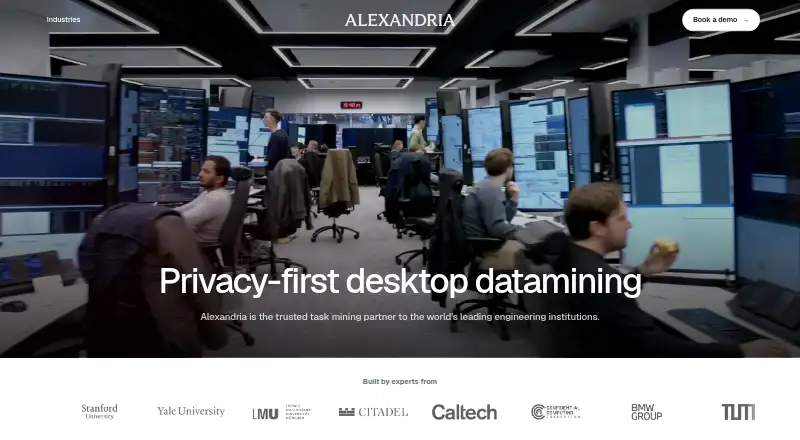
Alexandria is desktop software for organizations that want to understand how employees carry out computer-based work. It analyzes computer use over extended periods, recording actions and the intent behind workflows. Listed uses include task mining, workflow documentation, semantic desktop logging, local VLM processing, workforce vector embeddings, and enterprise GPT integration. Its homepage names software such as AutoCAD, SolidWorks, Bloomberg, Excel, GitHub, VS Code, Salesforce, SAP, Slack, and Chrome, and highlights industries including biotech, quant trading, banking, engineering, operations, and logistics. Alexandria runs on Windows and macOS. The maker says recordings stay on the device in encrypted SQLite, processing is end-to-end encrypted using NVIDIA Confidential Compute, and the product is open source for zero-trust auditability. Organizations can choose which apps and sites are recorded and what information is shared; PII is redacted locally before data reaches a server. Pricing is available on request, and the site offers a demo booking link.
Who it suits
Alexandria suits organizations in areas such as biopharma, banking, quant finance, and engineering where workflows are difficult to model. It is available for Windows and macOS.
What it does well
- Analyzes computer use over extended periods.
- Records actions and workflow intent.
- Supports controls over recorded apps and websites.
- PII is redacted locally before reaching a server.
- Available on Windows and macOS.
What to know first
- Pricing is available only on request.
- Desktop platforms are limited to Windows and macOS.
Getting started
- Visit the Alexandria website.
- Book a demo through the site to contact the company.
- Use the Windows or macOS desktop agent for capture.
Alexandria is a privacy-first desktop task-mining system for organizations that need to understand complex, long-running computer workflows. It fits biopharma, finance, engineering and other teams whose work spans specialist applications, while giving administrators control over capture and sharing. Its strongest case is governed workflow intelligence built from local, auditable capture; organizations that need transparent public pricing or a lightweight individual task tracker should look elsewhere.
Overview
Alexandria analyzes extended computer use rather than isolated clicks, aiming to capture both the actions people take and the intent behind those actions. The product is positioned for enterprises that record employee work to create workflow intelligence, document procedures and preserve expertise that is otherwise difficult to model. Its stated uses include task mining, semantic desktop logging, workflow documentation, workforce expertise cloning, local vision-language-model processing, workforce vector embeddings and enterprise GPT integration.
The privacy architecture is central to the proposition. Recordings remain on the local computer in encrypted SQLite storage, and processing is described as fully end-to-end encrypted through NVIDIA Confidential Compute. Alexandria is presented as open source for zero-trust auditability. Organization controls let users choose which applications and websites are recorded and what information is shared, with personally identifiable information redacted locally before data is sent to a server. Those controls make the product more suitable for sensitive operations than a capture tool that treats all desktop activity alike.
Key features
Broad workflow capture
The system is designed for long-horizon analysis across Windows and macOS activity. Its vision-language models are said to work across AutoCAD, SolidWorks, Bloomberg, Excel, GitHub, SAP, Salesforce, Veeva, Figma, Chrome, Slack and Notion. That breadth matters to engineering, trading, banking and operations teams whose processes cross several specialist and general-purpose tools.
Enterprise-oriented intelligence
Task mining and semantic logs support workflow documentation, while vector embeddings and enterprise GPT integration are aimed at making organizational knowledge usable beyond the original worker. These capabilities are most relevant when a company needs to understand repeatable expert work, not simply monitor screen time.
Governance and auditability
Local storage, local PII redaction, selectable app and website recording, encrypted processing and an open-source positioning together provide a governance story for zero-trust environments. They do not remove the need for an organization to define an appropriate recording policy, but they give administrators controls that are directly tied to what gets captured and shared.
Pricing
Alexandria uses custom pricing. Prospective customers must use the site's book-a-demo path, so there is no published seat price, quota, free plan, trial length or renewal term to compare. That sales-led model is consistent with an enterprise deployment spanning sensitive workflows, but it makes early budget screening harder for smaller teams and individual buyers.
Platforms
Alexandria has desktop applications for macOS and Windows. The workflow examples identify activity on both systems, matching its focus on capturing work across mixed desktop fleets.
Who it's for
Alexandria is aimed at organizations in biopharma, banking, quant finance, mechanical engineering, PCB design, defense technology, operations and logistics. It is particularly suited to teams using applications such as CAD, trading terminals, ERP systems, CRM software and development tools, where a process may be spread across many screens and require substantial expert judgment. Companies seeking to document procedures, analyze task execution or preserve workforce expertise are the clearest fit.
It is less suitable for a person who wants a simple personal activity journal, or for a buyer who requires an immediately self-serve plan with a posted price and fixed limits.
Pros and cons
- Pros: long-horizon capture targets complete workflows instead of isolated events.
- Pros: local encrypted storage and local PII redaction reduce unnecessary exposure of employee information.
- Pros: selectable recording of apps and websites gives organizations practical scope controls.
- Pros: broad software coverage spans engineering, finance, enterprise and collaboration tools.
- Cons: custom pricing and a demo-first sales process make cost and commitment difficult to assess upfront.
- Cons: the enterprise focus and governance requirements are likely excessive for lightweight individual use.
Alternatives
Task Mining Software is the broader category guide for comparing task-mining products. Automation Anywhere Document Automation is a better choice when document automation and a free Community Edition for eligible small businesses (up to five machines and 100 pages per month) matter more than desktop workflow intelligence.
Choose mindzie Desktop Process Mining when a free Windows desktop edition with full functionality and up to 1,000 cases is the priority. screenpipe suits buyers wanting a free one-device option with screen, audio and meeting capture, recent-work search and AI-tool context sharing, with a Basic plan at $21 a month.
Celonis Process Mining Platform is an alternative for organizations evaluating a web and API-oriented process-mining platform with a free plan. EdgeVerve AssistEdge fits learning and automation building through its free single-user Community Edition. Operavix and ARIS are paid process-focused alternatives with web and Windows support. MemoryLane is the freemium macOS and Windows option, with its Individual plan priced at $100 a month.
Verdict
Choose Alexandria if your organization needs to turn sensitive, cross-application desktop work into documented and analyzable workflows while retaining control over capture, redaction and sharing. Its combination of long-horizon analysis, specialist-software coverage and privacy controls is the main reason to consider it. Look elsewhere if you need transparent pricing, a self-serve trial or a simpler personal capture tool.
Verdict
Alexandria combines long-horizon workflow analysis with organization controls over captured apps and shared information. Organizations need to request pricing and book a demo through the site to contact the company.
Questions
What does Alexandria cost?
Pricing is on request.
Which platforms does Alexandria support?
Alexandria runs on Windows and macOS, and uses a desktop agent for capture.
Is Alexandria open source?
The product describes itself as open source for zero-trust auditability.
How does Alexandria handle recordings and processing?
The maker says recordings stay local in encrypted SQLite and processing is end-to-end encrypted using NVIDIA Confidential Compute.
Can organizations control what is recorded and shared?
Yes. Organizations control which apps and websites are recorded and what information is shared. PII is redacted locally before data reaches a server.
Who is identified as Alexandria's legal entity?
The Impressum names Alexandria Cornerstone Inc. and identifies Raphael Volpert as Managing Director and CEO.
Facts from Alexandria's own pages
- Auditability
- The site describes the product as open source for zero-trust auditability. · alexandria.so, 9 Oct 2026
- Company
- The site footer identifies the company as Alexandria Cornerstone Inc. · alexandria.so, 9 Oct 2026
- Contact
- The homepage offers a Book a demo link for contacting the company. · alexandria.so, 4 Oct 2026
- Desktop platforms
- The site’s workflow examples show both Windows and Mac activity identifiers. · alexandria.so, 9 Oct 2026
- Encryption
- The site says processing uses fully end-to-end encrypted NVIDIA Confidential Compute. · alexandria.so, 9 Oct 2026
- Enterprise focus
- The site positions Alexandria for teams and enterprises that record employee work to build workflow intelligence. · alexandria.so, 9 Oct 2026
- Headquarters
- The site lists Munich HQ at Crusiusstraße 1, 80538 München, Germany. · alexandria.so, 9 Oct 2026
- Industries
- The site highlights biotech, quant trading, mechanical engineering, banking, PCB design, defense tech, operations, and logistics. · alexandria.so, 9 Oct 2026
- Legal entity
- The Impressum names Alexandria Cornerstone Inc. and identifies Raphael Volpert as Managing Director and CEO. · alexandria.so, 4 Oct 2026
- Local storage
- The site says recordings stay local and data is stored in encrypted SQLite. · alexandria.so, 9 Oct 2026
- Organization controls
- A maker search result says users control which apps and websites are recorded and what information is shared, and that PII is redacted locally before data reaches a server. · alexandria.so, 4 Oct 2026
- Product
- Alexandria describes itself as a privacy-first desktop task mining product for understanding how employees work. · alexandria.so, 9 Oct 2026
- Purpose
- The site lists task mining, semantic desktop logging, workflow documentation, and workforce expertise cloning among its uses. · alexandria.so, 9 Oct 2026
- Sales
- The site offers a book-a-demo contact path. · alexandria.so, 9 Oct 2026
- Software coverage
- The homepage names tools including AutoCAD, SolidWorks, Bloomberg, Excel, GitHub, VS Code, Salesforce, SAP, Slack, and Chrome. · alexandria.so, 4 Oct 2026
- Supported software
- The site says its vision language models work across software including AutoCAD, SolidWorks, Bloomberg, Excel, GitHub, SAP, Salesforce, Veeva, Figma, Chrome, Slack, and Notion. · alexandria.so, 9 Oct 2026
- Target customers
- The site positions Alexandria for organizations in fields such as biopharma, banking, quant finance, and engineering where workflows are difficult to model. · alexandria.so, 4 Oct 2026
- Use cases
- The homepage lists task mining, local VLM processing, semantic desktop logging, workflow documentation, workforce vector embeddings, and enterprise GPT integration as uses. · alexandria.so, 4 Oct 2026
- Workflow analysis
- Its homepage says it analyzes long-horizon computer use and captures the action and intent behind workflows. · alexandria.so, 4 Oct 2026
Where Alexandria stands on Freedom251
- Task Mining Software#13 of 28