Recommended Free Tools
Xona says six production satellites for Pulsar are preparing to launch in October 2026, a step it describes as the start of deploying its commercial satellite-navigation service. As of October 9, the company had announced a launch plan—not confirmation that the satellites had launched or that Pulsar was broadly available. Pulsar is a low Earth orbit (LEO) positioning, navigation and timing system designed to work alongside GPS and other global navigation satellite systems (GNSS).
What is Pulsar, and is it live yet?
Pulsar is Xona Space Systems’ planned commercial LEO positioning, navigation and timing network. It is intended to provide an additional source of navigation and timing signals alongside established GNSS services such as GPS; it has not replaced GPS, and ordinary phones or receivers should not be assumed to use it automatically.
As an Amazon Associate I earn from qualifying purchases.
Xona’s product page says signals from its Pulsar-0 satellite are being received and tested in parts of the United States and Canada. The company says full service rollout is planned over the next few years. That limited testing is different from broad commercial availability or global coverage. Xona’s Pulsar product page
Free tools Windows power users keep installed
One-click scans. No signup required.
What is the October launch milestone?
On October 7, 2026, Xona said six production Pulsar satellites were preparing to launch that month. The company called their launch the beginning of deployment of its commercial satellite-navigation service. Its update did not confirm that launch had already occurred as of October 9. Xona also said the next four spacecraft were entering production at its Burlingame factory, with manufacturing capacity expected to keep scaling through 2027. Xona’s October 7 company update
#1 Best Overall
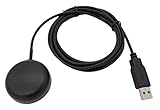
- Built-in high-performance UBX-G7020KT multi-GNSS chip supports GPS, GLONASS, QZSS and SBAS, enabling fast and accurate positioning and obtain error-free NTP network time service. With official free GNSS software U-Center, it is easier to parsing the data of GPGGA, GPGLL, GPGSA, GPGSV, GPRMC, GPVTG and GPZD via PC, Laptop.
- Compatible: Win 11/10/ Win 8/ Win 7/Vista/XP/CE. Free GNSS Evaluation Software. 56-Channel All-IN-VIEW Tracking. Working process: Menu-> Receiver->Port or SensorAPI to get data from GPS Receiver after instialled GNSS software (Software can be downloaded from CD-ROM and Official website)
- Support OpenCPN, Kali Linux, Realtime Google-Earth Pro and maps. WIth the USB to type c converter, it fits Andriod phone/tablet. ( need to install GPS tools apps, like GNSS Master)
- With a magnetic base, it is convenient for installation and fixation anywhere., High sensitivity and Strong Singal,Protocol: NMEA 0183, ASCII and TTL stardard. Customizd navigation rate 1-10 hz.
- Cable Length 6.5 Ft / 2 Meters , IPX4 Water Resistance / Dust-tight. One-year after-sales service. Buy with confidence.
The change is significant because it moves the program from early signal testing toward production deployment. It is not, by itself, evidence that the full service is operational. Xona COO Patrick Cadariu described the current challenge as proving the company can build the satellites repeatedly, not just prove the technology works.
What did FCC authorization allow?
On August 3, 2026, Xona announced that the Federal Communications Commission had authorized Pulsar signal broadcasting from the company’s planned constellation of more than 250 low Earth orbit satellites. Xona called this a major regulatory milestone before scaled deployment. Authorization to broadcast from a planned constellation is not the same as having that constellation in orbit, or providing current global coverage. Xona’s FCC authorization announcement
What performance does Xona claim?
Xona’s product specifications list dual-band Pulsar X1 and X5 signals and advertise positioning accuracy of 2 cm horizontally and 4 cm vertically, timing below 10 nanoseconds, and signal power up to -136 dBW. Xona characterizes that signal power as 100 times GPS L1 C/A. These are company-published specifications, not independently established performance results across typical receivers, locations, or operating conditions. Xona’s Pulsar specifications
Rank #2

- With a USB interface, you can directly use the phone data cable on the computer point of view positioning effect; With IPEX antenna interface, the default distribution of active antenna, can be quickly positioned;
- GT-U7 main module GPS module using the original UBLOX 7th generation chip, Software is compatible with NEO-6M. GT-U7 module, with high sensitivity, low power consumption, miniaturization, its extremely high tracking sensitivity greatly expanded its positioning of the coverage;
- USB directly connected to the computer, That is, with the host computer-owned serial port function, no need for external serial module, send IPX interface active antenna;
- If you have any issue when using our product,or you need product use documentation, please contact us directly for assistance.we will reply your problem in 24 hours.We try our best to provide the most professional service for each customer.
- How to use the GPS module better, the link is obtained in the Product guides and documents, please download it before use
Those figures are best read as the system’s stated technical targets or capabilities, not a promise that every user will see centimeter-level accuracy. Real-world positioning also depends on receiver support, signal availability, corrections, environment and deployment maturity. The public evidence cited here does not provide a broad independent head-to-head performance ranking against GPS.
Has Pulsar worked with existing GNSS equipment?
There is a bounded receiver demonstration. Furuno reported receiving live Pulsar-0 signals in Nishinomiya, Japan, in June 2026. In a July test at Fukushima Robot Test Field, the company said Pulsar reception remained stable while spoofing signals disrupted GNSS. Furuno said the test used a commercial GNSS antenna and a commercial receiver evaluation unit with limited firmware modifications. The spoofing targeted GNSS signals, not Pulsar specifically, so the result does not establish that Pulsar is immune to spoofing in general. Furuno’s evaluation report
Xona says Pulsar is designed for GNSS receiver hardware using L1 or L5 signals. That does not mean every L1/L5 receiver is compatible out of the box: Furuno’s evaluation included firmware changes, and the published material does not identify a verified retail receiver model for consumers.
Rank #3

- Explore confidently with the reliable handheld GPS
- 2.2” sunlight-readable color display with 240 x 320 display pixels for improved readability
- Preloaded with Topo Active maps with routable roads and trails for cycling and hiking
- Support for GPS and GLONASS satellite systems allows for tracking in more challenging environments than GPS alone
- 8 GB of internal memory for map downloads plus a micro SD card slot
Which companies are preparing for integration?
Pulsar’s practical adoption depends on receiver makers, chip suppliers and positioning-equipment companies integrating support. Xona’s Pulsar Verified program, announced in July 2026, is intended to check that participating hardware can receive and operate with Pulsar. Its initial cohort includes Trimble, Septentrio, STMicroelectronics, Safran, StarNav and Keysight. Participation signals work toward compatibility; it is not a universal certification of all products from those companies. Xona’s Pulsar Verified announcement
Topcon announced a commercial early-access agreement with Xona in February 2026 to prepare Pulsar integration for future high-precision positioning workflows. Topcon’s announcement
Trimble and Xona announced a collaboration in March 2025 to explore combining Trimble correction services with Pulsar. At the time, they expected initial launches in late 2026 and service starting in 2027; that was a forecast published then, not a current guarantee of availability. Trimble and Xona’s announcement
Rank #4

- Navigate with Garmin Caliber GPS data on the mobile device of your choice.
- Glow 2 can receive position information from both the GPS and GLONASS satellite constellations, allowing it to connect to up to 24 more satellites than devices that rely on GPS alone.
- This allows Glo 2 to lock on to satellites approximately 20% faster and remain connected even at high speed.
What should a potential user check?
- Coverage and service: Confirm that Pulsar is actually available where and when you need it; Pulsar-0 testing in parts of the United States and Canada does not establish broad commercial coverage.
- Receiver and firmware: Ask the manufacturer whether the exact receiver, chipset and firmware support Pulsar. L1/L5 capability alone is not proof of compatibility.
- Performance conditions: Treat Xona’s published accuracy, timing and signal-power values as vendor specifications until validated for your setup and use case.
- Integration maturity: Look for a product-specific compatibility statement or test result, rather than inferring readiness from a company’s participation in an ecosystem program.
A general L1/L5 GNSS receiver is a category that could be evaluated, not a guarantee of Pulsar support. No specific retail model is established as compatible by the cited demonstrations.
How should Pulsar be compared with GPS?
A useful comparison is not simply which advertised accuracy number is smaller. Consider current coverage and service availability; receiver compatibility and required firmware; positioning and timing performance in the intended environment; how authentication and interference are handled; and whether the service is still in test, deployment or routine operation. The evidence available supports those comparison dimensions, but not a complete independent ranking of Pulsar against GPS.
The Tool Desk
Outbyte Driver Updater FREEScan for outdated or missing drivers - takes under a minuteDriver Scan →Outbyte PC Repair FREEClear out junk files and repair common Windows errorsFree Scan →A separate U.S. Small Business Administration SBIR award record describes a 2024 Air Force project to demonstrate security features including over-the-air rekeying and watermark authentication of range measurements. The award record describes project goals and demonstration work; it is not independent proof that all security performance has been validated. U.S. Small Business Administration SBIR award record
Quick Recap
Product prices and availability are accurate as of the date/time indicated and are subject to change. Any price and availability information displayed on Amazon at the time of purchase will apply.




