Physical AI is artificial intelligence connected to sensors and machines that can change the physical world. A robot observes cameras, joint feedback and other signals, uses a policy or decision process to choose what to do, and sends commands to motors, actuators and end effectors. Its actions alter the environment, creating new observations for the next cycle.
The term is broad rather than a formally settled technical standard. NVIDIA uses it for systems that perceive, reason, learn and act in the physical world. That description is useful, but it is a vendor definition, not an industry-wide certification. The important distinction from a text-only chatbot is embodiment: a physical system must deal with geometry, contact, movement, occlusion and the consequences of mistakes.
As an Amazon Associate I earn from qualifying purchases.
What makes an AI system physical?
A conventional software model can transform one digital object into another. It may classify an image, summarize a document or generate language without directly affecting anything outside the computer. Physical AI adds a closed connection to a body or machine. Sensors report what is happening, a policy interprets those observations in relation to a task, and actuators produce movement.
Outdated Drivers Are Slowing You Down
One free scan finds every outdated or missing driver and matches the right update for your exact hardware.Free scan · exact hardware matchWindows Errors? Fix Them Before They Spread
Repair common Windows errors and clear accumulated junk for a smoother, more stable PC - no reinstall needed.Free scan · no reinstallThat connection changes the engineering problem. A robot cannot assume that an object is exactly where a data label says it is. Lighting can change, a camera view can be blocked, a gripper can slip, and contact forces can differ from a simulation. The robot therefore has to operate with incomplete and noisy information while respecting the limits of its hardware.
#1 Best Overall

- Wiring optimization: Compared to SO-ARM100, SO-ARM101 features improved wiring that prevents disconnection issues previously seen at joint 3. The new wiring design also no longer limits the range of motion of the joints.
- Different gear ratios for the leader arm: The leader arm now uses motors with optimized gear ratios, improving performance and eliminating the need for external gearboxes.
- New functionality support: The leader arm can now follow the follower arm in real-time, which is crucial for the upcoming reinforcement learning (RL) policy, where a human can intervene and correct the robot’s actions.
- Open-source and low-cost: It is an open-source, low-cost robotic arm solution from TheRobotStudio.
- Integration with LeRobot: Designed for integration with LeRobot platform which offers PyTorch models, datasets and tools for reinforcement learning and imitation learning for real-world robotics applications (including data collection, simulation, training and deployment).
NVIDIA’s SO-101 learning documentation states: “Physical AI refers to AI systems that interact with and manipulate the physical world.” This is an official learning-path definition, not a definition issued by a standards body. In practice, the phrase can cover industrial robots, mobile machines, autonomous vehicles, drones and other embodied systems, provided that their AI is involved in sensing and acting rather than only generating a digital response.
The robot learning loop: observe, decide, act, learn
A useful way to understand physical AI is as a repeated control loop. The exact sensors and algorithms vary, but the functions below appear in the SO-101 example and in the broader robot-learning workflow.
- Observe. Cameras, joint encoders and other sensors produce the robot’s current observations. In the SO-101 course, camera images and joint feedback are policy inputs.
- Interpret the task. A policy relates observations to a goal. One approach is a vision-language-action (VLA) model, in which a language instruction and visual observations help determine the next robot action. VLA is one approach, not a requirement for every physical-AI system.
- Act. The policy outputs commands such as target motor positions. Motors and actuators move the robot, while an end effector such as a gripper contacts the object.
- Observe again. Movement changes the scene, so the robot collects a new set of observations rather than assuming that its previous prediction was correct.
- Learn and improve. Developers train policies from demonstrations, reinforcement learning or combinations of real and simulated data. Evaluation and physical testing reveal failures that can be used to refine the policy, controls or hardware.
For a simple pick-and-place task, the loop might begin with a spoken or written instruction, continue through camera-based object detection and motion planning, and end when the gripper releases an item. If the object moves or the camera becomes occluded, the next observation can trigger a correction instead of a blind continuation.
Physical AI versus generative AI
Generative AI describes models that create content such as text, images, audio or code. Physical AI describes an embodied interaction pattern. The two categories can overlap: a robot may use a language model to interpret an instruction, a vision model to identify an object and a learned controller to move its joints. What makes the overall system physical is that its output is tied to action in an environment.
| Aspect | Text-only generative system | Physical-AI robot |
|---|---|---|
| Typical input | Digital text, images or other files | Sensor observations such as camera images and joint feedback, sometimes combined with a language instruction |
| Typical output | Generated digital content | Motor or actuator commands that move a body or end effector |
| Environment | Primarily a digital workspace | A physical scene containing objects, surfaces, geometry and contact |
| Failure consequences | Incorrect or misleading content | Possible dropped objects, collisions, hardware damage or an unsafe motion |
| Feedback | Often supplied by a user or another software process | Arrives continuously through sensors as the robot changes the scene |
This is a difference in coupling, not a claim that one technology is more intelligent. A chatbot can be part of a physical-AI architecture, but language generation alone does not make a system embodied.
Rank #2

- Optimized AI Arm Kit for LeRobot & Hugging Face Projects – The SO-ARM101 is an upgraded low-cost robotic arm servo motor kit designed for AI robotics enthusiasts and developers. Fully compatible with LeRobot and Hugging Face frameworks, it supports imitation learning and reinforcement learning, making it ideal for real-world robotics applications. (3D-printed parts not included.)
- Enhanced Wiring & Performance – Compared to the SO-ARM100, the SO-ARM101 features improved wiring to prevent disconnection at joint 3 and eliminates range-of-motion limitations. The leader arm uses optimized gear ratio motors for smoother performance—no external gearboxes required.
- Real-Time Leader-Follower Functionality – New real-time tracking allows the leader arm to follow the follower arm, enabling human intervention and correction during reinforcement learning (RL) training. Perfect for hands-on AI robotics development and research.
- Open-Source, DIY-Friendly & Nvidia-Compatible – Developed by TheRobotStudio, this open-source AI Arm kit integrates seamlessly with the LeRobot platform, offering PyTorch-based datasets, simulation, training, and deployment tools. Fully compatible with Nvidia Jetson edge devices, including reComputer Mini J4012 Orin NX 16 GB.
- Comprehensive Learning Resources – Includes detailed open-source assembly and calibration guides, testing tutorials, and deployment instructions. From wiring to AI training, get everything you need to start building, teaching, and optimizing your robotic arm for grasping and placing tasks.
How robots acquire physical skills
Demonstrations and imitation
In demonstration-based learning, a person operates or guides the robot through examples of the desired behavior. The recorded sensor readings, actions and task context become training data for a policy. Teleoperation is used in the SO-101 learning example to collect such data. Demonstrations can show a robot what a successful sequence looks like without requiring a developer to write every joint-level rule.
Demonstrations still have limits. They may cover only a narrow range of object positions, lighting conditions or operator styles. A policy trained on those examples can fail when a vial is partly hidden or when friction differs from the demonstrations. Coverage and evaluation matter as much as the number of recorded actions.
The Tool Desk
Outbyte Driver Updater FREEScan for outdated or missing drivers - takes under a minuteDriver Scan →Outbyte PC Repair FREEClear out junk files and repair common Windows errorsFree Scan →Reinforcement learning
Reinforcement learning trains a policy through feedback about outcomes. The system explores actions and receives a reward or penalty according to the task. Training can happen in simulation, where many trials are possible without repeatedly risking physical hardware. A reward design that succeeds in a simulator can nevertheless encourage unsafe or unrealistic behavior on a real robot, so physical validation remains necessary.
Vision-language-action policies
A VLA policy combines visual observations and a natural-language task description with action generation. In NVIDIA’s SO-101 example, the instruction is to pick up a vial and place it on a rack. The model receives the language goal together with camera observations and joint feedback, then produces motor-position outputs. This illustrates how language can specify a task, but it does not mean every robot uses a VLA model or that language understanding solves manipulation by itself.
Hybrid systems
Many practical robots combine learned components with conventional software. A learned policy may select a grasp or trajectory while lower-level controllers enforce joint limits, velocity limits and collision constraints. NVIDIA’s learning materials establish the observation-to-action workflow, but they do not provide a neutral benchmark showing that one learning method is superior to another. A meaningful comparison should examine sensor handling, data sources, transfer to hardware and safety evidence for the target task.
Rank #3
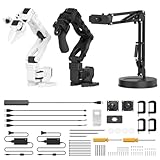
- 【End-to-End Imitation Learning】Hiwonder SO-ARM101 robot arm is an embodied intelligent hardware platform compatible with the Lerobot open-source framework. It provides developers with streamlined access to shared code, templates, and pre-trained models to explore the latest advancements in AI research.
- 【Dual-Camera Vision System】Equipped with both a gripper-mounted camera and an external camera, the system supports both precise manipulation and environmental awareness for accurate imitation learning.
- 【Hiwonder High-Performance Bus Servos】Featuring 12 high-torque bus servo motors with magnetic feedback, the Hiwonder SO-Arm101 robotic arm delivers smooth, stable motion, eliminating issues like power deficiency and jitter.
- 【Professional Control & Debugging】Integrated with the Hiwonder BusLinker V3.0 debugging board, the system supports servo scanning, real-time status monitoring, and trajectory control. The professional PC software simplifies device calibration and debugging, making it accessible for both researchers and hobbyists.
- 【Open-Source Compatibility】The SO-ARM101 robotic arm is designed to be fully compatible with the LeRobot open-source project. We acknowledge the contributions of the open-source community; all trademarks and copyrights belong to their respective owners.
Why simulation is central to robot learning
Simulation provides a controllable environment in which developers can generate scenarios, train policies and investigate failures. NVIDIA’s learning materials describe several practical motivations: reducing time spent on physical trials, avoiding some hardware cost and failure risk, and creating more varied situations than may be convenient to stage manually. Synthetic data can expose a policy to different object arrangements, viewpoints and disturbances.
Simulation also supports evaluation before a policy is placed on hardware. A developer can repeat the same scenario, inspect trajectories and test edge cases while protecting the physical robot. These benefits are the vendor’s explanation of simulation’s value, not an independent economic analysis.
The sim-to-real gap
A simulator is an approximation of the world. It may provide information that a real robot cannot directly access, such as an object’s exact pose or contact forces. Real cameras introduce noise, blur and occlusion. Materials can have different friction, objects can deform, and motors can respond differently from their simulated models.
The SO-101 course describes this difference as a fundamental challenge. In its vial-grasp example, the gripper-mounted camera can become occluded after the robot closes around an object. A simulator might expose the object’s location or contact state even when the real camera view is blocked. A policy that depends on privileged simulated information can therefore fail when deployed.
Strategies for narrowing the gap include training with varied simulated conditions, adding sensor noise, randomizing object positions and appearances, and testing repeatedly on physical hardware. These methods improve the odds of transfer; they do not turn a simulation result into proof of real-world safety or reliability.
Quick wins for a faster PC:
Fix the driver behind crashes, sound loss and screen glitchesFind Drivers →Repair Windows errors before they cause bigger problemsFix Now →Rank #4

- 【End-to-End Imitation Learning】Hiwonder SO-ARM101 robot arm is an embodied intelligent hardware platform compatible with the Lerobot open-source framework. It provides developers with streamlined access to shared code, templates, and pre-trained models to explore the latest advancements in AI research.
- 【Dual-Camera Vision System】Equipped with both a gripper-mounted camera and an external camera, the system supports both precise manipulation and environmental awareness for accurate imitation learning.
- 【Hiwonder High-Performance Bus Servos】Featuring 12 high-torque bus servo motors with magnetic feedback, the Hiwonder SO-Arm101 robotic arm delivers smooth, stable motion, eliminating issues like power deficiency and jitter.
- 【Professional Control & Debugging】Integrated with the Hiwonder BusLinker V3.0 debugging board, the system supports servo scanning, real-time status monitoring, and trajectory control. The professional PC software simplifies device calibration and debugging, making it accessible for both researchers and hobbyists.
- 【Open-Source Compatibility】The SO-ARM101 robotic arm is designed to be fully compatible with the LeRobot open-source project. We acknowledge the contributions of the open-source community; all trademarks and copyrights belong to their respective owners.
Example: the SO-101 vial pick-and-place task
NVIDIA’s SO-101 learning path uses an educational robot arm to demonstrate the complete workflow. Centrifuge vials are scattered on a table, and the robot must pick them up and place them in a rack.
- Collect demonstrations. A person teleoperates the arm to create examples of approaching, grasping and placing the vials.
- Represent the task. The policy receives a task instruction, camera observations and joint feedback. The course uses the instruction to pick up the vial and place it on the rack as its VLA example.
- Train or evaluate in simulation. Developers can vary scenes and examine behavior without exposing the physical arm to every failed attempt.
- Deploy cautiously on the arm. The learned policy outputs motor positions that move the arm and gripper. Real camera views, contact and object variation now affect the result.
- Inspect failures. Occlusion, inaccurate grasping or a changed vial position can reveal where additional data, control logic or safety limits are needed.
The SO-101 is presented as an approachable learning platform, not as a production robot. This demonstration shows how robot-learning concepts fit together; it is not evidence that the arm or its policy is ready for unsupervised laboratory deployment.
Independent reader supportYour contribution helps us test, update, and keep practical guides available for everyone.What to evaluate before trusting a physical-AI system
A convincing demo is only one data point. Before using a robot for a real task, evaluate the complete system under the conditions in which it will operate.
- Observation robustness: Test changes in lighting, camera angle, clutter and partial occlusion. Record how the system detects missing or uncertain information.
- Task coverage: Vary object size, pose, material and location instead of testing a single scripted arrangement.
- Action limits: Verify joint, speed, force and workspace limits independently of the learned policy.
- Recovery behavior: Check whether the robot pauses, retries or requests human help after a failed grasp or sensor fault.
- Simulation-to-hardware transfer: Compare simulated outcomes with repeated physical trials; do not treat simulation success as a guarantee.
- Safety evidence: Establish emergency-stop procedures, collision protection, supervision requirements and a defined operating envelope for the target environment.
- Reproducibility: Document the model, sensor setup, software version, training data and evaluation conditions so that results can be checked after changes.
The available official material does not establish an independent benchmark, regulator approval or general production-readiness threshold for physical AI. Claims about broad generalization or safety should therefore remain specific to a tested robot, task and environment.
Common misconceptions
Physical AI is not simply a smarter chatbot
Adding a language interface does not remove the need for perception, control and safety engineering. The robot still has to locate objects, plan reachable motions and handle contact.
Best Value

- COMPLETE BUILD: Includes all electronics and 3D-printed frame components to build a fully functional SO-101 leader arm -- the human-controlled half of a teleoperation system.
- 6 FEETECH STS3215 SERVOS: 19kg.cm torque at 7.4V with metal gears and magnetic encoder 3× 1/147 gear (C046), 2× 1/191 gear (C044), 1× 1/345 gear (C001)
- AI TRAINING READY: Record demonstrations with LeRobot (Hugging Face) to build training datasets for imitation learning policies like ACT, Diffusion, and pi0
- QUICK ASSEMBLY: Pre-printed frame components snap and screw together - pair with a follower arm to start collecting robot training data in one afternoon
Simulation is not proof of deployment readiness
Simulation can reveal useful behavior and expose some failures, but it may include privileged information and simplified physics. Hardware trials are required to establish how a policy behaves with real sensors and materials.
A successful demonstration is not general-purpose autonomy
The vial example is a focused educational task. Performance on that scenario cannot establish that the same robot will safely perform unrelated laboratory, household or industrial work.
How to start learning about physical AI
You do not need to purchase a robot to understand the core ideas. Start by tracing the observation-to-action loop in a simulator or an existing educational course. Identify each sensor, the policy input format, the action output and the safety layer around the controller.
Recommended Free Tools
If you choose hands-on work, the SO-101 learning path uses an SO-101 robot arm kit as its platform. The materials describe it as an educational learning platform rather than production hardware. Current kit contents, software compatibility and availability should be verified from the official documentation before buying; the cited materials do not establish a current price, included components or affiliate eligibility.
Whether you work in simulation or with hardware, keep the task narrowly defined, log observations and actions, and test failure cases deliberately. The most valuable lesson is not that a policy can complete one scripted motion, but how its performance changes when the world is only partly visible and the consequences of an error are physical.
Why the term matters
Physical AI brings machine learning into environments where actions have geometry, timing and consequences. Its defining loop is simple to state—observations lead to a task-conditioned decision, which leads to motor action and new observations—but making that loop dependable requires data, simulation, controls, hardware testing and safety engineering together.
NVIDIA CEO Jensen Huang described physical AI in a company newsroom announcement as “models that understand the real world, reason and plan actions” that are unlocking new applications. That statement is a vendor executive’s promotional characterization, not independent evidence of a particular system’s capabilities. The practical test is narrower and more useful: can a specified robot perform a specified task, under specified conditions, with measured reliability and safe recovery when its observations are incomplete?
Do these 3 things before closing this tab:
1Repair Windows errors before they cause bigger problems2Fix the driver behind crashes, sound loss and screen glitches3Clear out junk files and repair common Windows errorsQuick Recap
Product prices and availability are accurate as of the date/time indicated and are subject to change. Any price and availability information displayed on Amazon at the time of purchase will apply.

