The right arXiv alternative depends on your field and what you need from a public record. Zenodo is a general-purpose repository that assigns DOIs and supports versioning; OSF connects authors with community-run preprint servers; and bioRxiv, medRxiv and SSRN serve particular subject areas under their own policies. Before posting, check the target journal or conference’s rules for the exact manuscript version and whether a preprint could affect anonymous review.
How to choose an arXiv alternative
Start by deciding whether you need a general research repository, a preprint server with a disciplinary community, or a place suited to a particular field. Then check the service’s scope, screening process and record-management features. There is no evidence-based universal ranking for audience size, discoverability or posting speed, so the best choice is a fit decision, not a leaderboard.
As an Amazon Associate I earn from qualifying purchases.
- Field: Is the work within the service’s stated scope?
- Record: Do you need a DOI, version history, or preservation of related code?
- Screening: What moderation or integrity checks occur, and what do they mean?
- Venue policy: Does the target journal or conference allow this version to be shared, and could public posting conflict with double-anonymous review?
Best arXiv alternatives by use case
| Service | Best fit | What to know |
|---|---|---|
| Zenodo | Cross-disciplinary research outputs or authors seeking a DOI-backed repository record | Zenodo says every upload receives a DOI and records can be versioned. It also supports preservation of GitHub repositories; the service describes CERN and OpenAIRE as its operators. |
| OSF Preprints and community servers | Work in a discipline served by an OSF community, including PsyArXiv and SocArXiv | OSF offers a network for working papers and preprints that can be linked to data and code. Submissions are moderated before posting, and individual communities publish scope policies. |
| bioRxiv | Life-sciences research | bioRxiv says it accepts preprints across the life sciences. Work outside its scope may fit another server, such as arXiv. It usually adds a link to the journal version after publication. |
| medRxiv | Health-sciences research that meets its submission requirements | medRxiv says submissions are not certified by peer review before posting. Its policies describe scope restrictions, moderation rights and author revisions before journal publication. |
| SSRN | Social sciences, law, economics and finance; some unpublished or early-stage work in technical and health fields | SSRN’s support policy, updated April 22, 2026, says it no longer posts final peer-reviewed articles in life sciences, healthcare, computer science and engineering. It continues to accept most published content in fields such as law, economics and finance. Submissions are subject to integrity checks. |
Which service fits your paper?
Choose Zenodo for a general-purpose repository record
If the priority is to archive a research output across disciplines and give it a citable record, Zenodo is a candidate. Its DOI and versioning features are useful when a work changes over time. A repository record is not automatically equivalent to placement in a field-specific preprint community, so consider whether your intended readers use that community.
What’s actually slowing this PC down?
Pick the symptom - the matching free tool is one click away.
Choose an OSF community when its scope matches your discipline
OSF’s network includes community-run servers such as PsyArXiv and SocArXiv. The community context can make the service a natural fit for working papers in the relevant field, while links to data and code can keep related materials connected. Check the chosen community’s scope and labeling policies: OSF describes submissions as pre-moderated, meaning they remain private and pending until a moderator accepts or rejects them.
#1 Best Overall

- Keep track of everything from attendance to test scores
- Spiral bound
- Measures 8-1/2" x 11"
Choose bioRxiv for life sciences
bioRxiv is intended for life-sciences preprints. If your manuscript falls outside that scope, its guidance points authors toward other services, including arXiv. The service says it usually links a preprint to its journal version after publication.
Choose medRxiv for eligible health-sciences work
medRxiv is focused on health-sciences submissions that meet its requirements. Its screening and moderation do not amount to peer review: the service says posted submissions are not certified by peer review before posting. Make the manuscript’s preprint status clear, especially when readers could mistake a public health-sciences manuscript for a reviewed clinical finding.
Rank #2

- 8 1/2" x 11" book for lesson plans and grades
- Combines W101 and R6080
- W101-Lesson Plan Book for 7 classes/days horizontally across the top
- R6080-Teacher Record Book for 6-8 weeks. 36 Student names. Large blocks.
Choose SSRN with its current field and version limits in mind
SSRN may suit work in social sciences, law, economics and finance, including much published content in those fields. Its policy is more restrictive for final peer-reviewed articles in life sciences, healthcare, computer science and engineering: the support update dated April 22, 2026, says those articles are no longer posted. Check the current policy for your discipline and manuscript stage rather than assuming that one field’s rule applies to another.
Check the venue policy and manuscript version before posting
A preprint is an author’s manuscript that has not been peer reviewed or otherwise enhanced by a publisher. It is different from an accepted manuscript and from the final published journal article; sharing permissions can differ for each version.
Rank #3

- Full of different activities to help your child develop their skills
- Contains one sixty-four page workbook
- Available in a variety of different age groups
- Available in different themed activity books
- Made in USA
- Identify the exact file. Decide whether you are sharing a preprint, an accepted manuscript or the published article. Do not apply a preprint rule to a later version.
- Check the journal or conference policy. Search the current policy for the specific venue and manuscript type. General rules may not cover every society-owned journal or double-anonymous review process.
- Check the server’s scope and moderation requirements. Confirm that the work is eligible and understand what screening does—and does not—establish.
- Consider anonymity. If the venue uses double-anonymous review, check whether posting the preprint could reveal authorship or otherwise conflict with its rules.
- Link the record to publication when appropriate. Elsevier’s sharing policy encourages authors to link a preprint to the formal publication by DOI after acceptance, while distinguishing preprint sharing from later-version permissions.
Elsevier’s policy says, “Authors can share their preprint anywhere at any time.” Treat that statement as Elsevier’s policy, not a universal guarantee: its own guidance notes that some society-owned journals and journals using double-anonymous review have different policies. Verify the destination venue’s current rules before relying on a general allowance.
Quick Recap
Best Value

- 8.5" x 11" Teacher Record Book
- Designed with extra-large blocks for grades, etc
- 3 Sections with 105 pages total
- Each double page in section I and II has 31 horizontal squares, sufficient for a six week marking period
Rank #4
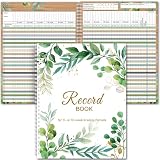
- Comprehensive Layout: the class record book manages your classes with dedicated pages for a student information sheet, daily schedules, and a weekly attendance sheet; Keep detailed notes and track all academic progress in one highly organized place effortlessly
- Optimal Dimensions: teacher record book measures approximately 8.5 x 11 inches, contains 106 pages, this letter-sized planner offers ample writing space, each recording area has ample space for notes, reminders, and other notes, The spacious layout of this teacher lesson planner ensures every grade recording book entry is legible and easy to review daily
- Quality Materials: the teacher gradebook features writing on 100g offset paper that resists ink bleeding; The sturdy 350g white cardboard laminated cover makes this teacher record book highly durable, ensuring reliable classroom organization throughout the entire term
- Track Classroom Progress and Organization: this teacher planner helps efficiently manage attendance, test scores, and grading records in one place. Includes structured space for classroom attendance, seating charts, class checklists, communication logs, notes, teaching records and more to simplify classroom management and keep everything organized throughout the school term
- Thoughtful Gift: record book for teacher features a beautiful botanical green aesthetic, this serves as a wonderful teacher appreciation gift. Providing up to twelve weeks of tracking, it is an essential school year planner teacher companion for every dedicated educator
Product prices and availability are accurate as of the date/time indicated and are subject to change. Any price and availability information displayed on Amazon at the time of purchase will apply.




