Oxford researchers reported a flexible, multilayer perovskite solar-cell material just over one micron thick, with a certified laboratory efficiency above 27%. The “100 times thinner than a human hair” wording is a news-headline comparison; Oxford’s announcement instead said the material was almost 150 times thinner than a silicon wafer. The work points toward solar coatings, but it does not show that this specific material is commercially available.
What did the researchers develop?
The Oxford team developed a thin-film, multi-junction photovoltaic device made from stacked perovskite layers. Unlike a conventional silicon cell, which uses a single main light-absorbing layer, the stacked layers are designed to absorb different parts of the light spectrum. Oxford describes the material as flexible and suitable in principle for use as a coating.
As an Amazon Associate I earn from qualifying purchases.
The announcement described the material as just over one micron thick—almost 150 times thinner than a silicon wafer. That is Oxford’s stated comparison. It is distinct from the “100 times thinner than a human hair” phrase used in the headline of a Futurism story published on 17 August 2024.
How efficient is the solar material?
Oxford’s 9 August 2024 announcement said the device had achieved more than 27% power-conversion efficiency, independently certified by Japan’s National Institute of Advanced Industrial Science and Technology (AIST). The Oxford University Research Archive’s record for the later Nature paper gives a certified result of 27.28% for a 1 cm² triple-junction device.
#1 Best Overall

- Works Indoors & Outdoors - Generates power from ambient indoor lighting, window light, and sunlight
- Perovskite Solar Technology - Advanced photovoltaic material designed to capture more usable energy in low-light environments than traditional silicon panels.
- Built for Energy Harvesting - Ideal for powering or extending battery life in low-power electronics and IoT devices.
- Ultra-Thin & Lightweight - Compact form factor makes integration easy, even in space-constrained projects.
- Easy to Integrate - Simple wire output design for fast prototyping and product development.
That figure is a small-area research-device result, not a rating for a commercial solar panel or a measurement of how much electricity a coating would deliver on a building, vehicle, or phone. The sources do not report a controlled head-to-head test against commercial silicon panels.
Oxford researcher Dr Shuaifeng Hu described progress over five years, saying the team raised efficiency “from around 6% to over 27%.” This is the team’s account of its research progress, not a direct comparison of equivalent commercial products. Hu also said the approach could, in time, enable devices to exceed 45%; that is a projection, not an achieved efficiency.
Rank #2

- Works Indoors & Outdoors - Generates power from ambient indoor lighting, window light, and sunlight
- Perovskite Solar Technology - Advanced photovoltaic material designed to capture more usable energy in low-light environments than traditional silicon panels.
- Built for Energy Harvesting - Ideal for powering or extending battery life in low-power electronics and IoT devices.
- Ultra-Thin & Lightweight - Compact form factor makes integration easy, even in space-constrained projects.
- Easy to Integrate - Simple wire output design for fast prototyping and product development.
Could it be used on cars, buildings, or phones?
Oxford researchers presented broader surfaces as possible future applications. Dr Junke Wang named car and building roofs and the backs of mobile phones as examples. Oxford’s announcement also mentioned rucksacks. A thin, flexible coating could make it possible to generate power from surfaces that are not practical places for rigid, conventional panels.
What’s actually slowing this PC down?
Pick the symptom - the matching free tool is one click away.
Those examples describe envisioned uses, not products demonstrated as ready for sale. The available sources do not establish that this exact coating can be purchased, installed at commercial scale, or used today to power a phone or car. Nor do they show that a thin cell automatically makes a complete solar installation cheaper or lighter: mounting, encapsulation, wiring, conversion electronics, and durability also matter.
Rank #3

- ShadowFlux Anti-Shading Technology - Renogy shadowflux technology delivers enhanced power generation even in shaded areas caused by buildings, plants, or stains. This solar panel innovative ShadowFlux anti-shading tech significantly reduces hot-spot risks, ensuring reliable power output and peace of mind.
- Unmatched Cell Efficiency - Featuring advanced N-Type solar cells with 16BB technology, this high-performance panel achieves 25% efficiency. The 200 watt solar panel enhances photoelectric conversion while reducing hot spots and micro-cracks, ensuring longer lifespan and superior performance.
- Compact and Lightweight Design - Renogy shadowflux 200w solar panel is 7% smaller and 10% more compact than PERC solar panels, making it an ideal choice for space-saving applications.
- Superior Environmental Endurance - With an ≥ IP67 rating, renogy solar panels are built to endure extreme weather conditions, from snow and rain to small hail. Its advanced encapsulation material enhances water vapor resistance, providing long-term durability.
- Long-Term Reliability - The shadowflux solar panel 200w is backed by a 5-year output warranty & material and workmanship commitment, complemented by a 25-year output ensuring 80% power output.
What is known about durability?
The Nature paper record reports that encapsulated triple-junction cells retained 80% of their initial efficiency after 860 hours of maximum-power-point tracking in ambient conditions. This is a defined laboratory stability result for encapsulated cells. It does not establish how many years a finished product would last outdoors, where exposure and operating conditions differ.
When was the research published?
The Futurism story carrying the headline was published on 17 August 2024 and said the findings had not yet been published. That description was accurate to the story’s timing, but the paper was subsequently published online in Nature on 23 December 2024. Its title is “Steering perovskite precursor solutions for multijunction photovoltaics.”
Rank #4
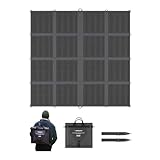
- [Ultra-Lightweight 16-Fold Design] This 400W solar blanket weighs 16.09 lb and folds to 16.54 x 15.83 x 4.13 in, making storage easier for SUVs, vans, campers, and tight campsites.
- [Multiple Installation Methods] Use the blanket across a windshield, on sunny ground, or hanging between trees or racks. Secure it with tie-downs, stakes, or weights in windy campsites.
- [Industry-Leading 25% Efficiency] 16BB N-Type cells help deliver more power from the same sunlight for RV owners, campers, van travelers, blackout backup, and off-grid use.
- [Compatible with Most Power Stations] Compatible with Jackery Explorer 1000 v2, EcoFlow DELTA 3/DELTA 3 Max, Anker SOLIX S2000/C1000 Gen 2/C2000 Gen 2, and other models that meets requirements. MC4 output only; the 4-in-1 adapter is sold separately.
- [UL 61730 Certified] Tested to UL 61730 with listed CE, RoHS, FCC, CA65, PSE, and ISO 9001 claims. Real-world output varies with sun angle, temperature, shade, cable length, and input limits.
How this differs from commercial perovskite products
Oxford Alumni has separately discussed Oxford PV, an Oxford spin-out commercializing perovskite photovoltaics. That is a distinct effort: the source does not say Oxford PV is commercializing this particular flexible, all-perovskite coating. The research result and commercial products should not be treated as interchangeable.
Quick wins for a faster PC:
Fix the driver behind crashes, sound loss and screen glitchesFind Drivers →Clear out junk files and repair common Windows errorsFree Scan →Scan for outdated or missing drivers - takes under a minuteDriver Scan →Quick Recap
Best Value

- Frame-Less Design: Star Cleanedge Series Solar Panel Feature a Frameless Design that prevents dust/water buildup. Rain Self-Cleaning, 0 Maintenance Costs
- Quality Guarantee: 495W 24 Volt Solar Panels Use 25.6% High-efficiency Cells, Certified by UL, ISO9001, CE, and US Patents, Stable Power Generation Even in Harsh Weather
- Power Boost: No Frame & Dust Obstruction,15% Increase in Power Generation Compared to Normal Solar Panels
- Reduce Costs: No Dust Accumulation,Only Rain Cleaning,Saves $3600/year on Cleaning Costs for the Family Travel Fund
- More Safety: No Need to Clean Rooftops,Climbing-Free,Faster Snow Removal in Winter, Safer to Use
Product prices and availability are accurate as of the date/time indicated and are subject to change. Any price and availability information displayed on Amazon at the time of purchase will apply.




