Free tools Windows power users keep installed
One-click scans. No signup required.
OpenSuperClone is a Linux disk-imaging tool: it copies a drive to an image file or another drive so you can work from that copy. It does not, by itself, turn the contents into a folder of recovered files. For a failing drive, the safer workflow is to preserve the project log, image the source to a separate healthy destination, and use a file-system recovery tool on the resulting copy.
What is OpenSuperClone?
OpenSuperClone is a Linux utility based on Scott Dwyer’s HDDSuperClone. The project describes it as “A powerful data recovery utility for Linux with many advanced features based on Scott Dwyer’s HDDSuperClone.” Its purpose is to image or clone disks, including drives that are difficult to read, rather than directly browse and restore individual files. OpenSuperClone’s project README lists features such as Virtual Disk Mode, direct AHCI/IDE access, USB relay control, and a script engine.
As an Amazon Associate I earn from qualifying purchases.
Does OpenSuperClone recover files or clone the whole drive?
OpenSuperClone creates a sector-level image or clone. That copy is the input for a separate file-system recovery step: another program must interpret the file system and extract files. A clone can also be examined without repeatedly working against the failing original. The distinction matters because completing an imaging pass does not guarantee that files are intact or recoverable. Rossmann Group’s technical overview discusses imaging separately from file-system recovery.
Do these 3 things before closing this tab:
1Clear out junk files and repair common Windows errors2Scan for outdated or missing drivers - takes under a minute3Repair Windows errors before they cause bigger problemsWhich OpenSuperClone mode should you use?
| Mode | What it is for | Practical consideration |
|---|---|---|
| Clone Mode | Imaging the source to an image file or cloning it to another drive. | Use a separate, healthy destination with capacity equal to or greater than the source. Confirm the source and destination before starting. |
| Virtual Disk Mode | Targeted extraction workflows rather than a straightforward full-drive clone. | Virtual Disk functionality requires the project’s kernel module; installation details depend on the Linux setup. |
The README also lists direct AHCI/IDE capability, USB relay control, and scripting. These are advanced capabilities, not a guarantee of compatibility with every drive, adapter, controller, or Linux kernel. Consult the project README and installation notes for the release and hardware you plan to use.
#1 Best Overall

- Supports Standard Desktop 2.5"/3.5" SATA Hard Drives or SSD.
- Supports hard drives up to 10TB.
- Plug and play, no drivers needed.
- Supports Offline Cloning up to 60Mbps.
- Supports Transfer Speeds up to 5Gbps (USB 3.0),480Mbps (USB 2.0), 12Mbps (USB 1.1)
How do I use OpenSuperClone?
The project wiki describes a workflow built around a project file that records the job’s state. Its pages are marked as a work in progress and may be incomplete, so check the current release documentation as well. The Clone Mode wiki page describes these basic steps:
- Create a new project file or log. Keep it with the job so you can preserve and resume the recorded progress.
- Select the source drive. Verify the device carefully; this is the drive being read, not the place to store the clone.
- Choose the output. Select an image file or a separate destination drive. The destination should be healthy and have at least the source drive’s capacity.
- Connect and start the job. Review the selected source and output before starting, then monitor the imaging process.
- Save the project state. Retain the project/log file with the image or clone. The wiki also documents importing and exporting GNU ddrescue map files.
- Recover files from the copy. Use a separate file-system recovery application to inspect the image or clone; OpenSuperClone is the imaging stage, not that extraction step.
Do I need a second hard drive to clone a failing drive?
You need a separate destination if you are writing a clone to another physical drive; it should be healthy and at least as large as the source. If you choose an image file instead, that file still needs adequate space on a separate healthy storage device. Do not store the only copy of the image on the failing source. A USB flash drive is useful for booting a Linux Live ISO, but it is boot media—not a substitute for storage sized for the clone. The project lists a Linux Live ISO among its distribution options.
Rank #2

- SATA DRIVES ONLY — 2.5in & 3.5in: Works with SATA I/II/III hard drives and SSDs. Does NOT support IDE/PATA, M.2 NVMe, M.2 SATA, SAS, or drives already in a USB enclosure. Check your drive's connector before ordering — a bare SATA drive has a wide flat L-shaped edge connector, not a ribbon cable or a small M.2 gold-finger card.
- USB TYPE-A HOST CABLE — NOT A USB-C PORT: The included host cable ends in USB Type-A and plugs into a USB 3.0 Type-A port. If your computer has only USB-C ports, you will need a USB-C to USB-A adapter, which is not included. For stable operation plug directly into the computer — USB hubs and USB 2.0 ports may cause intermittent disconnections.
- REAL-WORLD SPEED, NOT INTERFACE MATH: USB 3.0 with UASP support (UASP-capable host required). Typical mechanical HDD transfer speeds are 100-160 MB/s, which is the drive's own limit, not the port's; SSD speeds vary up to the USB interface maximum. Backward compatible with USB 2.0 and USB 1.1.
- 12V POWER ADAPTER INCLUDED — REQUIRED FOR 3.5in DRIVES: A 12V/2A AC power adapter is in the box and a wall outlet is needed. 3.5in HDDs cannot run on USB power alone — without the adapter the drive will fail to spin up or drop out during use. 2.5in drives are generally bus-powered, but the adapter is recommended for stability.
- PLUG AND PLAY, TOOL-FREE, HOT-SWAP: No drivers on Windows 10/11, macOS, or Linux. Lay-flat bay accepts a bare drive without tools, swaps without rebooting, and an LED shows power and activity. Note: S.M.A.R.T. diagnostics are not passed through the USB bridge, and on macOS a drive may need remounting after sleep. Drive not included.
OpenSuperClone vs. GNU ddrescue
Both programs are used for disk imaging. GNU ddrescue’s manual describes an approach that prioritizes recovering readable data and uses a mapfile to track progress, so completed regions need not be read again. OpenSuperClone likewise documents project-state and map-file workflows, while adding options such as Virtual Disk Mode and direct AHCI/IDE access. The right choice depends on your hardware access, desired targeting workflow, Linux setup, and comfort with the tools—not on a universal performance ranking.
| Decision point | OpenSuperClone | GNU ddrescue |
|---|---|---|
| Primary role | Disk imaging and cloning; separate software is needed to extract files. | Disk imaging; the manual focuses on recovering readable data and recording progress. |
| Targeting and access | Project documentation lists Virtual Disk Mode and direct AHCI/IDE capability. | The cited manual describes the mapfile-based recovery workflow; it does not establish equivalent OpenSuperClone features. |
| Progress record | Project file/log; the wiki also documents GNU ddrescue map-file import and export. | Mapfile records progress and helps avoid rereading completed regions. |
| Setup considerations | Linux packages and a Live ISO are listed; Virtual Disk functionality requires a kernel module. | Use depends on having a Linux environment and following the program’s documented workflow. |
GNU ddrescue’s behavior is documented in its official manual. This comparison is about documented workflows and features, not a benchmark of recovery rates or speed.
Rank #3
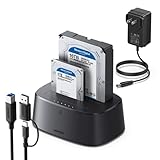
- Offline cloning: This External hard drive docking station supports wireless cloning mode, which allows you to clone the contents of two hard drives at once without connecting to a computer. Note: The capacity of the hard drive must meet A≤B
- Large capacity and wide compatibility: This hard drive enclosure supports the simultaneous use of two 2.5-inch and 3.5-inch 7+15-pin SATA III hard drives and is backward compatible with SATA II/SATA I; it supports a maximum capacity of 32TB x 2
- Lightning Transmission:This hdd docking stationt uses the USB 3.0 protocol, with a maximum transfer speed of 5Gbps, and is backward compatible with USB 2.0/USB 1.1, allowing for fast file transfers without waiting. In addition, it comes with a 1-meter USB B to USB C data cable, eliminating the hassle of short cables.
- Excellent Heat Dissipation & Safety: The hard drive reader features 360° surround cooling, eliminating your worries about hard drive safety. It also includes a dust cover to better protect the contact points and extend the product's lifespan when not in use. Additionally, anti-slip pads prevent the product from falling, making your use safer.
- Universal Compatibility & Reliability: This External hard drive dock is compatible with Windows XP / Vista / Windows 7 / Windows 8 / Windows 8.1 / Windows 10 and Mac IOS 10.4 to 10.11 Linux Kernel 2.4.2 or greater versionscomes.
Installation and version notes
The OpenSuperClone README lists prebuilt DEB and RPM packages, source installation instructions, and a Linux Live ISO. The installation wiki says the kernel module is needed for Virtual Disk functionality; if DKMS is installed, it can build and install the module automatically, while systems without DKMS require manual steps. See the installation wiki and confirm the instructions for your distribution.
The README lists version 2.5.0 and labels 2.6.0 as work in progress. Its changelog says OSCDriver 2.6.9 adds support up to kernel 7.2.0 and notes experimental UART/script support for Seagate F3 drives. These are project changelog statements, not a compatibility guarantee for every kernel and distribution. Check the current README and release information before installing.
Rank #4

- OFFLINE CLONER, NO COMPUTER NEEDED: Copy one SATA drive to another at the press of a button, up to 60MBps, with the dock unplugged from any PC. Target drive must be the same size as the source or larger.
- READS AND WRITES TWO DRIVES AT ONCE: Both bays mount as separate drives when connected to a computer over USB, so you can move files between them or work off both. Hot-swappable, tool-free, with an HDD access LED per bay.
- SATA ONLY, 2.5in AND 3.5in: Fits bare 2.5in and 3.5in SATA hard drives and SATA SSDs. It does NOT support IDE/PATA drives, drives with a 4-pin Molex power connector, M.2 or NVMe drives, and drives are not included.
- WHAT COMES IN THE BOX: Docking station, power adapter and a USB Type-C cable. The cable is USB-C on the dock end - check your computer has a USB-C port or add your own USB-C to USB-A cable before you order.
- USB 3.0 SPEEDS UP TO 5GBPS: Plug and play on Windows and Mac with no drivers to install. Real-world speed is set by the drives you fit - a mechanical hard drive will not reach 5Gbps, and offline cloning runs up to 60MBps by design.
When software imaging is not enough
Imaging software cannot repair physical damage. If a drive is making clicking or other severe mechanical noises, or its condition is deteriorating, repeated DIY reads can make matters worse; stop attempts and consider a specialist with appropriate equipment. A successful image is not assured, and neither OpenSuperClone nor any other imaging tool can promise that damaged or unreadable data will be recovered. Rossmann Group’s overview discusses cases where professional equipment or physical repair may be needed.
What’s actually slowing this PC down?
Pick the symptom - the matching free tool is one click away.
Quick Recap
Product prices and availability are accurate as of the date/time indicated and are subject to change. Any price and availability information displayed on Amazon at the time of purchase will apply.




