What’s actually slowing this PC down?
Pick the symptom - the matching free tool is one click away.
Los Alamos National Laboratory (LANL) has selected NVIDIA’s Vera Rubin platform, Vera CPUs and Quantum-X800 InfiniBand for three HPE-built supercomputers named Mission, Vision and Veritas. The systems are planned for national-security work, open science and technology experimentation, respectively. However, the reviewed official announcements do not confirm that the first Vera test server actually arrived at LANL; the stated summer 2026 arrival was an expectation.
What LANL selected
NVIDIA and the U.S. Department of Energy’s National Nuclear Security Administration describe a codesigned program in which HPE will build the systems using HPE Cray supercomputing architecture. The planned technology stack includes NVIDIA Vera Rubin GPU nodes, Vera CPUs and Quantum-X800 InfiniBand networking on the HPE Cray Supercomputing GX5000 architecture.
As an Amazon Associate I earn from qualifying purchases.
The announcement concerns three different systems rather than one replacement machine:
| System | Stated purpose | Published configuration or status |
|---|---|---|
| Mission | Classified national-security workloads; NVIDIA says it is intended to replace Crossroads for those workloads. | NVIDIA says the plan includes Rubin GPU nodes and 2,300 standalone Vera CPUs in an HPE Cray GX240 blade. This is a planned configuration, not a confirmed final inventory. |
| Vision | Open and fundamental science, including AI, materials and nuclear science, energy modeling, biomedical research, fusion and quantum-computing work. | No standalone Vera CPU count was given in the reviewed NVIDIA LANL announcement. DOE/NNSA places Mission and Vision in a combined 2027–2028 full-deployment window. |
| Veritas | LANL’s Laboratory-Directed Research and Development (LDRD) work, including experiments with agentic-AI technologies for larger systems. | NVIDIA reports approximately 1,150 standalone Vera CPUs plus Rubin GPU nodes. DOE/NNSA’s July announcement does not provide a Veritas schedule. |
All three are planned HPE-built systems based on the latest HPE Cray design, according to NVIDIA’s June 22, 2026 announcement.
#1 Best Overall

- Content Creation Workstation PC: Powered by the Intel Hexa-Core i5 (8th Gen) processor with 32GB DDR4 RAM and NVIDIA's Quadro K1200 4GB Graphics Card, this Workstation PC Computer is built for creative environments
- NVIDIA's Quadro K1200 4GB Graphics Card: Graphic support built to be an efficient workstation for creative applications like photo and video editing, 3D Design, AutoCAD, and much more
- Software Compatibility: Workstation PC for use with independent software vendors (ISV) and certified for use with modeling, rendering, and engineering software from Adobe, AutoCAD, 3DS Max, and many more
- Massive Storage Solutions: An ultra-fast 1TB Solid State Drive (SSD) setup as the primary boot device; Boot and load programs with little to no lag; An additional 4TB Hard Disk Drive (HDD) is installed for additional storage; Never run out of storage
- Connectivity for Creative Projects: USB 3.0 (x5) | USB 2.0 (x4) | USB Type-C (x1) | DisplayPort (x2) | Serial Port (x1) | VGA Port (x1) | Audio Combo Jack (x1) | Audio In (x1) | Audio Out (x1) | RJ-45 Ethernet (x1) | Internal SATA (x3)
What each supercomputer is meant to do
Mission: national security
Mission is the classified-workload system. NVIDIA says its standalone Vera CPU partition will contain 2,300 CPUs and that the machine is intended to replace Crossroads. The published description makes Mission the clearest successor-oriented project, but it does not establish that replacement or operation has already occurred.
Vision: open research
Vision is intended for work that can support broader scientific research. NVIDIA lists foundation models, agentic AI, simulations, materials science, nuclear science, energy and biomedical research among its uses. The reviewed sources do not provide a final node count or assign Vision a specific deployment year within DOE/NNSA’s 2027–2028 window.
Veritas: an experimental proving ground
Veritas is focused on LDRD projects and on testing technologies that could later be used in larger LANL systems. NVIDIA reports about 1,150 standalone Vera CPUs, making this a substantial planned CPU partition, but the source material does not establish when Veritas will become operational.
Recommended Free Tools
Rank #2

- POWERFUL BUSINESS PERFORMANCE – The Dell Precision 3431 is a professional-grade business workstation featuring an Intel Core i5-9500 9th Gen Hexa-Core processor, delivering fast performance, efficient multitasking, and enterprise-level reliability for office environments.
- OPTIMIZED MEMORY & STORAGE FOR PRODUCTIVITY – Equipped with 16GB DDR4 RAM for smooth multitasking and a 1TB SSD, this workstation provides lightning-fast boot times, quick file access, and ample storage for business applications and large datasets.
- PPROFESSIONAL GRAPHICS FOR VISUAL WORKLOADS – Featuring an NVIDIA Quadro P620 2GB graphics card, the Dell Precision 3431 is designed for business professionals, engineers, and creatives who need reliable performance for CAD, 3D modeling, and multi-display setups.
- WINDOWS 11 PRO & ESSENTIAL CONNECTIVITY – Pre-installed with Windows 11 Pro, offering advanced security, remote desktop access, and business-friendly features. Built-in WiFi and Bluetooth ensure seamless connectivity to networks, wireless peripherals, and office devices.
- READY-TO-USE WITH INCLUDED KEYBOARD & MOUSE – Comes with a wired keyboard and mouse, ensuring a plug-and-play setup for immediate productivity in any office or professional workspace.
Has the first Vera server arrived at LANL?
Not conclusively, based on the official material reviewed for this article. DOE/NNSA’s July 16, 2026 announcement said a first Vera Rubin CPU server was expected to arrive at LANL in summer 2026 for testing. That wording describes an expected delivery, not a confirmation that delivery occurred.
The same distinction applies to the larger systems. DOE/NNSA says full deployment of Mission and Vision is expected in 2027 and 2028, while NVIDIA’s June blog says Mission and Vision were expected to be operational in 2027. These statements are projections with different levels of specificity; neither confirms present-day operation.
What NVIDIA says Vera CPUs add
NVIDIA’s current Vera CPU product page lists up to 88 custom Olympus cores, up to 1.2 terabytes per second (TB/s) of LPDDR5X memory bandwidth and up to 1.5 TB of memory. Those are product-level specifications and do not show that every LANL node will use the maximum memory configuration.
Rank #3
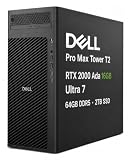
- POWERFUL FOR CREATIVITY - Building on Dell’s established Precision Tower workstation heritage, the Dell Pro Max Tower T2 brings professional-grade graphics and AI-ready capabilities to Dell’s latest Pro Max generation. Equipped with NVIDIA RTX 2000 Ada 16GB GDDR6 Graphics, it delivers powerful acceleration for demanding workflows in design, architecture, photography, and visual computing. Advanced AI capabilities help accelerate AI-enhanced applications and intelligent workflows, improving efficiency and responsiveness for modern professional work.
- PREMIUM PERFORMANCE - Powered by the Intel Core Ultra 7 265 vPro processor (20-Core, up to 5.3GHz), the Dell Pro Max Tower T2 handles intensive multitasking, business applications, and complex workloads with ease. Equipped with 64GB DDR5 RAM and 2TB SSD, it delivers responsive operation, fast boot times, quick application launches, and ample space for essential files and projects.
- RICH CONNECTIVITY OPTIONS - Connect your essential devices with three USB-C ports, one Thunderbolt 4, six USB-A ports, dual DisplayPort 1.4a, RJ-45 Ethernet, and an audio jack. This configuration does not include a Wi-Fi card or support Wi-Fi and Bluetooth connectivity, with RJ-45 Ethernet available for wired networking. The NVIDIA RTX 2000 Ada features four Mini DisplayPort 1.4a outputs, supporting up to four displays and resolutions up to 8K (7680 × 4320) at 60Hz for an expansive visual workspace. A built-in DVD±RW optical drive adds convenient access to CDs and DVDs.
- OPERATING SYSTEM - Preinstalled with Windows 11 Pro 64‑bit and integrated AI‑powered Copilot, delivering business‑ready features for document management, information organization, collaboration, and virtual meetings. Built to support secure, efficient daily operations in professional office and commercial environments.
- BUILT FOR PROFESSIONAL WORKFLOWS - Ideal for engineers, architects, Creator, developers, data analysts, researchers, creative professionals, and technical users who need a capable workstation for demanding projects. Built to handle CAD, 3D modeling and rendering, simulation, software development, video production, content creation and complex multitasking, the Dell Pro Max Tower T2 provides the versatility needed across business, creative, and technical environments. ISV certifications help ensure reliable compatibility and optimized operation with professional applications.
The design emphasis is high memory bandwidth and capacity for applications that are difficult to feed with conventional processors. LANL chief architect of advanced technology systems Galen Shipman said the laboratory improved performance and efficiency by targeting unmet needs such as high-memory bandwidth and support for complex applications. That is an official statement about the design effort, not an independent system-wide measurement.
Free tools Windows power users keep installed
One-click scans. No signup required.
How the reported performance figures should be read
NVIDIA reports several comparisons from LANL demonstrations. Each is limited to the named workload and comparison system:
- URSA: NVIDIA reports seven times higher performance than the CPUs in Crossroads on URSA workloads.
- Branson: NVIDIA reports more than three times the performance of Crossroads CPUs in an early test using Branson, an open-source Monte Carlo heat-transfer simulation tool.
- Broad product comparisons: NVIDIA claims more than three times the performance of a single-socket x86-based CPU, more than four times the memory per core and six times the memory per node.
These figures are vendor-reported, workload-specific comparisons. They are not universal CPU benchmarks, independent tests, proof of system-wide delivered performance or evidence of realized energy savings. The reviewed sources also provide no cost figures.
Rank #4

- AI-powered Technology: Advanced artificial intelligence capabilities integrated into the workstation for enhanced performance and productivity
- Processor Manufacturer: Intel processor technology delivering reliable and powerful computing performance
- Processor Type: Core Ultra 7 processor designed for demanding professional workloads and multitasking
- Processor Model: 265 model providing high-speed processing with 2.40 GHz base speed and 30 MB L3 cache
- Processor Core: Icosa-core (20 Core) architecture with 20 threads for exceptional parallel processing capabilities
Why the codesign matters
DOE/NNSA presents Mission and Vision as a partnership among LANL, HPE and NVIDIA rather than an off-the-shelf installation. NNSA Administrator Brandon Williams said the Genesis Mission calls for partnerships of this kind and that codesigning the systems from the ground up is intended to reduce discovery time “from months to minutes.” That phrase describes the program’s goal, not a measured result.
NVIDIA CEO Jensen Huang called Vera Rubin “a new instrument for science,” referring to the combination of simulation, AI and data processing. In practice, the three-system plan separates classified production work, broadly accessible research and experimental technology development so each can be optimized for its intended users.
Windows Errors? Fix Them Before They Spread
Repair common Windows errors and clear accumulated junk for a smoother, more stable PC - no reinstall needed.Free scan · no reinstallOutdated Drivers Are Slowing You Down
One free scan finds every outdated or missing driver and matches the right update for your exact hardware.Free scan · exact hardware matchWhat is known—and what is not
- Known: LANL selected an HPE-built, HPE Cray architecture using NVIDIA Vera Rubin, Vera CPUs and Quantum-X800 InfiniBand.
- Known: Mission, Vision and Veritas have different stated roles.
- Known: NVIDIA published planned standalone CPU quantities for Mission and Veritas, but not Vision in the reviewed LANL announcement.
- Not established: That the first test server arrived during summer 2026.
- Not established: That any of the three systems is currently operational.
- Not established: Final system inventories, total cost, system-wide benchmark results or realized energy savings.
The Bottom Line
LANL’s Vera program is a three-system plan, not a confirmed completed deployment. Mission targets classified national-security computing, Vision targets open science and Veritas provides an LDRD test bed. NVIDIA has reported promising workload-specific CPU results and detailed product specifications, but the available official announcements do not confirm that the first Vera server—or the finished supercomputers—has landed and entered operation.
Quick Recap
Product prices and availability are accurate as of the date/time indicated and are subject to change. Any price and availability information displayed on Amazon at the time of purchase will apply.




