Quick wins for a faster PC:
Scan for outdated or missing drivers - takes under a minuteDriver Scan →Repair Windows errors before they cause bigger problemsFix Now →Near-field magnetic induction is the transfer of energy or information through changing magnetic flux between nearby circuits, usually coils. Alternating current in a transmitter coil creates a changing magnetic field; when some of that field passes through a receiver coil, it induces a voltage there. It is a magnetic-field coupling mechanism—not the same as capacitive coupling, which uses an electric field.
What does near-field magnetic induction mean?
It describes short-range coupling in which a changing magnetic field induces voltage in a nearby receiving circuit. In common wireless systems, the transmitter and receiver are coils. The International Electrotechnical Commission’s terminology for near-field wireless power transfer covers a transmitter and receiver located within an induced magnetic or electric field, and separately identifies magnetic-field-based transfer. IEC 63244-1:2021
As an Amazon Associate I earn from qualifying purchases.
How does induction work between coils?
- The transmitter creates a changing field. Alternating current flowing through its coil produces changing magnetic flux.
- The field links with the receiver. Some of the transmitter’s magnetic flux passes through the nearby receiving coil.
- The receiver develops voltage. Because the linked flux changes, it induces an electromotive force in the receiver coil.
- The received signal is used. The circuit can deliver power to a load, or a modulated magnetic field can convey information.
Coil geometry, spacing, orientation, and the surrounding system affect how strongly the coils couple. Engineers describe that relationship using mutual inductance and a coupling coefficient. Resonant inductive systems tune their transmitter and receiver circuits to a common resonant frequency. A peer-reviewed review of inductive coupling
How is magnetic induction different from other wireless coupling?
| Method | Field doing the coupling | Typical interface | What it can do |
|---|---|---|---|
| Magnetic induction | Changing magnetic field | Coil to coil | Transfer power or information |
| Capacitive coupling | Electric field | Plate or electrode to plate or electrode | Transfer power or information |
| Far-field transmission | Radiated electromagnetic waves | Typically antennas | Transmit information or energy |
The first two are near-field coupling mechanisms, but they are not interchangeable: induction relies on magnetic flux, while capacitive transfer relies on an electric field. Far-field transmission instead carries energy through radiated waves rather than primarily through a local reactive coil-to-coil link. National Academies, Frontiers of Engineering (2017)
#1 Best Overall

- Support NFC RFID reading and writing, P2P communication with peers
- Support I2C, SPI and HSU (High Speed UART), easy to change among these modes
- On-board level shifter, standard 5V TTL for I2C and UART, 3.3V TTL SPI
- Arduino Raspberry Pi compatible, Small Size and easy to embed into your project
- RFID reader/writer supports: Mifare 1k, 4k, Ultralight, and DesFire cards, ISO/IEC 14443-4 cards such as CD97BX, CD light, Desfire, P5CN072 (SMX), Innovision Jewel cards such as IRT5001 card, FeliCa cards such as RCS_860 and RCS_854
Does near field have a fixed distance limit?
No single distance cutoff applies to every frequency, antenna, coil, or application. Technical definitions use conventions suited to particular purposes. For example, an IEC glossary includes an application-specific short-range near-field definition based on coil spacing relative to coil radii; that is not a universal boundary. IEC 63006:2019 glossary
Where is near-field magnetic induction used?
Wireless power transfer
Inductive charging transfers power by magnetic coupling between coils. Documented examples include charging handheld devices and stationary electric vehicles. The physical principle is the same, although implementations differ in design and operating details. Inductive coupling review
Rank #2

- Support NFC RFID reading and writing, P2P communication with peers
- Support I2C, SPI and HSU (High Speed UART), easy to change among these modes
- On-board level shifter, standard 5V TTL for I2C and UART, 3.3V TTL SPI
- compatible for Arduino Raspberry Pi compatible, Small Size and easy to embed into your project
- RFID reader/writer supports: Mifare 1k, 4k, Ultralight, and DesFire cards, ISO/IEC 14443-4 cards such as CD97BX, CD light, Desfire, P5CN072 (SMX), Innovision Jewel cards such as IRT5001 card, FeliCa cards such as RCS_860 and RCS_854
Short-range communication
Resonant or matched coils can couple a modulated magnetic signal over short distances. Near-field magnetic-induction communication and wireless power transfer are among the reported applications of near-field electromagnetic systems. Near-field electromagnetic induction article
Is it the same as NFC or wireless charging?
Not exactly. Near-field magnetic induction names a physical coupling mechanism; NFC and wireless charging refer to technologies or system applications with particular designs and protocols. They can use inductive coupling, but the terms are not synonyms, and not every wireless charging system or near-field link should be assumed to work identically.
Rank #3

- PN532 gilt PCB and Small dimension and easy to embed into your project , support I2C.SPI and HSU (high speed UART), change between those modes
- Typical Operating Distance have been updated to 5cm~7cm reading distance, work in NFC Mode or RFID reader/writer mode
- On-board level shifter, Standard 5V TTL for I2C and UART, 3.3V TTL SPI
- Work as RFID reader/writer, work as 1443-A card or a virtual card
- Exchange data with other NFC devices such as smartphone
Does the definition establish whether a device is safe?
No. Describing the coupling mechanism does not determine exposure or safety for a particular product. OSHA notes that electric- and magnetic-field relationships in the near field can be complex and that both may need measurement when characterizing exposure. OSHA electromagnetic-field memo
IEC/IEEE 63184:2025 specifies assessment methods for fields from stationary wireless power transfer systems operating from 3 kHz to 30 MHz, with a focus on inductive systems. That scope describes an assessment method; it does not establish the safety of any specific device or exposure. IEC/IEEE 63184:2025
Quick Recap
Best Value
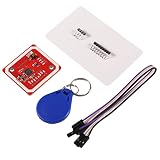
- PN532 gilt PCB and Small dimension and easy to embed into your project , support I2C.SPI and HSU (high speed UART), change between those modes
- Typical Operating Distance have been updated to 5cm~7cm reading distance, work in NFC Mode or RFID reader/writer mode
- On-board level shifter, Standard 5V TTL for I2C and UART, 3.3V TTL SPI
- Work as RFID reader/writer, work as 1443-A card or a virtual card
- Exchange data with other NFC devices such as smartphone
Rank #4
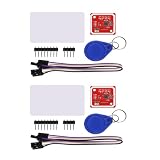
- PN532 gilt PCB and Small dimension and easy to embed into your project , support I2C.SPI and HSU (high speed UART), change between those modes
- Typical Operating Distance have been updated to 5cm~7cm reading distance, work in NFC Mode or RFID reader/writer mode
- On-board level shifter, Standard 5V TTL for I2C and UART, 3.3V TTL SPI
- Work as RFID reader/writer, work as 1443-A card or a virtual card
- Exchange data with other NFC devices such as smartphone
Product prices and availability are accurate as of the date/time indicated and are subject to change. Any price and availability information displayed on Amazon at the time of purchase will apply.
Do these 3 things before closing this tab:
1Scan for outdated or missing drivers - takes under a minute2Clear out junk files and repair common Windows errors3Fix the driver behind crashes, sound loss and screen glitches



