Short answer: choose the SSD whose published endurance, warranty, sustained-write behavior, interface and protection features match your NAS workload—not the one with “NAS” on the label. A NAS-oriented model can make sense for write-heavy arrays, caching or continuous service, while a consumer SSD is often adequate for read-heavy storage, occasional backups and lighter home use. Neither category is universally more reliable. Compare the exact model and capacity, then check current documentation and regional pricing.
What the NAS and consumer labels actually tell you
“NAS SSD” and “consumer SSD” describe intended markets, not guaranteed reliability tiers. A NAS-oriented drive is marketed for storage appliances and may be specified for workloads that run continuously or generate more writes. A consumer drive is generally optimized for desktop and laptop use, where activity often arrives in short bursts separated by idle time. Those design targets can affect firmware behavior, sustained performance, endurance ratings and available support terms.
As an Amazon Associate I earn from qualifying purchases.
The label still does not answer the questions that determine whether a drive will suit your system. You need the exact capacity, interface, endurance rating, warranty conditions, workload limits and any required features such as power-loss protection. A four-terabyte model and a one-terabyte model in the same family can have very different TBW ratings. A drive sold for NAS use can also lack a feature your workload requires, while a consumer model may offer enough endurance for a lightly written home NAS.
Start with workload, not category
Estimate what the NAS will write and how continuously it will write it. Read-heavy media libraries and document shares usually stress an SSD less than virtual-machine storage, databases, surveillance recording, download caches or a busy multi-user backup target. Burst activity and sustained activity are also different: a drive can look fast during a short benchmark yet slow down when its cache fills during a long transfer.
#1 Best Overall
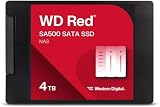
- Storage optimized for caching in NAS systems to rapidly access your most frequently used files.
- Superior endurance can handle the heavy read and write loads demanded by NAS, giving you the reliability you need in a 24/7 environment.
- Purpose-built for NAS with proven Western Digital 3D NAND to deliver maximum SATA performance to both home and business users.
- Reduces latency and improves responsiveness for OLTP databases, multi-user environments, photo rendering, 4K and 8K video editing, and more.
- Available in 2.5” and M.2 form factors to fit the slots in modern NAS systems.
- Mostly reads: media playback, photo browsing and an archive that is written only occasionally generally place modest write demand on the SSD.
- Periodic backups: large weekly or monthly jobs create predictable bursts. Include the amount of data rewritten, not just the size of the backup set.
- Cache or scratch use: browser, download and application caches can create many small writes whose total is easy to underestimate.
- Virtual machines and databases: frequent small random writes and synchronization can produce a much higher daily write rate than file storage.
- Continuous recording: cameras or other always-on streams generate a steady write workload; check the chosen model’s workload guidance and sustained behavior.
Seagate’s workload-rate guidance emphasizes that limits are product-specific. Exceeding a stated workload can reduce reliability or affect warranty claims under the applicable product manual, so use the chosen SSD’s own documentation rather than a generic NAS rule.
How SSD endurance ratings work
TBW: total bytes written
TBW is the manufacturer’s rated amount of data that can be written over the specified endurance period. It is a design rating, not a countdown timer. Reaching the number does not predict the exact day a drive will stop working, and a drive can fail before or continue operating after a rating is reached. Samsung identifies workload, NAND endurance, write amplification and physical capacity as factors in SSD lifetime.
DWPD: drive writes per day
DWPD expresses the number of complete drive-capacity writes allowed each day over a stated warranty or endurance period. To compare a TBW figure with DWPD, use the capacity and the period together:
The Tool Desk
Outbyte PC Repair FREEClear out junk files and repair common Windows errorsFree Scan →Outbyte Driver Updater FREEScan for outdated or missing drivers - takes under a minuteDriver Scan →DWPD = TBW ÷ (capacity in TB × 365 × years)
Use the manufacturer’s capacity convention and the warranty period stated for that model. Do not compare TBW numbers from different capacities as if they represented the same workload. A 2,000-TBW rating on a four-terabyte drive represents a different daily-write allowance than 2,000 TBW on a one-terabyte drive.
A capacity-aware example
The published listing for the 4 TB WD Red SA500 NAS SATA SSD gives 2,500 TBW and a five-year warranty. Using decimal terabytes, the implied average is approximately 0.34 full-drive writes per day: 2,500 ÷ (4 × 365 × 5). That is about 1.37 TB of host writes per day if spread evenly across five years. This is a calculation from the published figures, not a promise of service life. Verify the current capacity listing, warranty region and terms before buying because product pages can change.
If your NAS writes 1 TB per day for five years, the simple total is about 1,825 TBW, below that 2,500-TBW rating. At 2 TB per day, the same period would produce about 3,650 TBW, above it. Real systems add write amplification and internal activity, so leave margin instead of planning to consume the entire rating.
Endurance is not the same as reliability
Endurance answers a narrow question: how much writing the manufacturer rates the media to tolerate under defined conditions. Reliability covers a wider set of outcomes, including controller, firmware, flash, power, temperature and system interactions. Western Digital’s January 2023 document, SSD Endurance and HDD Workloads, states that “SSD endurance ratings are based on known, predictable, attributes of the underlying storage media.” It also explains that SSD endurance and HDD workload ratings measure different phenomena and should not be treated as equivalent.
Free tools Windows power users keep installed
One-click scans. No signup required.
A high TBW value therefore does not prove that one model will have fewer sudden failures than another. Conversely, a lower TBW consumer drive is not automatically unsafe in a lightly written NAS. Warranty coverage is another separate issue: it may be limited by years, TBW, workload conditions, region or exclusions, whichever applies first.
Continuous performance and power-loss protection
Samsung’s 2015 product-class comparison describes data-center SSDs as designed for sustained performance and mixed workloads, while consumer-class products are designed around shorter bursts. That is useful class-level guidance, not proof that every NAS-labeled SSD has enterprise behavior. For a busy NAS, look for sustained-write specifications, thermal limits and reviews or documentation that describe performance after the temporary cache is exhausted.
Power-loss protection (PLP) is equally model-specific. A NAS label does not guarantee capacitors or firmware that protect in-flight data during an unexpected shutdown. Samsung discusses power-fail protection in its data-center SSD comparison. If your NAS lacks reliable battery backup and the workload includes databases, metadata-heavy operations or synchronous writes, check the exact SSD datasheet for PLP rather than inferring it from the product family name.
What independent failure data can—and cannot—show
Backblaze’s 2023 review reported a 0.89% lifetime annualized failure rate for its SSD cohort through the end of 2022. The dataset contained 2,906 drives, and Backblaze cautioned that some model estimates had wide confidence intervals because of limited drive days. The environment was Backblaze’s own boot-drive fleet, not a controlled comparison of NAS-oriented and consumer SSDs under the same NAS workload.
For individual models in that 2022 fleet, Backblaze reported 0.73% AFR for the Seagate ZA250CM10003, 1.04% for the Crucial CT250MX500SSD1 and 1.98% for the Seagate ZA250CM10002. Those historical fleet figures cannot be generalized to every consumer SSD, to NAS installations or to current production revisions.
Rank #3

- Access Big Files Fast: WD Red SA500 NAS SATA SSD storage is optimised for caching in NAS systems to rapidly access your most frequently used content
- Give it Your Tough Workloads: WD Red SSD’s superior endurance can handle the heavy read and write loads demanded by NAS, giving you the reliability you need in a 24/7 environment
- Work More Efficiently: Purpose-built for NAS with proven Western Digital 3D NAND, the WD Red SSD delivers maximum SATA performance to boost your productivity and effectiveness at home or in the office
- Use it for Your Demanding Applications: The drive reduces latency and improves responsiveness for OLTP databases, multi-user environments, photo rendering, 4K and 8K video editing, and more
- Customise Your NAS System: The WD Red SSD comes in 2.5 Inch and M.2 form factors so you can upgrade your existing NAS system or design a new one from scratch
An earlier Backblaze SSD-versus-HDD analysis adjusted for age and drive days and found failure rates that were similar within the stated confidence intervals. The post also noted differences in cohort age and limitations in SSD sample size. These observations illustrate why field evidence needs matched workloads, enough drives and narrow confidence intervals before it can establish a category-wide reliability advantage. The available evidence does not establish that NAS SSDs are universally more reliable than consumer SSDs, or the reverse.
NAS-oriented example: WD Red SA500
The WD Red SA500 is a useful example of why model-level specifications matter. The 4 TB listing cited above specifies 2,500 TBW and a five-year warranty. Those figures make it a candidate for a NAS workload with substantial writes, but they do not make it the best choice for every array, cache or appliance. Check the exact capacity, SATA interface, supported form factor, current endurance table, warranty region and NAS compatibility list.
Do not transfer the 4 TB figures to smaller or larger capacities without checking their individual entries. Endurance can scale differently across a product range, and a warranty may have conditions that vary by market. Treat the listing as a concrete reference point, not as a category-wide NAS standard.
Recommended Free Tools
Cost: compare usable capacity and service life
There is no verified, current matched price study here, so an exact “NAS premium” would be misleading. Street prices change by region, capacity, promotions and interface. Instead, record the price and date for the exact models you can buy, then calculate:
price per usable TB = purchase price ÷ usable capacity in TB
Compare that figure alongside TBW, warranty length, sustained performance, PLP and the workload you estimated. A cheaper drive may cost more over time if its endurance margin is too small for the write rate, but replacement-frequency savings should only be claimed when your workload and the manufacturer’s rating support the calculation. RAID overhead, filesystem reservations and over-provisioning mean usable NAS capacity is lower than the number on the box; use the capacity your system actually exposes.
Rank #4

- Robust system responsiveness and exceptional I/O performance
- Tackle NAS workloads with exceptional reliability and endurance
- Tame tough projects like virtualization and collaborative editing
- Perfect for multitasking applications with multiple users
- Scale your NAS device with huge capacities up to 4TB*
A practical selection process
- Measure or estimate writes. Use NAS monitoring, backup logs, application statistics or a representative week. Separate host writes from read traffic and note whether the rate is steady or bursty.
- Project the period. Multiply average daily writes by 365 and the number of years you expect to keep the drive. Add margin for growth, rebuilds, snapshots, garbage collection and write amplification.
- Normalize endurance. Convert TBW to an approximate DWPD using the drive’s capacity and stated warranty period. Compare only figures with equivalent periods and capacities.
- Check sustained behavior. For virtual machines, databases, recording and long backups, read documentation about sustained writes and thermal throttling instead of relying only on peak sequential speed.
- Verify protection features. Confirm PLP, encryption, firmware behavior and any requirement your NAS vendor lists. Never assume a NAS label includes a feature.
- Read warranty conditions. Confirm years, TBW limits, workload restrictions, region, proof-of-purchase rules and exclusions for the exact model.
- Confirm physical and firmware compatibility. Match SATA or NVMe interface, 2.5-inch or M.2 form factor, drive height, carrier requirements and the NAS maker’s compatibility information.
- Compare current delivered cost. Use the same currency, tax and shipping basis, and note the date and region. Calculate price per usable terabyte rather than comparing retail prices alone.
Will a consumer SSD work in a NAS?
Often, a consumer SATA or NVMe SSD can operate in a NAS that supports the same interface and form factor, but compatibility is appliance-specific. Check the NAS manufacturer’s drive list, firmware notes, thermal limits and behavior when a drive is not on the list. A drive that functions electrically may still lack vendor validation, health-monitoring support or the endurance margin your workload needs.
Crashes, No Sound, or Screen Glitches?
Random freezes, missing sound and display glitches usually trace back to one bad driver. Find and replace yours safely.Free scan · under a minuteWindows Errors? Fix Them Before They Spread
Repair common Windows errors and clear accumulated junk for a smoother, more stable PC - no reinstall needed.Free scan · no reinstallFor a lightly written home share, a compatible consumer SSD can be a rational choice when its warranty and TBW comfortably exceed the projected workload. For a busy cache, virtual-machine datastore or continuous recording target, favor the model whose sustained behavior, endurance and protection features are documented for that duty—whether its marketing calls it NAS, data-center or consumer.
Common workload decisions
Media library and family file share
Reads dominate, writes are occasional and capacity usually matters most. A compatible consumer SSD may be sufficient if the endurance rating and warranty cover the projected backups and file changes. Prioritize capacity, NAS compatibility and a sensible replacement plan.
Weekly full backups
Calculate the amount rewritten each week, including retention rotations and verification passes. A drive can accumulate significant TBW even when the NAS appears idle most days. Choose enough endurance margin that a failed backup cycle or rebuild does not consume the remaining allowance.
Virtual machines or databases
Expect frequent random writes and sustained activity. Investigate steady-state performance, thermal behavior, PLP and support terms. A short burst benchmark is not an adequate proxy for this workload.
Quick wins for a faster PC:
Repair Windows errors before they cause bigger problemsFix Now →Scan for outdated or missing drivers - takes under a minuteDriver Scan →Clear out junk files and repair common Windows errorsFree Scan →Surveillance or other continuous recording
Use the camera count, bitrate, retention policy and overwrite pattern to estimate daily writes. Verify the SSD’s workload guidance and temperature limits, and leave room for metadata, indexing and rebuild traffic.
Quick Recap
Pitfalls that produce bad comparisons
- Ranking TBW without capacity: normalize to capacity and period before deciding which rating is stronger.
- Treating TBW as a failure date: it is a rated write-life measure, not a prediction of when the controller or flash will fail.
- Assuming NAS branding means PLP: inspect the exact datasheet.
- Using desktop burst benchmarks for continuous work: examine sustained performance after caches fill.
- Ignoring warranty limits: years, TBW and workload conditions can all affect coverage.
- Generalizing fleet statistics: Backblaze’s figures describe its historical boot-drive population, not every NAS or SSD model.
- Comparing launch prices: use current, region-specific prices and the capacity your NAS actually makes usable.
- Filling a NAS with no monitoring: track writes, temperature, SMART health and remaining life so you can replace a drive before an endurance margin disappears.
Model-specific buying checklist
- NAS workload: reads, backups, cache, virtual machines, database or continuous recording.
- Estimated average and peak daily writes, plus expected growth.
- Capacity and usable capacity after RAID or filesystem overhead.
- TBW and, where possible, calculated DWPD for the stated warranty period.
- Sustained-write behavior and thermal limits for continuous workloads.
- Power-loss protection or an alternative power-failure strategy.
- Interface, form factor, firmware and NAS compatibility.
- Warranty years, TBW ceiling, region and workload exclusions.
- Current price per usable terabyte, recorded with date and region.
- A replacement and backup plan that does not depend on the SSD lasting until its rating.
Product prices and availability are accurate as of the date/time indicated and are subject to change. Any price and availability information displayed on Amazon at the time of purchase will apply.




