What’s actually slowing this PC down?
Pick the symptom - the matching free tool is one click away.
Liquid cooling is usually the better choice for high-density AI racks, while air cooling remains the simpler and often cheaper option for moderate loads or facilities with spare CRAC/CRAH capacity. The deciding factors are rack power density, available electrical and mechanical capacity, retrofit constraints, heat-rejection method, water strategy, and the operator’s ability to manage pumps, coolant and leak controls. There is no universal winner: compare the whole cooling plant and its service regime over the intended lifecycle.
What liquid cooling and air cooling actually do
Every server converts electrical power into heat. Cooling equipment must capture that heat at the chip, move it out of the rack, and reject it outdoors or to another building system. The difference is the medium that carries most of the heat away from the IT hardware.
As an Amazon Associate I earn from qualifying purchases.
Air cooling
In a conventional air-cooled room, fans move air through server heat sinks. The heated air passes through a computer-room air handler (CRAH) or computer-room air conditioner (CRAC), where coils remove the heat. Chilled-water or refrigerant circuits then carry that heat to the cooling plant. Containment, floor grilles, filters and airflow controls keep supply air within the temperature and humidity envelope required by the servers.
Air cooling has a straightforward service model: replace or clean filters, maintain fans and coils, and service chillers or dry coolers. It also has a physical limit. As accelerator boards and complete racks draw more power, the volume of air required to hold safe inlet temperatures rises sharply. Fans consume more electricity, pressure drops increase, and a room can develop hot spots even when its average temperature looks acceptable.
#1 Best Overall

- T2 copper base plate,401W/m.k high thermal conductivity ,Strengthen theral conductivity,Increase heat dissipation area.0.3MM jet microchannel toiprove heat absorption area UP to 44 waterways,increasing the water area to 10723.993mm².
- Matte texture craftsmanship,using high-quality aluminum material,with sandwich installation providing all-round protection.Ultra high wind pressu reand airflow can quickly dissipate heat through hin/thick cold pipes,effectively improving the heat dissipation and cooling of the water cooling system.
- Adopting high-performance split type water cooling pump to provide powerful power for the water cooling system.
- Ensure to with stand installation pressure while using a copper base thickness of 0.35mm,effectively reduce the thermal resistance of copper lpates and improve thermal conductivity efpciency.Made of all metal material that is not easily damaged,deformed,or aged,ensure the stability of heat dissipation performance and bave a long service life.
- Using EPMD material braided bube,it has good heat resistance and furability,can operate stably for a long time in high load working environments,ensuring performance and material quality.
Liquid cooling
Liquid systems place a cold plate or another heat exchanger close to the processor or accelerator. A pump circulates coolant through the cold plate, then to a coolant distribution unit (CDU). The CDU uses pumps, controls and a heat exchanger to connect the technology loop to a facility-water or chilled-water loop without mixing the two fluids.
The U.S. Department of Energy Federal Energy Management Program describes the distinction this way: “Direct liquid cooling systems transfer the heat generated by the IT equipment directly to a recirculating chilled water loop rather than transferring the heat to the room air and then moving the heat from the air to the chilled water loop.” That shorter heat path is why liquid is attractive for dense AI hardware.
Liquid cooling does not necessarily eliminate room air. Memory, power supplies, storage devices and networking components may still be air-cooled, and the room still needs enough airflow for those residual loads and for people. A design should therefore specify the percentage of rack heat handled by liquid rather than assuming a binary liquid-versus-air installation.
Recommended Free Tools
Why AI racks change the decision
AI training and inference servers concentrate many high-power accelerators in a small footprint. A rack that was manageable with air-cooled general-purpose servers can become difficult to cool when accelerator boards, high-speed networking and power-conversion equipment are added. The relevant question is not whether a liquid loop is technologically superior in isolation; it is whether the planned rack density exceeds the practical capability of the existing air path.
- Rack density: use the expected sustained and peak IT load per rack, not only the average load at commissioning.
- Heat distribution: identify which devices are true hotspots. GPUs and CPUs may need cold plates even when lower-power components remain on air.
- Growth: include the next hardware generation and a realistic expansion plan. A room that works today can become constrained when accelerator counts increase.
- Facility headroom: check electrical service, chiller capacity, pump capacity, floor loading and pipe routes together. Cooling capacity alone does not make a rack deployable.
For moderate-density racks, a well-designed air system with containment and adequate CRAH or CRAC capacity can be efficient and dependable. For very dense racks, moving heat directly into a liquid loop usually reduces the room-air burden and makes the thermal design more predictable.
Efficiency: where liquid can help, and where it cannot
Shorter heat path and lower air-side work
Air systems move heat from the chip to a heat sink, across the rack, through the room and across a coil. Liquid cold plates remove much of that air movement from the chain. The room still requires airflow, but fans and air handlers no longer have to carry the full accelerator load. This can reduce fan energy and may allow a smaller or less heavily loaded air plant.
The result depends on the entire system. Pumps in the liquid loop consume electricity, CDUs add controls and heat-exchanger losses, and the facility plant still has to reject the heat. A liquid design is more efficient only when those additions are lower than the air-side energy they replace under the site’s actual operating conditions.
Outdated Drivers Are Slowing You Down
One free scan finds every outdated or missing driver and matches the right update for your exact hardware.Free scan · exact hardware matchWindows Errors? Fix Them Before They Spread
Repair common Windows errors and clear accumulated junk for a smoother, more stable PC - no reinstall needed.Free scan · no reinstallRank #2
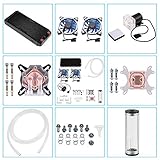
- 【Professional Water Cooling Kit】This liquid CPU cooler kit provides a 240mm heat sink within screw pack+2pcs LED fan+universal CPU block within 4pcs screws+universal GPU Block within 4pcs screws+cylindrical water reservoir (Including screw pack+2pcs plastic bracket+2pcs metal bracket)+transparent hose water pump with shock pad+a set of water pipe connectors,hose clamps and plugs
- 【High Performance】The CPU/GPU block is constructed with a copper base to provide exceptional heat transfer and cooling performance.The extreme performance fans offer a high air static pressure with lower noise. 9W 600L / H G1/4 Thread size High quiet water Pump,high stability,long lasting.Easy and intuitive installation and setup,set your fan and pump speeds to their lowest possible noise level while still keeping your system exceptionally cool
- 【Super Water Circulation Cooling System】240mm Heat Sink: Provide the excellent heat dissipation, as you need for highly overclocked desktop processors.160mm high capacity cylindrical water reservoir is manufactured from transparent acrylic so that the circulation system is visible.Upgraded flexible anti-explosion, hoses enable a space-saving installation and exceptional durability
- 【Universal Water Cooling Block】The CPU water cooling block made of copper and transparent plexiglass suitable for / Platform,the 0.8MM parallel waterway G1/4 universal thread GPU water cooling block made of copper and POM high temperature materials support 9.5mm ID / 12.7mm OD PU tube,or 10mmID/16mmOD solid tube,or 8mmID/12mmOD silicon tube.Complete Accessories,you don't have to worry about installation at all
- 【Quality Service】This liquid CPU cooler kit will dramatically improve heat dissipation experience, especially in terms of stability, silence, efficiency, and convenience.If this product has any quality problems or you have any questions about this product, you can us at any time. We have a professional customer service team that will provide you with the best service. will do our best to solve your problem in time, please rest assured to buy
Supply temperature and heat rejection
Efficiency is strongly affected by the coolant supply temperature and by how heat leaves the building. Chillers, dry coolers and cooling towers have different energy and water consequences. A liquid loop connected to an inefficient or poorly controlled plant can erase the benefit of efficient cold plates. Conversely, a design that can use favorable outdoor conditions or higher-temperature heat rejection may reduce compressor work.
Do not compare a liquid CDU with an air handler as if they were complete cooling systems. Compare the pumps, fans, chillers, heat exchangers, controls and heat-rejection equipment required to support the same IT load and operating schedule.
PUE and WUE must be read together
Power usage effectiveness (PUE) is total facility energy divided by IT energy. Water usage effectiveness (WUE) measures site water consumption against IT energy. A project can improve PUE while increasing water use, or reduce water use while consuming more electricity. Report both metrics with the climate, operating temperatures, load profile and heat-rejection technology stated.
A closed technology loop itself does not continually evaporate water. However, if the facility rejects heat through cooling towers, that plant can still consume significant water through evaporation and blowdown. A dry cooler may avoid that water consumption but require more fan energy or larger equipment in hot weather. The correct comparison is the complete heat-rejection design, not the presence of liquid inside the rack.
Do these 3 things before closing this tab:
1Repair Windows errors before they cause bigger problems2Fix the driver behind crashes, sound loss and screen glitches3Clear out junk files and repair common Windows errorsCapital cost, operating cost and total cost of ownership
Air cooling usually has the lower initial cost when a building already has suitable CRAC or CRAH units, distribution, controls and power for the planned density. Reusing that infrastructure avoids new technology loops and shortens the installation scope.
Liquid cooling adds equipment and work that an air-only room does not need. A direct-to-chip deployment normally requires CDUs, pumps, heat exchangers, supply and return piping, rack manifolds, valves, drip management, leak detection, controls, water treatment and commissioning. The International Energy Agency’s 4E review identifies high initial cost, standardisation and long-term reliability as adoption considerations.
| Cost area | Air cooling | Liquid cooling |
|---|---|---|
| Core room equipment | CRAC or CRAH units, fans, containment and airflow distribution | Residual room cooling plus CDUs, pumps and liquid distribution |
| Rack-level hardware | Heat sinks and server fans | Cold plates or other liquid heat exchangers, manifolds and quick-disconnects |
| Building work | Air distribution, floor or overhead pathways and chiller connections | Pipe routes, supports, isolation valves, drainage or containment and heat-exchanger connections |
| Commissioning | Air balancing, controls tuning and thermal-load testing | Pressure testing, flushing, coolant verification, leak detection tests, controls integration and thermal-load testing |
| Operations | Fan, filter, coil, chiller and containment maintenance | Pump, CDU, valve, coolant-quality, leak-detection and residual-air-system maintenance |
| Universal price figure | Not stated; site scope and existing capacity determine cost | Not stated; site scope, density and liquid architecture determine cost |
Operating cost has several competing parts. Liquid cooling can lower fan and air-handler energy, but pumps and controls add a continuous load. It may also permit a different chiller or heat-rejection strategy. Air cooling avoids liquid-treatment and leak-response work but can incur high fan energy, especially when filters load up or pressure drops rise.
Rank #3

- Minimalist design,pure design structure brings comfortable visual experience,enhances MOD personalized layout,fully showcases the beauty of hardwre.
- T2 copper material bottom plate,with a high thermal conductivity coefficient of 401W/m. k,enhances thermal conductivity and improves heat dissipation area.0.03 jet microchannel enhances heat dissipation and provides strong heat dissipation capability for water cooling system.
- High temperature aluminum welding with high thermal conductivity efficiency. The contact area between the 11 water channels ,effectively enhancing the heat dissipation capacity. Ultra high wind pressure and air volume can penetrate thin/thick cold exhaust pipes. Quickly remove heat and efficiently improve the heat dissipation and cooling of water cooling systems.
- Adopts a high-performance split type water cooling pump,providing strong power for the water cooling system. Speed:7000 RPM,head flow rate:7M 450L/H. While ensuring installation pressure,using a copper bottom thickness of 0.35mm effectively reduces the thermal resistance value of the copper plate and improves thermal conductivity efficiency. Surface passivation treatment to prevent oxidation. Passivation increases thermal resistance,slightly higher temperature.
- Using EPDM material woven tube,it has good heat resistance anddurability. Can operate stably for a long time in high load working environments,ensuring performance and material assurance.
Total cost of ownership should include downtime during installation, floor reinforcement, pipe supports, staff training, spare pumps and valves, coolant disposal, warranty requirements, and the cost of keeping an air system available for components that are not liquid-cooled. A liquid conversion that requires long outages or major structural work can cost more than a new-build liquid design even when the rack hardware is identical.
The Tool Desk
Outbyte Driver Updater FREEScan for outdated or missing drivers - takes under a minuteDriver Scan →Outbyte PC Repair FREERepair Windows errors before they cause bigger problemsFix Now →Reliability and leak prevention
Liquid cooling is not inherently unreliable. It changes the failure modes that operators must control. Air systems have no coolant leak path, but they depend on fans, filters, dampers, compressors, pumps in the chilled-water plant and accurate airflow management. Liquid systems add pumps, valves, hoses, seals, heat exchangers and fluid chemistry to the critical path.
Design controls that limit leak impact
- Use a separated technology loop: keep rack coolant isolated from the facility loop through the CDU so a fault does not contaminate the building system.
- Install isolation: provide valves at the CDU, branch, rack manifold and service connection so a single rack can be removed without draining an entire row.
- Specify containment: use drip trays, routed drains or other engineered collection where a connection could release fluid above electronics.
- Detect early: combine point sensors at likely release locations with sensing cable along manifolds and pipe routes. Alarm thresholds should be integrated with building management and IT monitoring.
- Provide redundancy: size pumps, power feeds and control paths so a single component failure does not remove cooling from a critical load. The required redundancy level depends on the availability target.
- Pressure-test before energising IT: test piping, hoses, manifolds and quick-disconnects at the specified pressure, then inspect joints after thermal cycling.
- Control coolant quality: verify conductivity, corrosion control, biological control and particulate levels against the equipment maker’s specification. Poor chemistry can damage metals, clog channels or shorten pump life.
Serviceability matters as much as containment
Technicians need a safe method to disconnect a server, cap both sides of a connection, capture residual fluid and return the loop to service without introducing air. Procedures should identify the valve order, required tools, spill response, personal protective equipment and post-service leak test. Keep compatible spare hoses, seals, valves, sensors and pump modules on site when replacement lead times could threaten availability.
Hardware warranty and compatibility must be confirmed before deployment. Cold plates, hoses and coolant specifications can be part of the server manufacturer’s approved configuration. Retrofitting unapproved components can create warranty disputes even when the thermal performance appears adequate.
Choosing among direct-to-chip, rear-door and immersion designs
Direct-to-chip cold plates
Direct-to-chip systems attach cold plates to selected CPUs and GPUs. They are the usual fit when accelerator hotspots drive the design but memory, storage or networking can remain air-cooled. This approach preserves conventional server service practices for many components while moving the largest heat sources into the liquid loop.
Quick wins for a faster PC:
Repair Windows errors before they cause bigger problemsFix Now →Fix the driver behind crashes, sound loss and screen glitchesFind Drivers →Clear out junk files and repair common Windows errorsFree Scan →Rear-door heat exchangers
A rear-door heat exchanger replaces or supplements the server rack’s rear door and captures hot exhaust air as it leaves the rack. It can be a bridge for a retrofit because servers do not all need liquid cold plates. The room still uses air distribution, and the rack needs water connections, doors, controls and safe hose routing. Check door weight, aisle clearances, rack compatibility and maintenance access before selecting it.
Immersion cooling
Immersion places servers or selected components in a dielectric fluid. It is a separate architecture with different tanks, fluid handling, seals, service tools, component compatibility and warranty conditions. Technicians must account for fluid on boards and connectors, lifting and draining equipment, and a different failure-response process. Do not treat immersion as a drop-in variant of direct-to-chip cooling.
Rank #4

- All-in-one Custom Cooling Kit: Comes with 2×420mm aluminum radiator, 24V water pump, 6 cooling fans, 24V power supply, water manifold, tubes, clamps and screws for full liquid cooling loop assembly.
- Dual 420MM Aluminum Radiator: Enlarged heat dissipation area with dense fins greatly improves thermal efficiency for high power CPU, GPU and workstation equipment.
- Stable 24V Circulation System: Matched 24V water pump and dedicated power supply offer steady, high-flow coolant circulation, supported by water manifold for balanced liquid distribution.
- Powerful Cooling Airflow: Equipped with six cooling fans to boost heat exhaust, effectively lower hardware temperature during overclocking, gaming and heavy graphic rendering.
- Complete Installation Accessories: Pre-matched silicone tubes, anti-leak clamps and mounting screws enable quick assembly, compatible with most full-tower cases supporting 420mm radiators.
Retrofit versus new build
Retrofit questions
Existing data centres often have limited ceiling space, congested cable trays, no spare pipe routes and floors designed for a different rack weight. Before approving liquid cooling, survey the path from the plant to every rack row and document shut-off locations, drainage, access panels and fire-protection interfaces. Confirm that the CDU can be installed without blocking egress or service clearances.
A rear-door exchanger or a hybrid row can reduce disruption when only a subset of racks is dense. A full direct-to-chip conversion may require a planned outage, temporary cooling, new controls and coordinated server replacement. Compare that downtime with the cost of operating an air-cooled room below its thermal limit.
New-build advantages
New construction can reserve vertical and horizontal pipe routes, size electrical service and floor loading for CDUs, place heat exchangers near the plant, and design containment and drainage from the start. It can also separate liquid-cooled and air-cooled zones so each receives the appropriate supply temperature and control strategy. Early coordination avoids the expensive compromise of fitting pipes around finished cable and air systems.
Independent reader supportYour contribution helps us test, update, and keep practical guides available for everyone.A practical deployment procedure
- Characterise the IT load. Record present and projected rack power, accelerator mix, peak versus sustained load, allowable inlet temperatures and the fraction of heat each device can transfer to liquid.
- Survey the facility. Document CRAC/CRAH capacity, chiller and dry-cooler performance, available water quality, electrical feeds, floor loading, ceiling height, pipe routes and maintenance access.
- Select the architecture. Choose air, direct-to-chip, rear-door or immersion per rack group. A hybrid plan is valid when densities and hardware generations differ.
- Define the hydraulic boundary. Specify CDU location, supply and return temperatures, flow rates, pressure limits, valve arrangement, filtration and the separation between technology and facility loops.
- Design resilience. Map single points of failure and set the required pump, CDU, power and control redundancy. Decide how a failed rack is isolated while neighbouring racks continue operating.
- Engineer leak response. Place sensors, containment and drains; connect alarms to the building management system and on-call procedures; and write a spill and isolation runbook.
- Verify compatibility. Obtain approved server, cold-plate, hose and coolant requirements. Confirm that the planned fluid, materials and quick-disconnects are compatible for the intended service life.
- Install and pressure-test. Flush piping, test joints and valves, verify sensor operation, and record baseline pressure, flow, temperature and fluid-quality readings before connecting production servers.
- Commission under load. Increase IT load in stages, check chip temperatures and rack inlet temperatures, tune pump and fan controls, and verify failover for pumps, CDUs and power paths.
- Document and train. Label every valve and hose, store drawings and test records, train technicians on isolation and reconnection, and stock the parts needed for the agreed response time.
Operating and maintenance checks
- Review leak alarms, sensor health and CDU status at every shift or automated monitoring interval.
- Trend supply and return temperatures, differential pressure, flow, pump speed and rack inlet temperatures. A gradual change can reveal fouling, a restricted filter or a developing pump problem.
- Sample coolant at the interval specified by the equipment maker and correct chemistry before corrosion or biological growth becomes visible.
- Inspect hoses, seals, manifolds, trays and quick-disconnects during scheduled maintenance; do not wait for a sensor alarm.
- Test isolation valves and failover sequences under a controlled maintenance window.
- For residual air cooling, maintain filters, fans, coils and containment. Liquid-cooled racks still fail thermally if their air-cooled components lose airflow.
- Keep current as-built drawings and a list of compatible spare parts. A response team that cannot identify the correct valve can turn a small leak into a prolonged outage.
How to compare proposals fairly
| Question | What to request from each design |
|---|---|
| Can it handle the load? | Thermal results for sustained and peak rack loads, including the next planned accelerator generation |
| What energy does it use? | Whole-system fan, pump, chiller and heat-rejection power at representative outdoor conditions |
| What water does it use? | WUE assumptions, tower operation, blowdown and the effect of dry-cooler or hybrid modes |
| What fails first? | Failure-mode analysis for pumps, CDUs, valves, sensors, fans, chillers and controls |
| How is a leak contained? | Sensor placement, alarm logic, automatic or manual isolation, drainage and response time |
| How hard is service? | Server removal procedure, fluid capture, reconnection test, access clearances and spare-parts plan |
| What is the capital scope? | CDUs, piping, supports, controls, commissioning, floor work, outages and decommissioning of replaced equipment |
| Who can maintain it? | Required skills, training, local service coverage and documented operating procedures |
Require assumptions to be explicit. A proposal that reports only a CDU efficiency or only a room PUE does not show the cost or energy of the complete installation. Ask for measured or modelled values at the load and climate conditions that match the site.
Common mistakes and their fixes
Treating liquid as a universal upgrade
Problem: A facility installs a liquid loop even though its racks are low density and its air plant has ample capacity.
Fix: Compare lifecycle cost and service complexity against an air optimisation first: containment, airflow balancing, controls tuning and capacity verification may solve the actual constraint.
Ignoring the non-liquid heat
Problem: Designers size the liquid loop for processor power but omit memory, drives, power supplies and network equipment.
Best Value

- Complete Custom Water Cooling Kit: Packed with 240mm aluminum radiator, 12V DDC pump, 2 cooling fans, silicone tube, clamps and screws, all essential accessories integrated for one-stop PC liquid cooling setup.
- Efficient 240MM Aluminum Radiator: High-density fin structure enhances thermal conductivity, rapidly dissipates heat from CPU/GPU to maintain low temperature during overclocking and heavy gaming tasks.
- Stable 12V DDC Water Pump: Offers consistent coolant circulation with low noise and minimal vibration, ensures smooth water loop operation for long-duration stable cooling performance.
- Leak-Proof & Durable Pipeline Set: Soft silicone tubes cooperate with matched hose clamps to avoid coolant leakage, resistant to aging and common PC cooling fluids for extended service life.
- Easy Universal Installation: Equipped with full mounting screws and standard-size accessories, fits most PC cases supporting 240mm radiators, friendly for both new DIYers and experienced PC modders.
Fix: Calculate the residual room load and retain enough air-side capacity for normal operation, maintenance bypass and future hardware changes.
Assuming a closed loop means zero water use
Problem: The technology loop is closed, but the facility uses evaporative cooling towers.
Fix: Report WUE for the whole heat-rejection plant and compare tower, dry-cooler and hybrid operating modes for the local climate.
Underestimating commissioning
Problem: Servers are connected before pressure, flow, sensor and failover tests are complete.
Fix: Treat flushing, pressure testing, staged loading and alarm verification as acceptance criteria, with records retained for operations.
Leaving staff without a leak procedure
Problem: An alarm occurs, but nobody knows which valve to close or how to protect adjacent racks.
Fix: Post labelled isolation diagrams, rehearse the response, and maintain compatible caps, collection equipment and replacement parts.
Free tools Windows power users keep installed
One-click scans. No signup required.
Decision guide
- Choose air cooling when rack density is moderate, existing CRAC/CRAH and chiller capacity is available, hardware is predominantly conventional, and the organisation wants the simplest service model.
- Choose direct-to-chip liquid cooling when accelerator hotspots or projected rack density exceed practical air capability, while preserving air cooling for components that do not need a cold plate.
- Choose rear-door heat exchangers when a retrofit needs higher density but replacing servers with liquid-ready models is impractical, provided the building can support rack water connections and door weight.
- Evaluate immersion separately when the application and service organisation can support dielectric-fluid handling, tank infrastructure and component-compatibility requirements.
- Use a hybrid design when one room contains multiple rack generations, differing densities or staged deployment dates. Keep boundaries, controls and maintenance responsibilities explicit.
Verdict
For dense AI deployments, liquid cooling generally offers the clearest path to manageable temperatures and higher rack density because it transfers heat directly from the main hotspots to a recirculating loop. Its benefits are realised only with a properly sized CDU and heat-rejection plant, leak detection, isolation, coolant management and trained service staff. Air cooling remains the rational choice where loads are moderate or existing air infrastructure can be reused without major upgrades. Compare both options on whole-facility energy, water, capital work, outage risk and operating capability rather than on the cooling medium alone.
Quick Recap
Product prices and availability are accurate as of the date/time indicated and are subject to change. Any price and availability information displayed on Amazon at the time of purchase will apply.

