The Tool Desk
Outbyte PC Repair FREEClear out junk files and repair common Windows errorsFree Scan →Outbyte Driver Updater FREEFix the driver behind crashes, sound loss and screen glitchesFind Drivers →There is no single winner. Intel Panther Lake (Core Ultra Series 3) is the broad-compatibility x86 option, AMD Ryzen AI Halo/Max-class designs offer the most ambitious integrated graphics and memory ceiling, and Snapdragon X Elite prioritizes efficient Windows-on-Arm laptops. The right choice depends on sustained power limits, software support, graphics workload, memory needs and battery targets—not on a single TOPS number.
Intel announced Panther Lake on October 9, 2025, with broad availability beginning in January 2026. AMD’s Halo developer platform and Qualcomm’s Snapdragon X Elite figures are vendor specifications, not results from one independent, identically configured laptop test. Treat the comparison below as a buying framework and verify the exact laptop configuration, firmware, drivers and application support before purchase.
As an Amazon Associate I earn from qualifying purchases.
What each platform actually is
These names describe different product families and design priorities. Panther Lake is Intel’s Core Ultra Series 3 client platform, built around Intel 18A and a balanced CPU, GPU and NPU (“XPU”) design. Intel’s catalog includes parts such as the Core Ultra X9 378H and Core Ultra 5 335. The family is intended for mainstream and premium Windows laptops that retain the established x86 software ecosystem.
What’s actually slowing this PC down?
Pick the symptom - the matching free tool is one click away.
AMD Ryzen AI Halo is presented as a high-end developer platform rather than one universal retail chip. AMD lists configurations with up to 16 Zen 5 CPU cores, 40 RDNA 3.5 graphics compute units, up to 55 NPU TOPS and as much as 192 GB of LPDDR5x unified memory. Max-class Ryzen AI systems target the same creator and developer segment, but the exact core, graphics and memory limits vary by model.
#1 Best Overall

- UNOPENED RETAIL PACKAGING, sold as configured by Lenovo. Includes one year of Courier or Carry-in Lenovo Warranty. Add up to 4 years of Lenovo Premium Care Onsite Plus when you register your computer with Lenovo.
- Amazing Display: 14.5" 3K (2944 x 1840), OLED, Glare, Dolby Vision, Touch, HDR 600 True Black, 100I-P3, 1000 nits (Peak)/500 nits (Typical), 90Hz, Glass
- Experience exceptional performance with the Snapdragon X Elite X1E-78-100 processor, Delivering 45 trillion operations per second, ensuring tasks are more efficient and faster. With exceptional power efficiency expertly managed by the tuning of the Slim 7x, you can enjoy up to 23.5 hours of video playback on a single battery charge.
- Designed to get any job done with memory of 16 GB and even more storage capacity at 1 TB. And power through your day with plenty of connectivity, including: 3x USB-C (USB4 40Gbps), with USB PD 3.1 and DisplayPort 1.4.
- The Snapdragon X Elite X1E-78-100 processor is perfect for those with a creative mind and an eye for design. It delivers top-tier performance while cutting power consumption by 68%, letting your creative juices flow all day without any interruptions.
Snapdragon X Elite is Qualcomm’s 12-core Oryon platform for Windows on Arm. Qualcomm specifies boost frequencies up to 4.2 GHz, Adreno graphics and a Hexagon NPU rated at 45 TOPS. Its value proposition is efficient, quiet, connected laptops with long unplugged runtime, provided the applications and peripherals you use run natively or acceptably through emulation.
| Platform | CPU information | Integrated graphics | AI figure supplied by vendor | Memory information | Operating-system ecosystem |
|---|---|---|---|---|---|
| Intel Panther Lake (Core Ultra Series 3) | Specific core counts and clocks depend on SKU; examples include Core Ultra X9 378H and Core Ultra 5 335 | Intel integrated GPU; model-level performance depends on SKU and laptop power limit | Up to 180 platform TOPS, including XPU resources | Exact capacity and bandwidth depend on the laptop | x86 Windows and other established x86 software; Intel graphics and media features |
| AMD Ryzen AI Halo/Max-class | Up to 16 Zen 5 cores on the Halo developer platform | Up to 40 RDNA 3.5 compute units | Up to 55 NPU TOPS | Up to 192 GB LPDDR5x unified memory on the Halo platform | x86 Windows and Linux software, subject to OEM and driver support |
| Qualcomm Snapdragon X Elite | 12 Oryon cores; up to 4.2 GHz boost | Adreno GPU; exact capability depends on system implementation | 45 NPU TOPS on the Hexagon NPU | Capacity depends on the laptop configuration | Windows on Arm; native Arm applications plus x86/x64 emulation |
The table mixes platform maximums with product-family descriptions. A thin laptop can ship with fewer cores, less memory or a lower sustained power limit than the headline configuration.
Why 180 TOPS cannot be compared directly with 55 or 45 TOPS
TOPS means trillions of operations per second, but it is meaningful only when the same processor block, numeric precision, sparsity assumptions, software kernel and power conditions are used. Intel’s “up to 180 platform TOPS” is a total for the Panther Lake platform’s XPU resources. AMD’s “up to 55 TOPS” and Qualcomm’s “45 TOPS” describe NPU capability. Intel’s number therefore covers a wider scope and is not a four-times performance promise against Qualcomm’s figure.
Free tools Windows power users keep installed
One-click scans. No signup required.
An application can run an operation on the CPU, GPU or NPU, and the fastest block depends on the model, precision and framework. Driver maturity, memory transfers and thermal throttling can erase theoretical advantages. For a fair AI comparison, run the same model with the same quantization, batch size, inference framework and operating-system build, then record tokens per second, latency, power draw and sustained performance. TOPS is useful for checking whether a machine meets a software requirement, not for ranking complete laptops.
CPU performance: sustained power matters more than the family name
Panther Lake, Ryzen AI and Snapdragon X Elite can all be fast in short bursts. Long exports, code builds and simulations expose the difference between a 15-minute boost and the cooling system’s steady-state limit. Compare the laptop’s configured wattage, fan profile and temperature after at least several minutes of continuous work.
Intel Panther Lake
Intel markets Panther Lake with claims of up to 50% better CPU and GPU performance and 40% lower power versus its stated comparison baseline. Those are launch claims, not a universal result for every Core Ultra Series 3 notebook. Intel’s cited comparison used a 45 W pre-production Panther Lake reference platform against an AMD Ryzen AI 9 HX 370 laptop with different memory, storage, display, firmware and drivers. The differing systems prevent a clean processor-only conclusion.
Rank #2
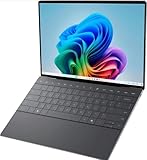
- 13.4 inch FHD+ (1920 x 1200) Anti-Glare 30-120Hz 500-nits InfinityEdge Eye Safe Non-Touch Display
- Snapdragon X Elite, X1E-80-100 (12 cores up to 3.4 GHz Dual-Core Boost up to 4.0 GHz, NPU Upto 45 TOPS)
- 16GB RAM | 512GB SSD
- Qualcomm Adreno GPU | Two USB4 40 Gbps USB Type-C ports with DisplayPort and Power Delivery
- Windows 11 PRO | Fingerprint Reader
AMD Ryzen AI
The Halo design’s ceiling of 16 Zen 5 cores gives it a clear paper advantage for heavily threaded compiling, rendering and data work when a laptop can feed and cool those cores. A smaller Ryzen AI model may have fewer cores and a lower power budget. Check the exact processor suffix, sustained package power and whether the memory is soldered before assuming Halo-level specifications apply.
Snapdragon X Elite
Snapdragon X Elite has 12 Oryon cores and up to a 4.2 GHz boost. Native Arm workloads can be highly responsive while using less power, but an emulated x86 application may run slower or consume more energy. Benchmark the programs you actually use instead of extrapolating from a native browser or office test.
Integrated graphics for games, video and local AI
AMD’s listed 40 RDNA 3.5 compute units make Ryzen AI Halo the most graphics-heavy design on paper. That can help with GPU-accelerated editing, 3D viewport work and local models that use the integrated GPU, provided the laptop supplies adequate memory bandwidth and cooling. The 192 GB unified-memory ceiling is a developer-platform maximum, not a promise that a retail notebook will include that amount.
Panther Lake’s integrated graphics performance varies by Core Ultra Series 3 SKU and system power limit. Intel’s launch material claims a platform-level CPU/GPU improvement, but it does not establish a single gaming frame-rate lead over every Ryzen AI or Snapdragon configuration. Intel’s media and graphics features may be decisive for a particular editing application even when average game performance is similar.
Snapdragon X Elite uses an Adreno GPU. Windows-on-Arm graphics drivers have to support the game engine, API and anti-cheat system involved. Older games, kernel-level anti-cheat and specialist plug-ins can fail even when ordinary 3D applications run. Confirm support for each title and peripheral rather than treating the Adreno name as equivalent to an x86 laptop GPU.
What to measure in a review
- Frame rate at the same resolution, quality preset and driver version, with a 20-minute loop to expose throttling.
- Video export time using the same source files, codec, effects and hardware-acceleration setting.
- GPU memory behavior when the system uses shared memory; unified memory capacity is not the same as dedicated VRAM.
- Fan noise and surface temperature while the workload is running, not only the first benchmark pass.
NPU and local-AI performance
All three families include an NPU intended for persistent, lower-power AI tasks such as camera effects, noise removal, transcription and selected local inference. The NPU is not a replacement for a discrete GPU in every model. Framework support determines whether an application can use it, and some workloads still execute faster on the CPU or integrated GPU.
Rank #3

- [Upgraded] Seal is opened for Hardware/Software upgrade only to enhance performance. 14.5 OLED 2944x1840 60Hz Touchscreen Display; 802.11be, Bluetooth 5.4, Integrated Webcam, Backlit Standard Keyboard
- [Powerful Performance with Snapdragon X Elite X1E-78-100 ] Snapdragon X Elite X1E-78-100 3.40GHz Processor (, 36MB Cache, 12-Cores, 12-Threads, ); Shared Integrated Graphics
- [High Speed and Multitasking] 16GB OnBoard RAM; 65W Power Supply Type-C Power-In, 4-Cell 70 WHr Battery; Cosmic Blue Color
- [Enormous Storage] 512GB 2242 PCIe NVMe SSD; No Optical Drive, Windows 11 Pro-64, 1 Year Manufacturer warranty from GreatPriceTech (Professionally upgraded by GreatPriceTech)
- Includes Authorized Dockztorm Portable USB Hub(Special Edition Portable Dockztorm Data Hub;Super Speedy Data Sync Rate up to 5Gbps)
AMD lists up to 55 NPU TOPS for Ryzen AI Halo material. Qualcomm lists 45 TOPS for the Snapdragon X Elite Hexagon NPU and positions Snapdragon X systems for Copilot+ PCs. Intel’s up-to-180 figure includes more than its NPU, so it should be read as a platform-capacity statement. Ask a review to identify the execution device and precision used for any AI benchmark.
Copilot+ qualification is a system property
Qualcomm describes Microsoft’s Copilot+ baseline as at least a 40 TOPS NPU, 16 GB of memory and 256 GB of storage. That description is a qualification framework, not a guarantee for every configuration in a processor family. A specific laptop must meet the current requirements and receive the necessary Windows features and drivers. Microsoft’s documentation can change, so verify the requirements at the time you buy.
Battery life, efficiency and fan noise
Qualcomm’s strongest argument is efficiency. It advertises Snapdragon X Elite laptops with multi-day battery-life positioning and a 45 TOPS NPU, while warning that battery life varies with device design. Screen brightness, battery capacity, modem use, browser tabs and emulation can change results dramatically. A thin Snapdragon model can outlast a larger Intel or AMD system, but that is a laptop comparison, not a guaranteed processor rule.
Windows Errors? Fix Them Before They Spread
Repair common Windows errors and clear accumulated junk for a smoother, more stable PC - no reinstall needed.Free scan · no reinstallCrashes, No Sound, or Screen Glitches?
Random freezes, missing sound and display glitches usually trace back to one bad driver. Find and replace yours safely.Free scan · under a minutePanther Lake’s launch material claims up to 40% lower power against Intel’s stated baseline. AMD’s Halo platform is aimed at high-performance creator and developer work, where a larger cooling system and battery may be necessary. Compare identical workload loops at a fixed brightness and record time to a defined charge level. Include sleep and standby behavior if the laptop will travel frequently.
Application, driver and peripheral compatibility
Intel and AMD use the familiar x86 ecosystem. That generally simplifies support for commercial plug-ins, virtualization tools, engineering packages, older utilities and games, although individual drivers still matter.
Snapdragon X Elite runs Windows on Arm. Arm-native applications can be efficient, while x86 and x64 programs may run through Microsoft’s emulation layer. Check the exact versions of Adobe or other creative tools, development containers, virtual machines, database clients, VPNs, printers, audio interfaces, scanners and anti-cheat games you rely on. A program that launches under emulation may still lack a plug-in, hardware driver or required system service.
Rank #4

- THE SMARTER CHOICE FOR MOBILITY – Get projects done on a device with the most capable AI platform available with the expansive 15" WUXGA 16:10 display that brings all-day battery life, and a durable metal chassis.
- ELEVATED VISUAL DISPLAY – The 15.3" 16:10 display brings elevated visuals and more screen space for work and play. Vivid colors, deep blacks, and sharp contrast make every detail shine, whether you’re streaming, gaming, or creating.
- YOUR PC, YOUR PRIVACY –The physical webcam shutter lets you stay in control of who’s watching and a fingerprint reader offers faster, safer logins. Plus, the Enhanced Security Suite adds extra protection to keep your data private and your PC secure.
- PREMIUM DURABILITY – The IdeaPad Slim 3x is built with a premium-grade metal chassis that offers supreme durability from military-grade MIL-STD 810H tests. It delivers strong, dependable performance with a premium design. Ready for whatever, wherever.
- BUILT FOR AI – Powered by a 45 TOPS NPU, this AI-driven Copilot+ PC crushes multitasking, smooths video calls, and lasts all day.
- Confirm that your application vendor publishes an Arm-native build or documents supported emulation.
- Check peripheral-driver support, especially for devices that install kernel components.
- Verify virtualization, Docker or Linux workflow requirements before choosing Windows on Arm.
- Read the laptop maker’s BIOS and driver support policy; the processor alone does not determine update quality.
Memory capacity and bandwidth
Memory can determine whether a local model or large project fits at all. AMD’s Halo specification of up to 192 GB LPDDR5x unified memory is unusually high for an integrated design and is attractive for developers who need large datasets or models without discrete graphics memory. It is a platform maximum; retail availability, soldered capacity and firmware limits must be checked per machine.
Panther Lake and Snapdragon X Elite systems ship in a range of capacities. More memory can improve multitasking and prevent swapping, but bandwidth and sustained power also affect integrated-GPU performance. Confirm whether memory is upgradeable, the channel configuration, and the amount reserved for graphics before comparing two similarly priced laptops.
Can Panther Lake beat Snapdragon X in gaming?
It can in a supported, native x86 title with favorable Intel graphics drivers, but the evidence supplied here does not establish a universal frame-rate winner. Snapdragon performance depends on the Adreno driver, Windows-on-Arm compatibility and anti-cheat support. Compare the exact games you play at the same settings and include frame-time consistency, not just an average FPS number.
For competitive games, a title that refuses to install or an anti-cheat driver that is unsupported is a practical zero. For casual or cloud gaming, battery life and display quality may matter more than a small integrated-GPU difference.
How to compare actual laptops before buying
- List your decisive workloads. Separate native AI inference, CPU rendering, GPU editing, games, office use and unplugged travel. Note applications that require x86, kernel drivers or anti-cheat.
- Match the configuration. Record the exact processor, memory capacity and speed, SSD, display resolution, battery size, charger wattage and advertised sustained power mode.
- Check software support. For Snapdragon, verify Arm-native or emulated support for every required application and peripheral. For all platforms, check the current GPU, NPU and BIOS driver versions.
- Use matched benchmarks. Prefer reviews that test the same application version, project files, Windows build, power mode and cooling conditions. Treat vendor-selected tests as directional claims.
- Measure sustained behavior. Look for a long CPU or GPU loop, temperature, fan noise and performance after throttling. A first-pass score is insufficient for a workstation workload.
- Evaluate mobility. Compare battery runtime in your own browser, video-call and development loops at a fixed brightness. Check standby drain and charging time.
- Check physical design. Ports, webcam quality, display, keyboard, repairability, warranty and OEM firmware support can outweigh a small silicon advantage.
- Confirm regional availability and price. Panther Lake launch timing, Ryzen AI model selection and Snapdragon configurations differ by country and retailer. Compare complete systems, not processor list prices.
Which platform fits which buyer?
Choose Panther Lake when compatibility and balanced performance lead
- You need broad x86 support for specialist software, plug-ins, games or peripherals.
- A tested Core Ultra Series 3 laptop delivers the CPU/GPU performance you need at its sustained power limit.
- You value Intel-specific media, graphics or connectivity features in a particular OEM design.
Choose Ryzen AI Halo or a comparable Max-class system when memory and parallel graphics work dominate
- Your projects benefit from many CPU cores, strong integrated graphics and large unified-memory capacity.
- You run local models, rendering or developer workloads that can use the GPU and memory bandwidth.
- You accept a potentially larger, hotter laptop in exchange for sustained throughput.
Choose Snapdragon X Elite when efficient mobility fits your software
- Long unplugged use, low fan noise and a light Windows laptop are more important than universal legacy compatibility.
- Your key applications are Arm-native or have been verified under emulation.
- You do not depend on unsupported games, kernel drivers, specialist peripherals or virtualization features.
What the available evidence can—and cannot—prove
Intel, AMD and Qualcomm publish useful architectural specifications and power or performance claims, but the cited material does not provide one independent retail benchmark suite spanning all three families. Intel’s reference comparison changes several system variables; AMD’s 55-TOPS figure is identified as testing by AMD Performance Labs in September 2026; Qualcomm’s 45-TOPS figure is a product specification. None of those figures alone proves which complete laptop is faster, quieter or longer-lasting.
Use the platform specifications to narrow your shortlist, then choose from matched laptop reviews that disclose application versions, memory, cooling, power mode, operating-system build and drivers. Recheck BIOS updates, Windows-on-Arm compatibility, retail availability and pricing immediately before ordering because those details can change after launch.
Quick Recap
Product prices and availability are accurate as of the date/time indicated and are subject to change. Any price and availability information displayed on Amazon at the time of purchase will apply.

