For a clearly defined, repetitive construction task, a purpose-built robot is usually the more evidence-backed option today. Humanoids could eventually help where human-scale access, ordinary tools or switching between tasks matter, but they are not yet a fixture on construction sites. Choose by the job, site conditions and demonstrated performance—not by whether a machine looks like a person.
What kind of work is each robot suited to?
Purpose-built robots: a defined operation
These systems are designed around a narrower task, which can make sense when the work is repeatable and its requirements can be specified in advance. Construction examples described by McKinsey include rebar work and ceiling drilling; reported pilots in groundworks and roadworks have used specialized equipment such as driverless pavers and autonomous rollers. These are examples of applications and pilots, not a promise that a particular system is available or will deliver the same result on your project.
As an Amazon Associate I earn from qualifying purchases.
IEEE’s Construction Robotics committee also lists the Hilti Jaibot and a Gravis Robotics robotic excavator for dry-stone construction as platform examples. Those listings identify examples, not current availability, price or independently measured job performance.
Free tools Windows power users keep installed
One-click scans. No signup required.
Humanoids: a potential multi-task approach
A humanoid is intended to work in spaces and with tools designed for people. That could be useful if a project needs a machine to move between varied small tasks—for example, carrying small panels or buckets, pulling wire, installing pipes in tight spaces, fitting sensors or cleaning up. McKinsey presents these as potential applications, while also noting that humanoids are not yet a fixture on construction sites. Treat them as prospective use cases, not established crew replacements.
#1 Best Overall
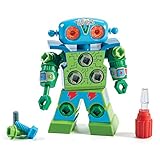
- TAKE APART TOY ROBOT: Kids can enjoy hours of independent building fun as they use the screwdriver to put together their very own snap-and-screw robot with this creative construction toy set
- SKILL-BUILDING TOOL KIT: Little builders develop early engineering & fine motor skills while practicing problem-solving & real world application as they use the screwdriver to tighten and loosen bolts
- KIDS ROBOT KIT INCLUDES: Kid-friendly screwdriver toy, robot with swiveling head, arms, and upper body; 15 bolts in different colors, and one full-color sheet of decorative stickers; ages 3+
- GIFTS FOR KIDS: Educational Insights toys and games make great birthday gifts for kids, holiday stocking stuffers, Easter basket toys, and back-to-school presents for teachers and students
- MORE TODDLER BUILDING TOYS: Visit the Educational Insights store link above for more construction kits for kids, STEM construction toys, take apart toys for boys and girls, tools for kids, and more
Human-like proportions do not by themselves make a robot adaptable, safe or economical. A system still has to perceive the work, handle materials and tools, move reliably, and operate around workers and changing site conditions.
How to compare the options for a specific project
Start with the task and compare the systems against the same job requirements. The following is a decision framework, not a universal ranking.
Rank #2

- 5 IN 1 CONSTRUCTION VEHICLE TOY: This detachable construction car toys includes 5 different styles of vehicles - crane, excavator, tractor truck, rescue truck,Dinosaur toy car,Trucks, rollers, etc. Toys for ages 5-7, Comes with assembly instructions. They're five separate kids toys vehicles that can also be assembled into one big cool robot, 5 year old boy birthday gift
- PREMIUM QUALITY TRANSFORMING ROBOTS: The kids robot toys set is made of high quality, highly durable ABS heavy duty plastic, toddler boy toys is 100% safe and built to last. Boys toys age 4-6 for feature a child-friendly and safe design, kids outdoor toys, kids can get started easily, toys for 6 year old boys for safe play and a perfect building experience
- EASY AND CONVENIENT ASSEMBLY: car for kids each step is clearly explained, kid toys the parts are transformed and combined to form a robot torso, 4 year old boy toys is easy for kids to understand and also improves their hand-brain combination ability, a variety of ways to play to meet your child's needs, boys toys 6-8 years old, let your kids love assembling and vehicle transformations,excavator toys for boys 3-5 year old
- FUN AND EDUCATIONAL: Novelty and fun vehicle robot toys let kids explore different possibilities,boy toys age 6-8, kids can develop fine motor skills and improve hand-eye coordination while playing.5 year old boy toys Combining playtime with education, and by figuring out how to match and assemble, toys for boys 4-6 they can increase frustration tolerance and perseverance, gifts for 6 year old boys
- BEST GIFT FOR BOYS AND GIRLS: These detachable construction vehicles toys for kids are excellent educational gifts for boys and girls,And parents can see the progress of their children from it. toy cars for boys age 4-7. The toy is not only a toy, but also a wonderful gift to accompany the child to grow up happily robot toys for kids 3-5 are perfect for 4 5 6 7 year old boys and girls as birthday gifts, party gifts or Christmas gifts
| Decision factor | Purpose-built robot | Humanoid robot | What to establish |
|---|---|---|---|
| Task scope | Usually designed for a narrower operation. | Aims to cover multiple tasks. | Is the work stable and repeated often enough to justify a specialized system? If tasks vary, how often must the robot switch? |
| Site fit | May require particular layouts, materials or setup. | Designed around human-scale spaces and tools, but still needs to navigate and manipulate safely. | Will the site need mapping, access controls, material staging or other changes? |
| Maturity | Specific applications and pilots are reported; adoption differs by task. | Construction use remains prospective and constrained. | Is there evidence from a comparable task and jobsite—not just a demonstration in a different environment? |
| Adaptability | Can suit its intended task; performance outside it should not be assumed. | Could offer flexibility across tasks, but that capability must be demonstrated in practice. | How often do task requirements, access routes and site layout change? |
| Safety and oversight | Assess the robot’s movement, working end or tools, and proximity to people. | Also assess locomotion, balance, manipulation and interactions with workers. | What safeguards, procedures, training and human oversight are needed for the actual work? |
| Economics | Account for equipment, setup, utilization, service and effects on labor. | Account for cost, uptime, charging, supervision and local labor alternatives. | What is the project-specific cost and output compared with the existing way of doing the task? |
The available sources do not establish a universal cost-per-task, productivity or safety ranking between the two categories. A comparison is meaningful only when it uses the same task, site conditions, safety requirements and accounting period.
Quick wins for a faster PC:
Clear out junk files and repair common Windows errorsFree Scan →Scan for outdated or missing drivers - takes under a minuteDriver Scan →Why construction sites are a hard test
A site is not a fixed production line. Its layout, project phase, equipment and active trades change over time. NIOSH notes that construction robotics need advanced sensing and computational capability to work amid changing conditions and interact with workers. As the agency puts it: “These active and ever-changing jobsites create unique challenges for automation, compared to more controlled and predictable environments such as manufacturing.”
Rank #3
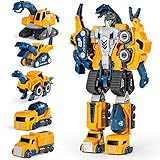
- This 5-piece transforming robot toy set supports three playable forms for endless imaginative play. Each module turns into excavator, mixer, dump truck, crane and bulldozer. Every vehicle deforms into matching dinosaur, and all units connect via built-in magnets to build a giant super robot without extra tools. The magnetic lock stays stable during rough play and allows easy disassembly for repeated DIY deformation. It offers three playable modes: separate trucks, matching dinosaurs and one giant combined robot.
- Made of thickened heavy-duty ABS plastic, the toy meets U.S. ASTM F963 standards with non-toxic, BPA-free and lead-free raw materials. All edges are polished into smooth round curves to protect toddlers’ hands. All built-in magnets undergo pull force testing and securely embedded within plastic shells to reduce the risk of detachment.
- Designed as a STEM educational toy for kids aged 3 to 6, deformation and assembly naturally train fine motor skills, hand-eye coordination, spatial cognition and problem-solving abilities. It keeps children away from screens for independent play and supports parent-child interaction to boost creativity. All play modes work manually without batteries, saving extra usage costs and avoiding electronic safety risks.
- Ideal all-occasion gift for toddlers, suitable for kid’s birthday, Christmas, Thanksgiving and holiday rewards. The yellow-blue engineering color scheme fits indoor play and mild outdoor activities. A detailed instruction manual helps kids aged 4-7 complete deformation independently, and continuous assistance from adults is not required during play.
- Upgraded magnetic connecting structure delivers stronger adsorption force to lower accidental separation and extend service life. Complete set includes 5 construction vehicle modules and one instruction manual. This magnetic transform toy suits indoor, backyard and portable travel play for kids.
A 2026 review in Results in Engineering, covering construction-robotics publications indexed in Scopus from 2015–2025, discusses challenges including dust, glare, inclement weather, uneven terrain, changing paths, task switching and coordination among trades. These are factors to test against a proposed system, not proof that every robot will fail in those conditions.
The UK Government describes humanoids as technically complex, with the most advanced systems being trialed in structured settings such as factories or warehouses. It places construction among the higher-challenge, longer-time-horizon uses and notes uncertainty about cost-effectiveness. That assessment is a reason to ask for jobsite-specific evidence rather than infer readiness from a factory or warehouse trial.
Rank #4

- Magnetic Engineering Toy Set: Each small part has a magnetic force. It can be assembled into bulldozers, dump trucks, airplanes, ships through magnetic points. Each truck can be moved, just push them and they slide across the floor.Toy trucks with sand play and other activities allow kids to become engineers
- Magnetic Transforming Robot: 5 construction cars can be assembled freely and can be combined into a giant robot, suitable for boys aged 3-12. Upgraded magnetic plum card slot design compact, not easy loose.No batteries required
- Easy To Carry: Our toy construction vehicles with storage box is equipped with a storage box, which allows children and parents to carry and store the magnetically engineering vehicle at home or out
- ABS Material: Magnetic truck toy is made of thick and sturdy plastic material with smooth edges and corners of the parts that won't hurt your child's hands, ensuring a safe and comfortable playing experience
- Educational and Interactive: Magnetic Assembly set allow children to explore the possibilities of different forms, improve imagination and manual coordination. The freely changing parts can assemble different toys for your kids Engage in truck play for hours and get, Your kids will be crazy about it when gifted on birthday, Thanksgiving, Christmas/X-mas
What safety and supervision should the evaluation cover?
NIOSH discusses established robot-safety concepts including monitored stops, force limits, speed and separation monitoring, and hand guiding. Guidance developed for controlled environments is harder to apply on a changing construction site. A robot’s moving parts or tools can strike or push a worker, so the assessment has to consider its actual motion, work area and interaction with people—not just its specifications.
Do these 3 things before closing this tab:
1Scan for outdated or missing drivers - takes under a minute2Clear out junk files and repair common Windows errors3Fix the driver behind crashes, sound loss and screen glitches- Map the task area, access routes and places where workers or other equipment may enter the robot’s operating space.
- Identify the robot’s movements and tool-related hazards throughout the task, including setup, pauses and recovery from an interruption.
- Specify safeguards, operating procedures, training and who is responsible for monitoring or intervening.
- Test foreseeable site changes and worker interactions in a controlled evaluation before expanding the operating area or task scope.
These checks apply to both categories. A humanoid adds questions about balance and movement through the site; a purpose-built system still needs a task- and site-specific safety assessment.
Best Value

- TAKE APART ROBOT TOYS: Kids can enjoy hours of independent building fun as they use the toy tool set to put together custom robots with this robotics lab-themed creative construction playset
- SKILL-BUILDING TOOL KIT: Little builders develop early engineering & fine motor skills while practicing problem-solving & real world application as they use the toy tools to tighten and loosen bolts
- KIDS ROBOT KIT INCLUDES: Kid-friendly drill, Phillips bit, screwdriver, gear socket bit, 32 bolts, 26 interchangeable pieces, seven gears, and sticker sheet; requires two AA batteries (not included)
- GIFTS FOR KIDS: Educational Insights toys and games make great birthday gifts for kids, holiday stocking stuffers, Easter basket toys, and back-to-school presents for teachers and students
- MORE TODDLER BUILDING TOYS: Visit the Educational Insights store link above for more construction kits for kids, STEM construction toys, take apart toys for boys and girls, tools for kids, and more
How to run a practical evaluation
- Define one task. Record the required output, acceptable tolerances, materials, work area and normal interruptions. Avoid evaluating a general promise such as “help on site.”
- Set a baseline. Measure how the task is currently completed, including time, labor, rework, setup and delays. Use the same scope when assessing a robot.
- Check site compatibility. Document layout changes, access constraints, uneven ground, dust, lighting, weather exposure, nearby trades and any required setup or exclusion area.
- Request comparable evidence. Ask whether the system has performed the same task under similar conditions, what human supervision it needed, and how it handled interruptions or changes. A demonstration alone does not establish routine performance.
- Trial in stages. McKinsey describes a possible progression from teleoperation to experiments in dedicated environments and then autonomous site use. For a contractor, each stage should test task performance, safety, uptime and human interventions before expanding.
- Calculate project-specific cost. Include equipment and setup, utilization, service, downtime, charging where relevant, supervision, integration and effects on labor. Compare these with the existing method over the same project scope.
- Set a scale-up threshold. Before the trial, agree what performance and safety evidence would justify continued use, what would trigger a redesign, and when to stop.
What do the available price estimates tell you?
McKinsey’s article discussion contrasts $150,000–$500,000 “today” with a potential future scaling target of $20,000–$50,000 per humanoid. These are estimates reported in that discussion, not verified current vendor quotes, universal prices or a project’s total deployment cost. They do not establish that a humanoid is cheaper than a purpose-built construction system for a particular task.
For a buying decision, request current supplier pricing for the required region, configuration and service terms, then include integration, utilization, supervision and downtime in the project comparison. The cited sources provide no apples-to-apples cost benchmark across humanoid and purpose-built construction robots.
Which one should you choose?
For work that is repeatable, clearly specified and matched by a specialized system, begin by evaluating purpose-built equipment. Consider a humanoid as a pilot or future candidate when human-scale access, ordinary tools or switching among small tasks could add value—and require evidence from a comparable site before treating that potential as operational capability. In either case, the deciding evidence is whether the system can complete the defined job safely, reliably and economically in the conditions where it will actually be used.
Quick Recap
Product prices and availability are accurate as of the date/time indicated and are subject to change. Any price and availability information displayed on Amazon at the time of purchase will apply.




