The Tool Desk
Outbyte Driver Updater FREEScan for outdated or missing drivers - takes under a minuteDriver Scan →Outbyte PC Repair FREERepair Windows errors before they cause bigger problemsFix Now →For stable, repetitive, high-volume factory work, a conventional industrial robot arm is usually the better choice today. It is designed around a defined operation, delivers predictable motion, and fits established safety and controls. A humanoid robot becomes worth a serious pilot when the work moves through a human-designed space, changes between several tasks, or could remove difficult ergonomic work without rebuilding the line.
There is no credible universal winner yet. No published source in the available evidence compares an arm and a humanoid on the same task with equivalent throughput, uptime, safety exposure, integration effort, and lifecycle cost. The practical decision is therefore a site-specific comparison of acceptable output, recovery time, risk, and total cost—not a contest based on appearance or a vendor demonstration.
As an Amazon Associate I earn from qualifying purchases.
What the two systems are built to do
Industrial robot arms
An industrial arm is a fixed or deliberately positioned machine with a defined reach, payload, tool, and motion program. The workcell is engineered around it: fixtures hold parts in repeatable locations, guarding or separation controls access, and a programmable controller coordinates the arm with conveyors, presses, welders, vision systems, and other equipment.
Free tools Windows power users keep installed
One-click scans. No signup required.
That specialization is an advantage when geometry and sequence remain stable. BMW describes traditional industrial robots as precise systems for welding, bonding, and lifting that are fixed in place and assigned a task. A purpose-built arm can therefore spend every cycle doing the same operation at the designed speed, with little locomotion or general-purpose perception to manage.
#1 Best Overall
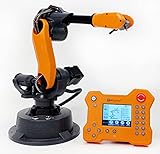
- WLKATA Mirobot Professional Kit. This Professional Kit includes everything in the Education Kit , plus a wireless Bluetooth controller.Part list:Robot arm,Power supply & High-speed USB cable & IDC cable, Pen holding, Micro servo gripper module,Pneumatic set, Multifunctional box,Mirobot Mecha sticker,Handbook,Wireless Bluetooth controller.
- Multiple control methods: computer terminal WLKATA Studio software control, APP mobile phone control, APP mobile phone control, three-dimensional virtual control (V-Rep Ros Matlab),Contains a matching robot controller for better and more comprehensive control
- WLkata Mirobot equipped with laser engraving, writing and drawing, handling and palletizing, mobile app control, etc. Multiple functions, reserved multiple expansion interfaces to support secondary development. Users can develop more application scenarios through software programming and hardware expansion to meet the needs of students of different ages.
- Desktop-level lightweight industrial robotic arm prototype, safe operation, comprehensive functions, freely set actions, add accessories arbitrarily, one arm has unlimited creativity!
- WLKATA is suitable for teaching and training scenarios, color sensor training, multi-fixture coordination training, joint training of six-axis robotic arms and code wheel robotic arms, scene training, painting and calligraphy art training, artificial intelligence voice training, etc.If you have any questions about installation or use, please check the manual or contact us, we will serve you wholeheartedly.
Humanoid robots
A humanoid combines a two-legged or human-proportioned body, arms and hands, onboard sensing, batteries, and software intended to handle a wider range of actions. Its attraction is compatibility with spaces already laid out for people: stairs, aisles, racks, bins, workbenches, and tools that do not fit a newly designed robot cell.
That flexibility introduces more variables. A humanoid must balance while standing or walking, recognize changing scenes, grasp objects with different orientations, avoid people and equipment, manage battery energy, and recover when an action fails. It may be able to move between stations, but those capabilities do not automatically produce the cycle time, precision, or uptime of a fixed arm.
The current decision in one sentence
Choose an industrial arm first for a fixed station with repeatable parts, a high production volume, and a known tool. Evaluate a humanoid when travel through an existing human workspace, frequent task changes, or ergonomic relief has enough value to offset its integration, safety, energy, and service burden.
Crashes, No Sound, or Screen Glitches?
Random freezes, missing sound and display glitches usually trace back to one bad driver. Find and replace yours safely.Free scan · under a minuteWindows Errors? Fix Them Before They Spread
Repair common Windows errors and clear accumulated junk for a smoother, more stable PC - no reinstall needed.Free scan · no reinstall| Factory condition | More likely to fit | Reason |
|---|---|---|
| Welding, bonding, or lifting at a fixed station | Industrial arm | Defined motion, fixed position, and repeatable geometry favor specialized automation. |
| Several recurring tasks spread across a human-designed area | Humanoid pilot | Mobility and adaptable tooling may avoid rebuilding every station. |
| Very high volume with a tight, validated cycle time | Industrial arm | Throughput and recovery behavior are easier to engineer around a dedicated workcell. |
| Material handling that requires walking between locations | Humanoid candidate | A mobile body can be tested against the cost of conveyors, carts, or multiple fixed cells. |
| Unproven process, uncertain safety case, or no integration owner | Neither without a pilot plan | The technology choice cannot compensate for missing risk assessment, controls, or maintenance capability. |
Where the evidence stands in 2026
BMW’s production pilots show feasibility, not superiority
BMW reports that a Figure 02 humanoid pilot at its Spartanburg plant supported production of more than 30,000 BMW X3 vehicles, moved more than 90,000 components, and accumulated about 1,250 operating hours over ten months. These are company-reported figures from a selected body shop that was already highly automated, not a controlled comparison with an industrial arm on the same operation. Read the release for the stated scope and context: BMW Group’s pilot account.
BMW says production IT, occupational safety, process management, and shop-floor logistics were involved early. The project used additional barriers and partitions as part of its safety concept, and improved 5G coverage was one lesson from deployment. Those details matter: a humanoid installation is a production-system project, not simply a robot delivered to a station.
Rank #2
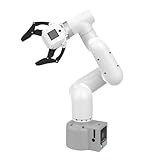
- Enhance your project capabilities with myCobot: The M5 version of the robot arm uses Esp32 as the core processor, two screens and multiple physical buttons, and can be used on the ground the size of a desk. Deeply integrated with the M5 expensive ecosystem, users can follow the tutorials provided by Yahboom to control the robot through UIFlow, Python, and Arduino.
- ROS support: Developed in ROS, the world's mainstream robot communication framework, myPalletizer can be controlled in a virtual environment and algorithm verification can be performed, which reduces the requirements for the experimental environment and improves experimental efficiency.
- Excellent configuration: 24V industrial electrical interface to meet your industrial scene development needs, button interaction, screen display, and PLC interface, allowing you to quickly and safely build robotic arm application exploration scenarios. With a 350mm working radius, 1000g payload and 1mm repeatability, the myCobot 320 robotic arm is the ideal solution for your scene exploration needs.
- DIY your personal mechanical assistant: open ROS simulation development environment, built-in kinematics forward and inverse solution algorithms, equipped with up to 12 standard 24V industrial I/O interfaces, expandable to develop PLC control independent programming, supports mainstream control interfaces, rich Terminal expansion accessories help explore the boundaries of personal applications.
- Open source interface, secondary development:Based on different types of applications, the interface is open sourced and can realize object recognition, face recognition, image recognition, etc. Easily learn to program myCobot in your style and get ready to start your robotics journey.
At Leipzig, BMW describes an AEON evaluation aimed at adaptable tooling and battery or component production. The company presents this as gradual testing of Physical AI—AI-enabled robots capable of learning—under real industrial conditions. Its description of conventional arms as fixed and task-defined, contrasted with AEON’s evaluation of mobility and adaptability, is useful for framing the choice: BMW’s Leipzig announcement.
Humanoid production remains a limited forecast
Gartner’s January 2026 forecast says fewer than 20 companies will reach production for manufacturing and supply-chain humanoid use cases by 2028. Gartner expects deployments to be mostly tightly controlled and identifies cost, energy, dexterity, and integration as current challenges. This is a forecast, not a measured count of future deployments. Gartner analyst Abdil Tunca describes the promise as compelling but the technology as still immature and far from meeting expectations for versatility and cost-effectiveness. See the forecast and its qualifications at Gartner.
Benchmarks are more useful than demonstrations
Fraunhofer IPA’s capability model separates mobility, manipulation, cognition, and safety/security into five maturity levels. Its benchmark is intended to compare humanoids with proven automation components and includes functional safety, cybersecurity, and energy tests. The model is a framework for asking better questions, not a universal substitute for a site acceptance test. The capability navigator is available at Fraunhofer IPA’s capability navigator.
Compare the same task, not the marketing category
Define one production operation and hold its conditions constant. Record the arm’s results and the humanoid’s results using the same part quality standard, shift length, staffing assumption, and recovery rules.
Throughput and repeatability
- Count acceptable parts or completed operations per hour, not raw motions.
- Measure variation in placement, insertion, fastening, or other critical dimensions.
- Include time spent detecting a fault, calling an operator, clearing the station, and restarting.
- Measure the effect on the line’s actual cycle time and buffer levels.
A humanoid that performs several operations may still lose on cost per good unit if it pauses frequently or requires manual recovery. Conversely, an arm that is faster at one task may require a separate machine, fixture, or conveyor for every variation.
Rank #3
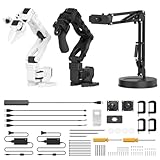
- 【End-to-End Imitation Learning】Hiwonder SO-ARM101 robot arm is an embodied intelligent hardware platform compatible with the Lerobot open-source framework. It provides developers with streamlined access to shared code, templates, and pre-trained models to explore the latest advancements in AI research.
- 【Dual-Camera Vision System】Equipped with both a gripper-mounted camera and an external camera, the system supports both precise manipulation and environmental awareness for accurate imitation learning.
- 【Hiwonder High-Performance Bus Servos】Featuring 12 high-torque bus servo motors with magnetic feedback, the Hiwonder SO-Arm101 robotic arm delivers smooth, stable motion, eliminating issues like power deficiency and jitter.
- 【Professional Control & Debugging】Integrated with the Hiwonder BusLinker V3.0 debugging board, the system supports servo scanning, real-time status monitoring, and trajectory control. The professional PC software simplifies device calibration and debugging, making it accessible for both researchers and hobbyists.
- 【Open-Source Compatibility】The SO-ARM101 robotic arm is designed to be fully compatible with the LeRobot open-source project. We acknowledge the contributions of the open-source community; all trademarks and copyrights belong to their respective owners.
Uptime and service
- Log productive runtime per shift, planned stops, unplanned stops, and mean time to recover.
- For a mobile system, include charging, battery swaps, route blockage, and safe return to a known position.
- Identify who can diagnose faults, what spare parts are stocked, and how software updates are validated.
- Calculate the production effect of a single failure at the station and of a fleet-wide software issue.
Task and workspace fit
- Check payload at the required reach, not only the headline maximum.
- Verify tool compatibility, wrist torque, gripper force, precision, and access to fixtures.
- Map the station geometry, floor condition, aisle width, stairs, doors, and shared routes.
- Ask whether multiple tasks are genuinely recurring and similar enough to share one platform. A theoretical ability to perform many tasks has little value if each task needs a different tool, program, or safety case.
Safety
Use an application risk assessment for either platform. Evaluate guarding or separation, emergency stopping, safe speed and force limits, stability, human detection, unexpected restart, dropped loads, and the consequences of a collision. A humanoid shape does not make a system intrinsically safe, and an arm is not safe merely because it is familiar.
Quick wins for a faster PC:
Clear out junk files and repair common Windows errorsFree Scan →Fix the driver behind crashes, sound loss and screen glitchesFind Drivers →Repair Windows errors before they cause bigger problemsFix Now →Integration and support
Siemens notes that a humanoid must exchange data with production systems and other vehicles and coordinate with machinery and workers. In practice, that means interfaces to PLCs, manufacturing-execution systems, warehouse or material-flow systems, safety controllers, time synchronization, network security, and changeover procedures. Siemens’ integration perspective is described at Siemens.
BMW’s pilot experience reinforces the organizational side: production IT, safety, process management, and logistics were engaged early. Assign an owner for controls, cybersecurity, maintenance, and operator training before selecting a platform.
Economics
Compare installed cost rather than a robot’s purchase price. Include end effectors, fixtures, guarding, sensors, software licenses, network changes, commissioning, training, maintenance, energy, floor-space changes, spare parts, downtime, and the labor or equipment the system actually displaces.
Gartner’s cost warning concerns humanoids versus task-specific polyfunctional robots in supply-chain settings; it is not a measured price ratio for every conventional arm. No universally valid cost-per-task result is established. Use your own cost per acceptable unit over a stated horizon, with the same production volume and uptime assumptions for both options.
Rank #4
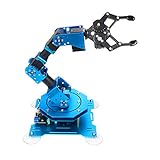
- Spark Your Creativity with Robotic Arm: Hiwonder-xArm1S is a high-quality desktop robot arm capable of remote-control grasping, object transportation, custom actions, graphical programming, and more. It serves as the ideal platform for building and showcasing creative projects and for learning about bionic robotics.
- Intelligent Servo: Hiwonder-xArm1S is equipped with 6 high-precision intelligent serial bus servos that provide position, voltage and temperature feedback. These powerful servos deliver strong torque, enabling the robot arm to grasp objects weighing up to 500g with ease.
- Premium Structure Design: The robot arm is constructed from an exquisite aluminum alloy bracket. The base is fortified with high-torque servos and industrial-grade bearings, guaranteeing exceptional stability.
- Various Control Methods: It supports PC, phone app, mouse, wireless PS2 Wireless Controller, and you can also control the robotic at your fingertips. With these control methods, xArm robotic Arm would bring more methods of play and study, perfect for realizing your innovative programming ideas and coding study.
- Versatile Action Editing: Hiwonder-xArm1S provides various action editing methods through a easy-to-use interface, including PC, app, and offline manual editing. This versatility allows you to easily create a wide range of robot applications.
A practical evaluation procedure
- Specify the operation. Write the part numbers, takt or required output, payload, reach, tolerance, tools, environmental conditions, shift pattern, and acceptable defect rate.
- Document the current cell. Record arm cycle time, changeover time, fault modes, maintenance hours, energy use, staffing, and the cost of a stopped line.
- Choose a bounded humanoid task. Select a process where mobility, access to existing fixtures, or ergonomic relief is a measurable advantage. Do not begin with an undefined “general helper” role.
- Define the safety case before testing. Set separation distances, barriers, speed and force limits, emergency actions, safe charging or battery handling, and rules for human intervention.
- Instrument both systems. Capture timestamps for successful cycles, retries, faults, recovery, charging, operator assistance, and quality checks. Keep the test window long enough to expose thermal, battery, and maintenance effects.
- Test integration paths. Connect the candidate to the same production signals and material-flow rules it would use in service. Exercise network loss, sensor failure, blocked routes, part variation, and a controlled restart.
- Calculate cost per good unit. Use installed and recurring costs, actual productive hours, acceptable output, energy, maintenance, and downtime. Show sensitivity to lower uptime or a longer recovery time.
- Set a go/no-go gate. Require agreed thresholds for quality, throughput, safety validation, recovery, cybersecurity, operator workload, and total cost before expanding beyond the pilot.
Safety evidence from a named humanoid benchmark
Fraunhofer IPA’s first comprehensive example used a Unitree G1 EDU-4 with Dex3-1 three-finger hands, delivered in May 2025, running firmware 1.04. In that tested configuration, the institute reported collision forces above 500 N and measured battery durations of 2 hours 49 minutes while standing and 1 hour 49 minutes in a typical standing-and-walking scenario. Those figures belong only to that model, hand configuration, firmware, and test method; they cannot be generalized to every humanoid.
The benchmark also found a Bluetooth security vulnerability that was subsequently resolved. That episode illustrates why cybersecurity belongs in acceptance testing alongside collision behavior and battery life. Review the benchmark’s methods and scope at Fraunhofer IPA.
Independent reader supportYour contribution helps us test, update, and keep practical guides available for everyone.How to read vendor specifications
Agility Robotics announced Digit 5 in September 2026 with vendor-stated specifications of a 50 lb (22.7 kg) repeated lift, 90-minute runtime, and nine-minute charge, implying a claimed 10:1 run-to-charge ratio. The company also reported more than $300 million in multi-year customer orders as of May 2026, subject to contractual milestones. These are company claims, not independent benchmark results, and they are not a like-for-like comparison with an industrial arm. The announcement is at Agility Robotics.
| Published figure | What it describes | How to use it |
|---|---|---|
| 50 lb (22.7 kg) repeated lift | Agility’s Digit 5 specification | Check the tested posture, reach, speed, repetition rate, and payload definition before comparing it with an arm. |
| 90-minute runtime and nine-minute charge | Agility’s Digit 5 specification | Model charging logistics and productive availability; do not treat it as independently verified uptime. |
| More than $300 million in multi-year orders as of May 2026 | Agility’s reported orders, subject to milestones | It indicates commercial interest, not realized factory performance or delivered production volume. |
Can humanoid robots replace industrial arms?
They can replace a particular arm only when the humanoid meets that application’s quality, cycle, safety, uptime, integration, and cost thresholds. A successful demonstration of walking, grasping, or moving a component does not establish replacement capability.
Recommended Free Tools
For a fixed weld, bond, dispense, or pick-and-place operation, replacing a mature arm with a humanoid usually adds capabilities the process does not need while introducing battery, balance, perception, and service variables. For a material route that changes frequently or crosses a human-oriented workspace, a humanoid may eliminate fixed infrastructure or reduce ergonomic exposure. The correct comparison is the complete alternative: humanoid plus charging, supervision, safety systems, and integration versus arm plus fixtures, conveyors, guarding, and any additional cells.
Best Value

- Synria Alicia-M is a lightweight 6-axis robotic arm designed for embodied AI research, robotics laboratories, teleoperation, imitation learning, and light industrial automation. It supports advanced manipulation workflows for VLA, ACT, and Diffusion Policy applications.
- With a 750mm working space and 1.5kg continuous effective payload, Alicia-M provides a larger operating range for object handling, testing, teaching, and automation tasks while maintaining a compact desktop-friendly structure.
- Built with precision motion control, Alicia-M offers ±0.1mm repeatability to support reliable task execution, experimental consistency, and long-term robotic operation in research, education, and engineering environments.
- Supports ROS2 teleoperation, gravity compensation, velocity mode, and MIT force control mode, enabling smoother manual guidance, responsive control, and safer interaction during data collection, task demonstration, and robotic learning.
- The full machine weighs approximately 5.1kg and uses DC24V power with CAN communication, making it easier to deploy in labs, classrooms, R&D workstations, and light industrial scenarios. Compatible with open-source robotics workflows and simulation-first control development.
Common failure modes and how to correct them
Choosing by appearance
A human-like body can look naturally suited to a human workspace, but visual similarity says nothing about payload at reach, hand durability, collision force, or recovery time. Demand measured application data.
Using a demonstration as a production rate
A short video rarely shows retries, battery changes, blocked routes, software faults, quality inspection, or operator intervention. Require timestamped logs over a representative shift and include failed cycles.
Ignoring the rest of the cell
The robot may be the smallest part of the project. Fixtures, safety scanners, network segmentation, charging space, material presentation, and MES or PLC interfaces can determine the schedule and cost.
Assuming one humanoid serves every task
Different tools, payloads, tolerances, environmental hazards, and safety zones can require different configurations. Count the real recurring tasks and the engineering effort to switch among them.
Underestimating recovery
When a part is misaligned or a person intervenes, measure how the system returns to a known safe state. A platform that needs a specialist for every recovery may not deliver the expected labor benefit.
Skipping cybersecurity
Connected mobile robots exchange data with production systems and may receive remote software updates. Include authentication, network segmentation, update validation, logging, and a response plan in the acceptance test.
Bottom line for factory planners
Industrial arms remain the default for stable, repetitive, high-volume operations because specialization, fixed geometry, and established workcell engineering are valuable. Humanoids are a rational pilot—not a blanket replacement—when mobility through existing spaces, task variety, or ergonomic relief solves a problem that fixed automation handles poorly. Make the decision with measured good-unit output, recovery and uptime data, a validated safety case, integration effort, and lifecycle cost over the same production horizon.
What’s actually slowing this PC down?
Pick the symptom - the matching free tool is one click away.
Quick Recap
Product prices and availability are accurate as of the date/time indicated and are subject to change. Any price and availability information displayed on Amazon at the time of purchase will apply.

